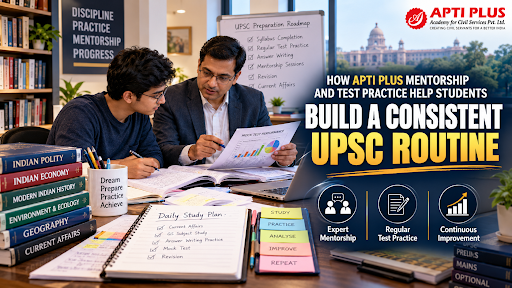
Many UPSC aspirants begin their preparation journey with great enthusiasm and determination. During the initial months, they follow a disciplined routine, wake up early, read newspapers regularly, and prepare detailed notes. However, this momentum often fades over time. As the syllabus appears vast and complex, subjects become overwhelming, answer writing seems daunting, and many aspirants gradually lose consistency in their preparation.
The UPSC Civil Services Exam does not reward the most talented student. It rewards the student who keeps going for a long time, and the Prelims, Mains and Interview together can take 12 to 18 months or more. This is why consistency matters more than speed.
Why Most Aspirants Lose Consistency
Most common reasons students slow down:
-
No clear plan. They read many books but do not know what to finish first.
-
No feedback. They write answers but never learn what is wrong with them.
-
Too much information. The syllabus is huge, and they get lost in extra material.
-
Loneliness. Studying alone for many months can feel heavy, especially in small towns.
-
Fear of tests. They delay mock tests until they feel "fully ready," which never happens.
Mentorship and test practice are two simple tools that solve most of these problems.
How Personal Mentorship Keeps You on Track
A mentor is not a teacher who only explains topics. A mentor is a guide who looks at your situation, your weak areas and your time, and then helps you decide what to do next.
The Mentorship Program at APTI PLUS is built around this idea. A good mentorship program usually helps you in these ways:
1. A study plan made for you. A student who works full time needs a different plan from a full-time aspirant. A mentor helps you divide the syllabus into weekly and monthly targets that are realistic for you.
2. Regular check-ins. When someone asks "What did you finish this week?", you are more likely to finish it. This small push builds discipline.
3. Help with doubts. Doubts that stay unanswered turn into confusion. Quick guidance saves hours of wasted effort.
4. Support at every stage. UPSC has three stages: Prelims, Mains and Interview. A mentor helps you change your approach at each stage instead of using the same method for all three.
5. Emotional support. Your mentor knows how long the journey is. A few honest words on a low day can keep you from quitting.
Why Test Practice Is the Heart of Consistency
Reading gives you knowledge. Testing shows you how much of it you can use under exam pressure. Many toppers say the same thing: they improved fastest when they started writing tests early.
1. Tests Turn Your Study into a Routine
When a test date is fixed, you have a deadline. You revise before it, write on the day, and review after it. This cycle of revise, test and improve becomes your weekly habit.
2. Tests Show Your Real Level
You may feel you know a topic well, but a test shows the truth. If you score low in Geography or Ethics, you know exactly where to put your time next week.
3. Answer Writing Gets Better with Practice
UPSC Mains is a writing exam. You must write clear and balanced answers within a strict word limit and time. This skill cannot be learned by reading alone. You have to practice it again and again.
The UPSC Mains Test Series cum Guidance Program at APTI PLUS is built for this. It includes sectional tests, full-length General Studies tests, essay tests and simulator tests. After each test, students receive detailed evaluation and feedback so they know what to fix next time.
4. Prelims Mocks Build Speed and Confidence
In Prelims, one or two wrong guesses can decide your result. Regular mock tests teach you how to handle negative marking, manage time and choose between two close options. Practicing before the real exam also reduces fear.
Mentorship and Tests Work Best Together
Each one is useful alone, but the real benefit comes when you combine them:
Without a mentor |
With mentorship and tests together |
|
You write a test but don't know how to improve |
Your mentor reviews your results and sets a clear next step |
|
You study everything equally |
You focus more on weak areas |
|
You get demotivated after a low score |
You see a low score as useful data and keep going |
|
You study in an irregular pattern |
You follow a steady weekly rhythm |
Studying for 14 hours for three days and then quitting for a week does not work. Studying 8 to 10 focused hours every day, with regular revision and practice, works much better.
Consistency has three parts:
-
A plan that tells you what to study each week
-
Feedback that tells you what you are doing wrong
-
Motivation that keeps you going on slow days
Mentorship gives you the plan and the motivation. Test practice gives you the feedback.
A Simple Weekly Routine You Can Follow
You can use this sample routine as a starting point and change it to fit your day:
-
Monday to Thursday: Study the planned subject, make short notes, and read current affairs daily.
-
Friday: Revise the week's topics and solve practice questions.
-
Saturday: Attempt a test (a Prelims mock or Mains answers).
-
Sunday: Check your answers, note your mistakes, and meet or talk with your mentor to plan the next week.
Keep this rhythm for a few months, and you will see steady progress.
Tips to Get the Most from Mentorship and Test Series
-
Take every test, even when you feel unready. Scores matter less than learning.
-
Spend more time on analysis than on writing. A test reviewed properly teaches more than three tests rushed through.
-
Keep a mistake notebook. Write the errors you repeat, and check it before each new test.
-
Be honest with your mentor. If you missed a week, say so. The plan can only help if it is based on the truth.
-
Focus on small wins. One better answer or one extra correct question this week is real progress.
-
Avoid too many sources. Follow a few trusted resources and revise them many times.
Who Can Benefit From APTI PLUS?
-
Beginners who do not know where to start
-
Working professionals who need a flexible, time-bound plan
-
Repeat aspirants who want to fix their weak areas
-
Students from smaller towns who want expert guidance without moving cities. APTI PLUS runs online and offline modes, so you can learn from wherever you are.
Final Thoughts
UPSC is a long journey, and nobody completes it on motivation alone. What carries you through is a simple system: a clear plan, regular practice, honest feedback and a person who guides you. If you are looking for that kind of structure, explore the programs at APTI PLUS and pick the one that fits your stage of preparation.
Start small, stay regular, and let every week move you a little closer to your goal.