The Mains Is Over. The Real Test Is Now
If you wrote the UPSC Civil Services Mains in August 2026, the hardest part of your wait has begun. The papers are behind you, the result is not out, and there is nothing left to revise.
This is exactly the window in which smart aspirants start their interview work. The Personality Test carries 275 marks. Mains carries 1,750. The final list is made from 2,025 marks, and the gap between a good and a poor interview score can cross 100 marks. That single conversation decides your rank and your service.
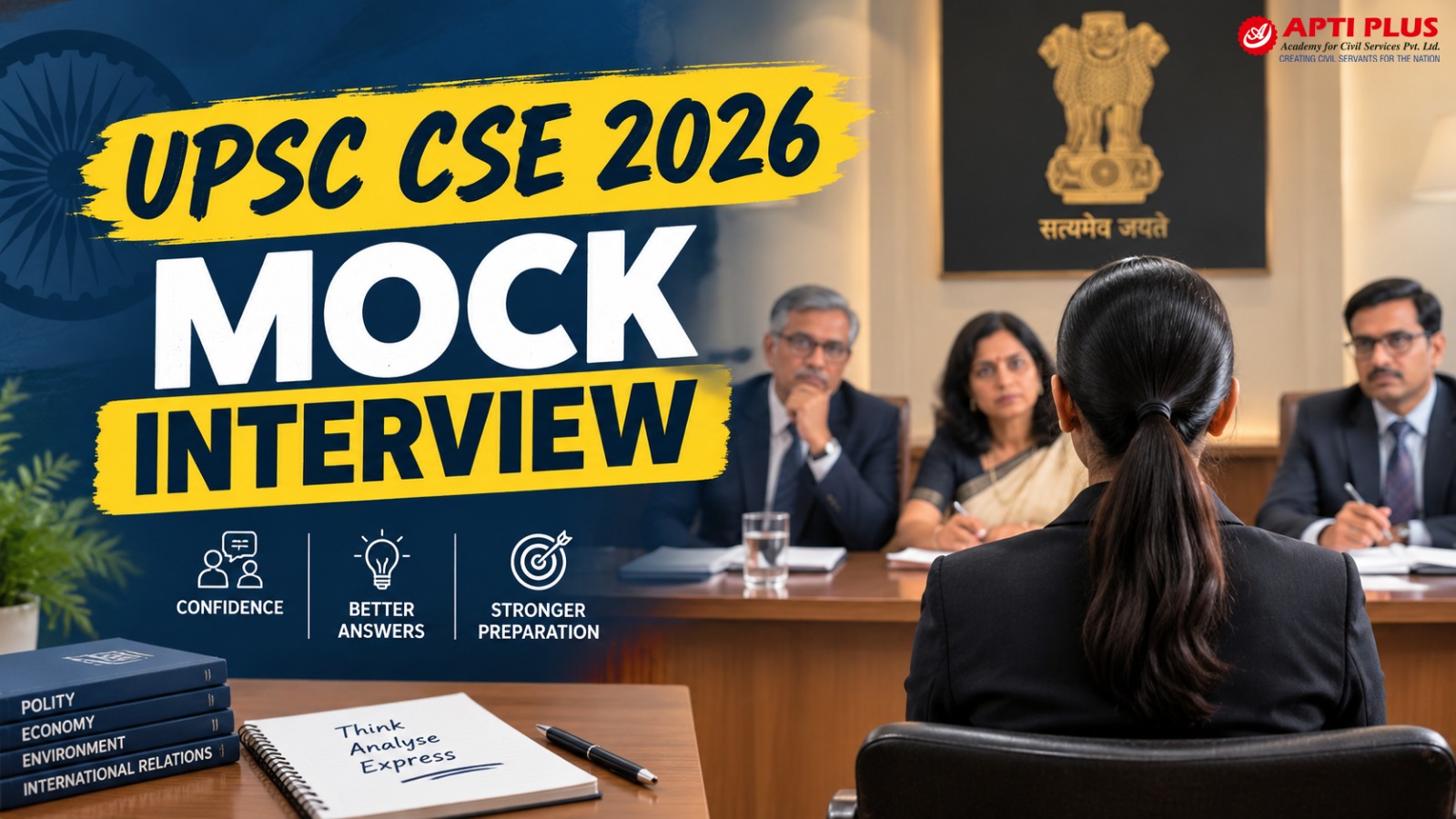
The problem is that you cannot practise this alone. You need a panel, a recording and honest feedback. That is what a UPSC CSE 2026 mock interview programme gives you.
The CSE 2026 Timeline: Why You Should Start Now
Here is where the current cycle stands, and what usually follows:
Stage |
Date or Expected Date |
|
CSE 2026 Prelims |
24 May 2026 (held) |
|
CSE 2026 Mains |
21 to 30 August 2026 (held) |
|
Mains Result |
Expected around November 2026 |
|
Personality Test |
Expected from December 2026 to early 2027 |
|
Final Result |
Expected around March or April 2027 |
For comparison, in the last cycle the interviews ran from December 2025 to February 2026, and the UPSC CSE 2025 final result came on 6 March 2026 with 958 candidates recommended.
Notice the gap. Once the Mains result is out, you may get only three or four weeks before your board date. That is too little time to fix a fast speaking pace, a nervous habit or a one-sided opinion. Students who start in October and November walk in calm; students who start in December walk in rushed.
What the Board Is Actually Testing
The Personality Test is not a knowledge test. The board, usually a chairperson with about four members, is judging whether you can be trusted with a district one day.
Before you plan anything, match this stage with the full IAS exam pattern and syllabus so you know exactly where this stage sits.
Here are the basics in one place:
Point |
Details |
|
Stage |
Final stage of UPSC CSE |
|
Marks |
275, added to your Mains marks |
|
Board |
A chairperson and about four members |
|
Duration |
Usually 25 to 35 minutes |
|
Style |
A conversation, not a question paper |
|
What it decides |
Your rank and your service (IAS, IPS, IFS and others) |
And here is what the board watches while you speak:
• Clarity of thought: Can you give a straight answer to a difficult question?
• Balance: Do you see both sides of an issue before taking a stand?
• Honesty: Do you admit when you do not know something?
• Composure: Do you stay calm when a member disagrees with you?
• Awareness: Do you know your own DAF, your state and the news of the last few months?
• Presence: Does your posture, tone and eye contact match your words?
A clear understanding of the UPSC personality test structure saves you from preparing like it is another written paper.
Start With Your DAF: It Is the Real Question Paper
The Detailed Application Form is the sheet lying in front of the board. Most of the questions are seeded from it, so go through yours line by line and prepare each entry.
• Your name: Its meaning, and any well-known person with the same name.
• Your home district and state: History, culture, crops, industries, problems and famous places.
• Your education: Basic ideas from your degree subject, and why you chose it.
• Your job, if any: What you did, what you learnt, and why you are leaving it.
• Your hobbies: Expect deep questions. If you wrote photography, be ready for questions on cameras, light and famous photographers.
• Your service and cadre choices: Why that order, and what you plan to do in that service.
Write 15 to 20 likely questions under each heading and answer them out loud, not in your head. Speaking an answer and thinking it are two very different skills.
Then Fix Your Current Affairs, but a Different Kind
For Prelims you memorised facts. For the board you need opinions that are balanced and your own.
Focus on the three to six months just before your interview date. For every big issue, prepare three things: what happened, what the two sides say, and what you think should be done. Also link each national issue to your home state, because the board usually moves in that direction.
What the APTI PLUS UPSC CSE 2026 Mock Interview Programme Includes
APTI PLUS Academy for Civil Services runs its Interview Guidance Programme every year in Kolkata, Bhubaneswar and Delhi, and online for students who cannot travel. For the 2026 cycle, the structure follows the same system that ran for CSE 2025.
1. DAF Analysis and a Personal Questionnaire
Around 70 per cent of interview questions come from your Detailed Application Form. The team studies your DAF line by line and prepares a written questionnaire for you. It covers your home state and district, your education, your work profile, your hobbies and your optional subject, along with guidance on how to answer personal questions without contradicting yourself.
2. Panel Mock Interviews
Each mock is held in a panel setup kept close to the real board. The panels include retired bureaucrats, senior faculty, defence officers and communication experts. A session runs for 25 to 35 minutes, with questions moving from your personal background to national and international issues, and with the same decorum you will find in the UPSC office.
3. Video Recording and Panel-Wise Feedback
You get the recording of your mock after the session. You also get a score from each panel member, with comments on your posture, tone, body language and facial expressions, plus suggestions on clarity and confidence. Watching your own recording is uncomfortable, and it is also the fastest way to improve.
4. One-to-One Sessions with Senior Members
These sittings are not question practice. They work on voice, speaking pace, articulation, situational judgement and confidence building. The aim is not to turn you into someone else, but to bring out the best version of you.
5. Interview Study Material
Registered candidates get curated interview material: sample DAF-based questions, expected questions subject by subject across Polity, Economy, History, Geography, Science and Technology, Environment, Security and International Relations, state-specific notes, and guidance on service preference between IAS, IPS, IFS and others.
6. Offline and Online Options
Mocks can be given in person at the Kolkata, Bhubaneswar or Delhi centres, or online from wherever you are. Students who prepared through the UPSC online coaching programme use the same panels remotely.
How It Compares With a Typical Interview Programme
|
What Matters |
APTI PLUS IGP |
Typical Programmes |
|
DAF questionnaire |
Yes, written and personalised |
Usually not provided |
|
Real bureaucrat panels |
Yes |
Partly |
|
Video recording with feedback |
Yes |
Not always detailed |
|
One-to-one mentorship |
Yes |
Limited |
|
Offline and online |
Both |
Mostly offline |
|
State-specific and hobby material |
Yes |
Rare |
The Record Behind the Programme
When you choose where to give your mocks, look at results rather than advertisements. Here is what APTI PLUS has shared from its recent years.
In UPSC CSE 2025, the academy recorded 56 or more selections. Its rank holders included Pakshal Secretry (AIR 8), Monika Srivastava (AIR 16), Shambhavi Tiwari (AIR 46), Samiksha Dwivedi (AIR 56), Tejaswini Singh (AIR 62), Akash Trivedi (AIR 73), Devansh Gupta (AIR 77) and Sattwik Satyakam Devta (AIR 100).
Before that result, 20 of its students had already reached the interview stage from the eastern centres alone. You can read the profiles of the 12 candidates from West Bengal who faced the board that year.
From the Odisha centre, the profiles of the 8 candidates from Bhubaneswar who appeared for the Personality Test are listed separately.
The complete list of selections across years is available in its UPSC success stories section.
The year before tells the same story. In UPSC CSE 2024, the academy recorded 77 or more selections, including AIR 13, AIR 16, AIR 24, AIR 36 and AIR 48.
The interview programme itself has a long record. Across CSE 2022, 2023 and 2024, 12 of its candidates scored above 200 marks in the Personality Test. Over the last five years, more than 300 selections have been linked to the Interview Guidance Programme.
Several 2024 rank holders came through the guidance programme route, including Urmi Sinha (AIR 170), Amit Meena (AIR 320), Vivek Shukla (AIR 355), Aashish Kumar (AIR 489) and Raunak Sharma (AIR 659). Scoring above 200 marks in the interview is rare, so a group of students crossing that line says something about the quality of the panels.
Past students have spoken about the programme too. Vivek Shukla (AIR 355, CSE 2024) said the one-to-one and panel mocks helped him frame his thoughts. Yash Vishen (AIR 452, CSE 2024) credited the test papers, study material and interview guidance together.
The DAF work gets mentioned most often. Ankit Shankar Mishra (AIR 294) and Medha Anand (AIR 311) both said that many questions from the DAF questionnaire prepared by the team were actually asked in their interviews.
How to Use the Programme Well
1. Register early. Slots fill quickly once the Mains result is out, and the best panel dates go first.
2. Send your DAF first. The questionnaire is only as good as the details you share.
3. Give your first mock early. A rough first mock is useful. A perfect mock two days before the board is not.
4. Face different panels. Each panel finds a different gap.
5. Fix one or two things after each mock. Do not try to change everything at once.
6. Stop taking mocks in the last few days. Revise your DAF and the news instead.
While you wait for your slot, start building your own answers to the most important UPSC interview questions. Write them in your own words and say them out loud, rather than reading them.
Dress, posture and the first two minutes in the room also carry weight. This APTI PLUS guide on how to present yourself in the UPSC interview explains the small things that change the first impression.
Mistakes That Cost Marks in the Board Room
• Bluffing: A polite "I am not aware, sir" is always safer than a guess.
• Extreme opinions: Strong one-sided views on sensitive issues rarely help.
• Memorised answers: They sound flat, and the follow-up question breaks them.
• Weak hobby preparation: Many students lose marks on one casual line in the DAF.
• Arguing: You may hold your view politely, but never fight for it.
• Treating mock marks as real marks: Panels mark strictly on purpose. Use the feedback, not the score.
Your Last Week Before the Board
1. Revise your DAF one final time. Every line should feel familiar.
2. Read the newspaper daily. Note three issues that touch your state or your job.
3. Keep your documents ready. Certificates, e-summon letter and photo ID in one folder.
4. Wear simple, formal clothes. Comfortable shoes, nothing bright or new.
5. Sleep properly. A tired face shows more than you think.
6. Speak slowly on the day. Take a second before answering. A short pause looks thoughtful, not weak.
Who Should Join, and When
|
Where You Are |
What To Do Now |
|
Wrote Mains 2026, result awaited |
Prepare your DAF and register for early mock slots |
|
Mains result out, interview called |
Give panel mocks first, then one-to-one sessions |
|
Interview within a week |
Revise DAF and news; stop taking new mocks |
|
Appeared before and scored low |
Focus on one-to-one work on speech and body language |
|
Living outside Kolkata, Bhubaneswar or Delhi |
Take the online mocks with recordings and feedback |
Conclusion
The interview does not reward memory. It rewards honesty, calmness and clear thinking, and those improve only when a real panel sits across the table and tells you the truth about your answers.
If you wrote Mains in August 2026, your window is open right now. Prepare your DAF deeply, form balanced views on the big issues of the year, and book your mocks before the rush begins.
Students from West Bengal often come back for this stage to the same best IAS coaching in Kolkata where they studied for Prelims and Mains.
Aspirants from Odisha can attend the same panels at the best IAS coaching in Bhubaneswar centre at Jayadev Vihar.
Done well, these few weeks can lift your rank by a hundred places. Done carelessly, they can cost you the service you worked years for.