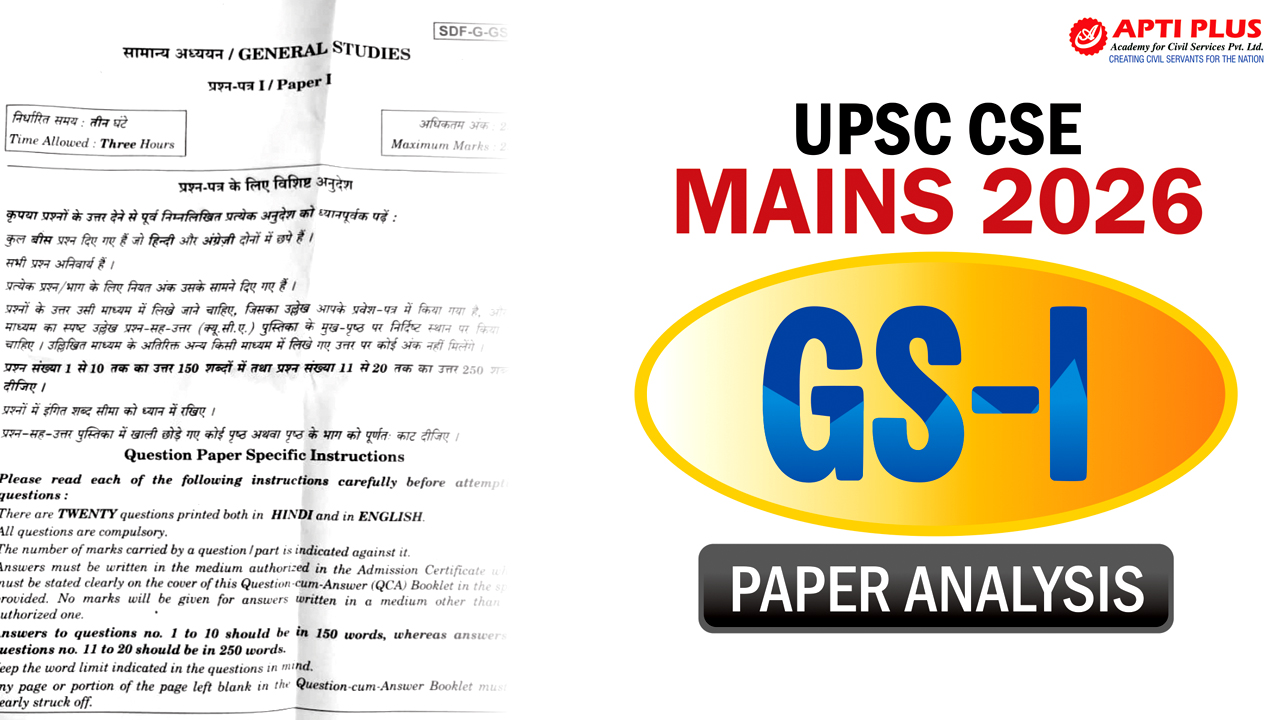
Paper at a Glance
250 marks. 3 hours. 20 compulsory questions — Q1 to Q10 in 150 words for 10 marks each, Q11 to Q20 in 250 words for 15 marks each. Subjects: Indian art and culture, ancient to modern history, world history, post-independence India, Indian society, and geography of India and the world.
Subject-wise Weightage (number of questions)
|
Subject |
2021 |
2022 |
2023 |
2024 |
2025 |
2026 |
2026 marks |
|
Art & Culture |
1 |
3 |
0 |
2 |
2 |
1 |
15 |
|
Ancient / Medieval History |
0 |
0 |
3 |
1 |
1 |
1 |
10 |
|
Modern History |
3 |
2 |
2 |
2 |
1 |
2 |
20 |
|
Post-Independence |
1 |
1 |
0 |
0 |
1 |
2 |
30 |
|
World History |
1 |
0 |
1 |
1 |
1 |
0 |
0 |
|
Physical Geography |
4 |
4 |
1 |
4 |
3 |
4 |
45 |
|
Indian Geography & Resources |
2 |
2 |
3 |
1 |
2 |
1 |
15 |
|
Human & Economic Geography |
3 |
3 |
3 |
1 |
3 |
3 |
40 |
|
Indian Society |
5 |
5 |
7 |
8 |
6 |
6 |
75 |
|
Total |
20 |
20 |
20 |
20 |
20 |
20 |
250 |
Main Trends
• Indian Society is the biggest block, every single year — 5, 5, 7, 8, 6 and now 6 questions. It has never dropped below five. In 2026 it carries 75 of 250 marks — nearly a third of the paper.
• Geography is the largest subject overall — Physical, Indian and human geography together give 8 questions and 100 marks in 2026. Across six years geography has never given fewer than 7 questions.
• World History is shrinking — 1, 0, 1, 1, 1 and zero in 2026. This is only the second blank year in six. High effort, low and falling return.
• Post-Independence is back — 1, 1, 0, 0, 1 and 2 in 2026 — the highest in the window, worth 30 marks. Both questions were 15-markers.
• Art and Culture stays small but never absent, except 2023 — 1, 3, 0, 2, 2, 1. Temple and monument architecture is the most repeated sub-theme — Gupta and Chola, Chola again, Chandella, and now Vijayanagara.
• Modern History is stable and predictable — 2 to 3 questions a year, almost always on the national movement or colonial policy and its effects.
• Physical Geography favours atmospheric and hazard themes — Cyclones, cloudbursts, tsunamis, auroras, twisters, and in 2026 the Fujiwhara effect plus three wind questions.
• Society questions are increasingly opinion-based — ‘Do you think’, ‘Is caste disappearing’, ‘Give your opinion’. UPSC wants a stated position with balance, not a description.
• Globalization is the single most repeated society theme — 2022 with technology, 2024 with women's migration, 2025 with consumer culture, 2026 with youth. Four of the last five papers.
• Current affairs enters through the back door — Questions are never dated, but disability policy, satellite agriculture, Indo-Pacific trade and digital empowerment all come straight from the year's news.
Themes That Keep Coming Back
|
Theme |
Years asked |
|
Globalization and society |
2022 Q20 → 2024 Q19 → 2025 Q10 → 2026 Q20 |
|
Caste and urban change |
2023 Q18 and Q19 → 2024 Q9 → 2026 Q18 |
|
Population and demography |
2021 Q18 → 2024 Q7 → 2026 Q19 |
|
Water stress and rivers |
2023 Q5 → 2024 Q14 → 2025 Q17 → 2026 Q7 |
|
Temple and monument architecture |
2022 Q12 and Q13 → 2024 Q11 → 2025 Q3 → 2026 Q11 |
|
Cyclones and severe weather |
2022 Q5 → 2024 Q4 and Q6 → 2026 Q4 |
|
Technology and society |
2021 Q19 → 2025 Q15 → 2026 Q10 and Q15 |
|
States reorganisation |
2022 Q11 → 2026 Q12 |
|
Land use and urban encroachment |
2021 Q6 → 2026 Q17 |
|
Tribal issues |
2021 Q9 → 2022 Q10 → 2023 Q13 → 2025 Q20 |
Difficulty Year by Year
|
Year |
Level |
Character |
|
2021 |
Moderate |
Straightforward geography, but a heavy society section. Cryptocurrency was the surprise. |
|
2022 |
Moderate |
Very balanced. Zero world history. Basic geography — rocks, troposphere, ocean currents. Sect and secularism troubled candidates. |
|
2023 |
Hard |
Zero art and culture, zero post-independence. Society jumped to seven, with unusual framings — suicide among young women, child cuddling and mobile phones. |
|
2024 |
Moderate to hard |
Society peaked at eight. Physical geography got technical — auroras, twisters, cloudbursts. Little scope for generic answers. |
|
2025 |
Moderate |
Well spread across all sections. AI and drones in planning was the modern surprise. |
|
2026 |
Moderate |
Balanced and fair. Only the Fujiwhara effect was genuinely unfamiliar. Two post-independence questions rewarded those who did not skip that section. |
CSE 2026 GS I Question Paper
Held on 22 August 2026.
|
No. |
Question |
Subject |
Marks |
|
1 |
Analyze the importance of Ashokan inscriptions for reconstructing Mauryan history. |
Ancient / Medieval History |
10 |
|
2 |
Discuss the impact of Macaulay's Minute on colonial administration and education in India. |
Modern History |
10 |
|
3 |
The significance of the Gandhian movements lay in the masses they mobilized. Elucidate. |
Modern History |
10 |
|
4 |
What is the Fujiwhara effect? Explain its impact on the movement and intensity of tropical cyclones. |
Physical Geography |
10 |
|
5 |
“Tundra regions are ecologically fragile but economically important.” Examine this statement critically. |
Physical Geography |
10 |
|
6 |
Discuss the role of aeolian processes in desertification and land degradation. |
Physical Geography |
10 |
|
7 |
“Water resources are both an asset and a source of conflict in South Asia.” Examine this statement giving examples. |
Human & Economic Geography |
10 |
|
8 |
Unity in diversity remains the defining feature of Indian society despite the challenges from communalism and regionalism. Comment. |
Indian Society |
10 |
|
9 |
How do you understand disability? Substantiate the need for inclusive policy framework in India in this regard. |
Indian Society |
10 |
|
10 |
Do you think digital technology promotes social empowerment? Explain with examples. |
Indian Society |
10 |
|
11 |
Vijayanagara architecture exemplifies the amalgamation of past traditions with contemporary practices. Elucidate with examples. |
Art & Culture |
15 |
|
12 |
Linguistic reorganization of Indian States was driven by popular pressure from below. Comment. |
Post-Independence |
15 |
|
13 |
The model of planned economy was adopted in India to address the regional imbalances left behind by colonial rule. Comment. |
Post-Independence |
15 |
|
14 |
Compare the Loo, Chinook and Foehn winds with respect to their regions of prevalence, their nature and climatic impacts. |
Physical Geography |
15 |
|
15 |
Analyze the role of satellite-based technologies in achieving climate-smart agriculture and food security in India. |
Human & Economic Geography |
15 |
|
16 |
“The centre of global trade is gradually shifting from the Atlantic region to the Indo-Pacific region.” Examine this statement. |
Human & Economic Geography |
15 |
|
17 |
Analyze the major drivers of human-induced land-use changes in India and their geographical consequences. |
Indian Geography & Resources |
15 |
|
18 |
Is caste disappearing in urban India? Illustrate your answer with examples. |
Indian Society |
15 |
|
19 |
Critically examine the challenges of demographic transition in contemporary India. |
Indian Society |
15 |
|
20 |
Evaluate the impact of globalization on Indian youths with reference to social, political, economic and cultural spheres. |
Indian Society |
15 |
Analysis
|
Point |
2026 |
|
Society weightage |
6 questions, 75 marks — in line with the five-year average of 6.2 |
|
Geography weightage |
8 questions, 100 marks — the largest single subject block |
|
History and culture weightage |
6 questions, 75 marks — spread across ancient, modern, post-independence and culture |
|
World History |
Zero — only the second time in six years |
|
Post-Independence |
2 questions, 30 marks — highest in the window |
|
Unfamiliar or surprise question |
Q4 on the Fujiwhara effect — the only genuinely new term |
|
Wind-related cluster |
Q4, Q6 and Q14 all involve air movement — an unusual concentration |
|
Opinion-type questions |
Q10, Q18, and to an extent Q8 and Q20 — a stated position was required |
|
Current-affairs linkage |
Q9 disability, Q10 digital empowerment, Q15 satellite agriculture, Q16 Indo-Pacific |
|
Diagram or map opportunities |
Q4 Fujiwhara diagram, Q14 mountain cross-section, Q16 chokepoint map, Q6 dune landforms |
|
Overall difficulty |
Moderate — fair and attemptable, but rewarding specificity over general writing |
Question-wise Points
|
No. |
What is being asked |
Key value addition |
|
Q1 |
Analyze — weigh what inscriptions do and do not tell us. |
Name specific edicts — Rock Edict XIII on Kalinga, Pillar Edict VII on dhamma, Minor Rock Edict I on Ashoka's Buddhist affiliation. A small map of edict sites earns marks. |
|
Q2 |
Discuss — both administration and education, and both positive and negative effects. |
Wood's Despatch of 1854 as the real blueprint of modern Indian education; Hunter Commission 1882. Mention that Gandhi's Nai Talim was a direct response to this model. |
|
Q3 |
Elucidate — accept the proposition and prove it, but note it was mobilization plus method. |
Numbers help — Congress membership growth after 1920, arrest figures in Civil Disobedience. Quote Nehru on Gandhi turning the Congress from a debating body into a movement. |
|
Q4 |
Define plus explain effects — a pure concept question. |
A diagram is almost mandatory here. Cite examples such as cyclones Ockhi-era interactions or documented Pacific twin-typhoon cases. Link to IMD forecasting and NDMA cyclone guidelines. |
|
Q5 |
Examine critically — both halves of the statement, plus the tension between them. |
India's Arctic Policy 2022 and observer status in the Arctic Council make this an Indian-relevance question, not just a world geography one. |
|
Q6 |
Discuss the role — process to consequence. |
The ISRO Desertification and Land Degradation Atlas figure and India's UNCCD pledge to restore 26 million hectares by 2030 are the two data anchors. |
|
Q7 |
Examine with examples — must genuinely cover both asset and conflict. |
Distinguish transboundary disputes from inter-state disputes inside India — most candidates will write only the first. Mention the Inter-State River Water Disputes Act amendment. |
|
Q8 |
Comment — a balanced verdict, not a patriotic essay. |
Nehru's phrase on unity in diversity and Ambedkar's caution in his final Constituent Assembly speech that India must place the country above creed. Note that regionalism accommodated through states reorganisation actually strengthened unity. |
|
Q9 |
Two parts — conceptual understanding of disability, then the policy argument. |
The phrase ‘nothing about us without us’ and the principle of reasonable accommodation. Note the shift from welfare to rights as the core argument. |
|
Q10 |
‘Do you think’ — an opinion question. Take a position, but show both sides first. |
Cite specific schemes and one or two data points on the gender gap in internet use. The Puttaswamy judgment and the DPDP Act give a rights dimension most answers will miss. |
|
Q11 |
Elucidate with examples — prove the amalgamation claim through named structures. |
Name at least four structures. Mention that the use of arches and domes in secular but not religious buildings was a deliberate distinction. Foreign travellers' accounts add authority. |
|
Q12 |
Comment — test the claim that it was bottom-up, and note the state's reluctance. |
Dates and named bodies carry this answer: Dar Commission 1948, JVP Committee 1948, Andhra 1953, SRC 1953, SRA 1956. Note that reorganisation is often credited with defusing rather than fuelling separatism. |
|
Q13 |
Comment — the stated reason is one reason among several; assess whether it worked. |
Freight equalisation is the sharpest example — a policy meant to reduce disparity that is widely argued to have deepened it for Bihar, Jharkhand and Odisha. Very few candidates will use it. |
|
Q14 |
Compare on three stated parameters — a table is the natural format. |
The adiabatic lapse rate contrast — wet ascent at about 6 degrees per km versus dry descent at about 10 degrees per km — explains why these winds are warm. A simple cross-section diagram of a mountain barrier scores well. |
|
Q15 |
Analyze the role — link the technology to the two stated outcomes. |
Name the specific ISRO programmes — FASAL, NADAMS, CHAMAN, Bhuvan. Linking to PMFBY claim settlement is the strongest concrete example. |
|
Q16 |
Examine — test the claim, and consider whether the Atlantic still matters. |
Chokepoint geography is what makes this a GS-1 geography answer rather than a GS-2 IR answer — keep Malacca, Hormuz and Bab-el-Mandeb central and draw a sketch map. |
|
Q17 |
Analyze drivers and consequences — two clear halves. |
Use named case studies rather than general statements — Bengaluru's lost lakes, Chennai's Pallikaranai marsh, Aravalli mining, Joshimath subsidence. |
|
Q18 |
‘Is it disappearing’ — answer no with nuance: form changes, salience persists. |
The distinction between caste as hierarchy and caste as identity is the argument that separates a good script from an average one. Cite Ambedkar, Srinivas, Beteille and Gupta by name. |
|
Q19 |
Critically examine — challenges, but also note the opportunity being missed. |
The delimitation and fiscal devolution angle of north-south demographic divergence is the sharpest and least commonly written point. NFHS-5 TFR of 2.0 is the essential data anchor. |
|
Q20 |
Evaluate across four named spheres — the structure is given in the question, so use it. |
Follow the four spheres as four subheadings — examiners reward visible correspondence with the question. The idea of glocalisation is the analytical hook. |
What This Means for 2027
• Indian Society must be treated as the core subject, not an add-on — it alone carries 75 marks.
• Geography carries 100 marks. Physical geography concepts must be diagram-ready.
• World History is now low-yield. Cover it, but do not over-invest.
• Post-Independence India returned strongly. Do not skip it.
• Temple and monument architecture is the safest art and culture bet.
• Learn to write opinion answers — take a clear position and defend it with both sides.
• Globalization, caste, demography and water are the four themes most likely to repeat.