Paper at a Glance
250 marks. 3 hours. 20 compulsory questions — Q1 to Q10 in 150 words for 10 marks each, Q11 to Q20 in 250 words for 15 marks each. Subjects: the Constitution and polity, governance, social justice, and international relations.
Subject-wise Weightage (number of questions)
|
Subject |
2021 |
2022 |
2023 |
2024 |
2025 |
2026 |
2026 marks |
|
Polity & Constitution |
8 |
9 |
7 |
8 |
9 |
8 |
105 |
|
Governance |
2 |
4 |
3 |
5 |
3 |
2 |
25 |
|
Social Justice |
6 |
3 |
6 |
3 |
4 |
6 |
70 |
|
International Relations |
4 |
4 |
4 |
4 |
4 |
4 |
50 |
|
Total |
20 |
20 |
20 |
20 |
20 |
20 |
250 |
Main Trends
• Polity is the backbone of the paper — 8, 9, 7, 8, 9 and 8 questions. It has never fallen below seven. In 2026 it carries 105 of 250 marks — more than 40 per cent of the paper.
• International Relations is fixed at exactly four — every single year — 4, 4, 4, 4, 4 and 4. Six years without a single deviation. This is the most reliable pattern anywhere in the GS papers, and it means 50 marks are guaranteed.
• Social Justice swings, Governance absorbs the swing — Social Justice: 6, 3, 6, 3, 4, 6. Governance: 2, 4, 3, 5, 3, 2. When one rises the other falls, because together they stay near 8 to 9 questions.
• A comparative constitutional question appears every year — 2021 equality in India and USA, 2022 Presidents of India and France, 2023 British and Indian parliamentary sovereignty, 2024 secularism in India and USA, 2025 pardon power and judicial appointments versus USA, 2026 separation of powers and PM versus US President. Six years unbroken — and the USA is the comparator in four of them.
• Constitutional and statutory bodies are asked repeatedly — NCBC in 2022, CAG in 2024, Attorney General in 2025, NCSC and NCST in 2026, Election Commission in 2022, 2025 and 2026, Human Rights Commissions in 2021, NALSA in 2023, CCI in 2023, NCPCR in 2025.
• Questions are getting longer and multi-part — In 2021 most questions were a single sentence. In 2026 nearly every question carries two or three distinct sub-questions — Q4 asks three separate things, Q11 asks three, Q13 asks three. Missing one sub-part now costs marks directly.
• Case law is expected, not optional — 2022 explicitly asked for relevant case laws twice, 2023 asked for gender justice with case laws, 2024 used the Puttaswamy framing, 2025 quoted a Supreme Court observation, and 2026 Q12 is built entirely on two judgments.
• Vulnerable sections rotate rather than repeat — Disability in 2022, women in 2021, 2023 and 2026, children in 2025, tribals in 2025 and 2026, transgender persons in 2026, SC and ST institutions in 2026. Nearly every listed group has now appeared.
• Elections and electoral machinery appear almost every year — 2022 on RP Act disputes and the Model Code, 2024 on one nation one election, 2025 on corrupt practices, 2026 on the right to vote and electoral roll revision.
• IR has moved from bilateral relations toward groupings and China — 2026 has no single bilateral neighbour question. Instead IPMDA, BRICS, the diaspora and BRI — three of the four are effectively about China and the shape of the global order.
Themes That Keep Coming Back
|
Theme |
Years asked |
|
Comparative constitutional analysis |
2021 Q13 → 2022 Q14 → 2023 Q4 → 2024 Q15 → 2025 Q3 and Q13 → 2026 Q14 |
|
Federalism and Centre-State relations |
2021 Q11 → 2022 Q13 → 2023 Q13 and Q15 → 2024 Q13 → 2025 Q14 → 2026 Q11 and Q13 |
|
Elections and the Election Commission |
2022 Q11 and Q15 → 2024 Q1 → 2025 Q1 → 2026 Q4 |
|
Pressure groups and civil society |
2021 Q5 and Q18 → 2022 Q17 → 2025 Q8 and Q15 → 2026 Q15 |
|
Poverty, malnutrition and food security |
2021 Q8 → 2024 Q7 → 2025 Q16 → 2026 Q7 |
|
Education and skilling |
2021 Q7 → 2022 Q18 → 2023 Q6 and Q18 → 2026 Q18 |
|
Women's rights and representation |
2021 Q2 and Q17 → 2023 Q12 and Q14 → 2025 Q6 → 2026 Q2 |
|
Constitutional bodies for vulnerable groups |
2022 Q5 NCBC → 2025 Q18 NCPCR → 2026 Q5 NCSC and NCST |
|
Governor and State executive |
2022 Q12 → 2026 Q11 |
|
China in India's neighbourhood |
2021 Q10 and Q20 → 2022 Q9 → 2024 Q9 and Q20 → 2026 Q9 and Q20 |
|
E-governance and citizen-centric administration |
2023 Q8 → 2024 Q16 and Q18 → 2025 Q7 → 2026 Q16 |
|
Judicial independence, accountability and overreach |
2023 Q1 → 2024 Q14 → 2025 Q11 and Q13 → 2026 Q3 and Q12 |
Difficulty Year by Year
|
Year |
Level |
Character |
|
2021 |
Easy to moderate |
Almost every question sat on an exact syllabus keyword — pressure groups, SHGs, NGOs, Legislative Councils. Only AUKUS and CBI were current-affairs driven. |
|
2022 |
Moderate |
Syllabus-keyword driven again, but with two explicit case-law demands. Ordinance re-promulgation and the India-France presidential comparison were the tough ones. |
|
2023 |
Easy to moderate |
Well spread and largely predictable. NALSA, IMO and the SCO conflict question were the less-prepared areas. |
|
2024 |
Moderate to difficult |
Governance rose to five questions and the paper leaned heavily on recent legislation — the Public Examination Act 2024 and recent Centre-State changes. Less room for generic writing. |
|
2025 |
Moderate to difficult |
Polity at nine, with technically demanding questions — preemptive pardons, tribunal rationalisation, substantive limits on amending power. |
|
2026 |
Difficult |
The hardest paper in the window. Questions are long and multi-part, several demand a stated position, and the framing is abstract in Q16 and Q17. Q1 requires knowledge of a 2026 amendment and Q9 requires IPMDA specifically, not just the Quad. |
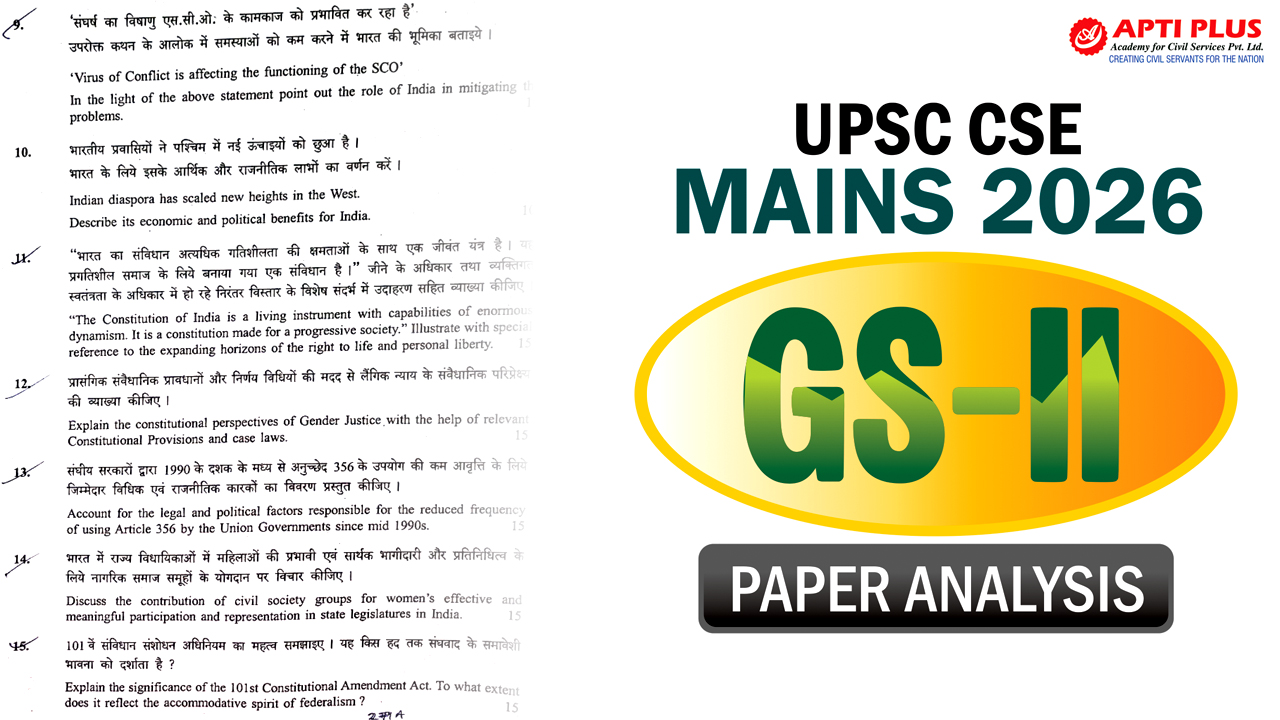
CSE 2026 GS II Question Paper
Held on 22 August 2026.
|
No. |
Question |
Subject |
Marks |
|
1 |
Right to privacy relating to self-identity is very dear to every human being and well protected under Article 21 of the Constitution. In this context, examine the effect of the amendment in 2026, to the Transgender Persons (Protection of Rights) Act, 2019. |
Social Justice |
10 |
|
2 |
“Women as a class neither belong to a minority group nor are they regarded as forming a backward class.” In the light of this statement, discuss the evolution of women's reservation from local bodies to Parliament. |
Social Justice |
10 |
|
3 |
Examine whether the constitutional office of the Lok Sabha Speaker has become vulnerable to partisan politics under the current anti-defection regime. What institutional changes are required to ensure the neutrality of the Lok Sabha Speaker in managing a polarised House? |
Polity & Constitution |
10 |
|
4 |
Is the right to vote a fundamental right? Discuss the position of the Election Commission of India while undertaking the revision of electoral rolls. Can it also examine the question of citizenship of voters? |
Polity & Constitution |
10 |
|
5 |
Do constitutional bodies like the National Commission for Scheduled Castes (NCSC) and the National Commission for Scheduled Tribes (NCST) possess adequate enforcement powers to secure substantive social equality? Suggest measures to enhance their institutional effectiveness. |
Polity & Constitution |
10 |
|
6 |
Does India's tribal development policy reflect the aspirations for a socially grounded and equity-based governance? Justify your answer. |
Social Justice |
10 |
|
7 |
Malnutrition in India is not merely a public health concern; it is also a challenge of social equity, human development and effective welfare governance. Discuss. |
Social Justice |
10 |
|
8 |
Analyse the advantages and limitations of the generalist structure of the Indian Civil Services in contemporary governance. |
Governance |
10 |
|
9 |
“IPMDA (Indo-Pacific Partnership for Maritime Domain Awareness) bridges the gap between India's SAGAR (Security and Growth for All in the Region) vision and the Quad's collective Indo-Pacific strategy.” Make a critical assessment of the statement focusing on IPMDA. |
International Relations |
10 |
|
10 |
“BRICS acts as a powerful counterweight in global governance, actively amplifying the voice and influence of the Global South.” Explain the role of BRICS in projecting itself as an alternative to other groupings. |
International Relations |
10 |
|
11 |
Discuss the position of the Governor in the federal polity of India. What is the nature of his power while giving assent to a bill passed by the State Legislature? Is he bound by the aid and advice of his Council of Ministers in all his functions? |
Polity & Constitution |
15 |
|
12 |
What is meant by judicial legislation? In this context, discuss the verdicts of the apex court allowing “passive euthanasia” and a “living will”. |
Polity & Constitution |
15 |
|
13 |
How far has the Indian federal framework been successful in accommodating regional and cultural diversities? Highlight the role of asymmetric federalism and suggest measures to make dispute resolution mechanisms more effective. |
Polity & Constitution |
15 |
|
14 |
Examine how the separation of powers is practised in India compared to the rigid presidential model of the United States of America. In this context, compare the actual authority of the Indian Prime Minister with that of the President of the USA. |
Polity & Constitution |
15 |
|
15 |
To what extent do pressure groups, social movements and corporate lobbies deepen pluralistic democracy in India by representing excluded interests? Analyse whether the growing convergence of corporate wealth and political power poses a threat to the autonomy of formal democratic institutions. |
Polity & Constitution |
15 |
|
16 |
“Transparency and accountability in governance are not about controlling corruption but about creating the trust of stakeholders in the policy process by following the Rule of Law and Participatory Governance.” Comment. |
Governance |
15 |
|
17 |
Can the constitutional mandate of rights-based welfare be effectively realised in the context of non-integrated governance and minimal public investment? Examine. |
Social Justice |
15 |
|
18 |
Should education be treated primarily as a welfare obligation of the state or as a strategic investment for building a globally competitive, knowledge-driven nation? Critically evaluate. |
Social Justice |
15 |
|
19 |
“India's global diaspora acts as a living bridge, as a critical economic factor and knowledge network in transforming cultural heritage into geopolitical influence and strategic leverage worldwide.” Critically examine this statement. |
International Relations |
15 |
|
20 |
“China's Belt and Road Initiative (BRI) has transformed South Asia from a regional space into a theatre of great power competition.” Analyse the strategic implications of the BRI for India's security and regional influence in South Asia. |
International Relations |
15 |
Analysis
|
Point |
2026 |
|
Total questions and marks |
20 questions, 250 marks, 10 × 10 and 10 × 15 — unchanged for six years |
|
Polity weightage |
8 questions, 105 marks — in line with the five-year average of 8.2 |
|
Governance weightage |
2 questions, 25 marks — the lowest in six years |
|
Social Justice weightage |
6 questions, 70 marks — joint highest with 2021 and 2023 |
|
International Relations weightage |
4 questions, 50 marks — exactly four for the sixth year running |
|
Comparative constitutional question |
Present — Q14, separation of powers and PM versus US President |
|
Case-law dependent questions |
Q1, Q3, Q4, Q11 and Q12 — five questions turn on judgments |
|
Multi-part questions |
Nearly all. Q4, Q11 and Q13 each carry three distinct sub-questions |
|
Most current-affairs driven |
Q1 the 2026 Transgender Act amendment, Q9 IPMDA, Q10 BRICS expansion, Q20 BRI |
|
Most attemptable |
Q7 malnutrition, Q11 Governor, Q13 federalism — all standard themes with ready material |
|
Least attemptable |
Q9 IPMDA, which required a specific initiative rather than general Quad knowledge, and Q1 which required the 2026 amendment |
|
Overall difficulty |
Difficult — the hardest GS-2 in the six-year window, mainly because of question length and the number of sub-parts |
Question-wise Points
|
No. |
Question |
What is being asked |
Key value addition |
|
Q1 |
Right to privacy relating to self-identity is very dear to every human being and well protected under Article 21 of the Constitution. In this context, examine the effect of the amendment in 2026, to the Transgender Persons (Protection of Rights) Act, 2019. |
Examine — link the privacy-self-identity principle to what the 2026 amendment actually changed. |
The tension between certification and self-identification is the analytical core. Cite NALSA and Puttaswamy by name; most answers will only describe the scheme. |
|
Q2 |
“Women as a class neither belong to a minority group nor are they regarded as forming a backward class.” In the light of this statement, discuss the evolution of women's reservation from local bodies to Parliament. |
Discuss the evolution — the quoted line is a legal classification point that must be engaged with, not ignored. |
The Article 15(3) versus Article 16(4) distinction explains why women's reservation is legally different from caste reservation. The 106th Amendment's dependence on census and delimitation is the sharpest current point. |
|
Q3 |
Examine whether the constitutional office of the Lok Sabha Speaker has become vulnerable to partisan politics under the current anti-defection regime. What institutional changes are required to ensure the neutrality of the Lok Sabha Speaker in managing a polarised House? |
Examine plus suggest — two clear halves, and the second half must be institutional, not moral. |
Naming Kihoto Hollohan, Keisham Meghachandra Singh and the British Speaker convention lifts this above a generic answer. |
|
Q4 |
Is the right to vote a fundamental right? Discuss the position of the Election Commission of India while undertaking the revision of electoral rolls. Can it also examine the question of citizenship of voters? |
Three distinct sub-questions — answer all three explicitly. |
The distinction between examining citizenship for enrolment and determining citizenship as a status is the exact point the question is testing. Also cite Article 326 and Section 16 of the RP Act, 1950. |
|
Q5 |
Do constitutional bodies like the National Commission for Scheduled Castes (NCSC) and the National Commission for Scheduled Tribes (NCST) possess adequate enforcement powers to secure substantive social equality? Suggest measures to enhance their institutional effectiveness. |
Answer the enforcement-power question directly, then reform. |
Article 338(9) on mandatory consultation and the civil-court powers under inquiry are the two provisions most answers miss. Add conviction-rate data under the Atrocities Act. |
|
Q6 |
Does India's tribal development policy reflect the aspirations for a socially grounded and equity-based governance? Justify your answer. |
‘Does it reflect’ — take a position and justify, covering both achievement and gap. |
The Xaxa Committee findings and Nehru's Panchsheel give the answer a benchmark to judge against, rather than just listing schemes. |
|
Q7 |
Malnutrition in India is not merely a public health concern; it is also a challenge of social equity, human development and effective welfare governance. Discuss. |
Discuss — the question already gives you three frames beyond health; use all three. |
Disaggregated NFHS-5 data by caste and wealth quintile is what converts this from a health answer into a social-equity answer. Note the paradox of food surplus with malnutrition. |
|
Q8 |
Analyse the advantages and limitations of the generalist structure of the Indian Civil Services in contemporary governance. |
Analyse both sides — a balanced verdict on the generalist-specialist debate. |
Second ARC's domain-assignment recommendation and Mission Karmayogi's competency framework are the two anchors. Mention lateral entry with balance rather than advocacy. |
|
Q9 |
“IPMDA (Indo-Pacific Partnership for Maritime Domain Awareness) bridges the gap between India's SAGAR (Security and Growth for All in the Region) vision and the Quad's collective Indo-Pacific strategy.” Make a critical assessment of the statement focusing on IPMDA. |
Critical assessment — does IPMDA really bridge SAGAR and the Quad, or only partly? |
Naming IFC-IOR Gurugram, dark shipping and the MAHASAGAR reformulation of SAGAR shows current awareness. Keep the assessment genuinely critical — the word is in the question. |
|
Q10 |
“BRICS acts as a powerful counterweight in global governance, actively amplifying the voice and influence of the Global South.” Explain the role of BRICS in projecting itself as an alternative to other groupings. |
Explain the alternative-grouping role — evidence for and against BRICS as a counterweight. |
India's formulation that BRICS is non-Western rather than anti-Western is the single most useful line, and it distinguishes India's position from Russia's and China's. |
|
Q11 |
Discuss the position of the Governor in the federal polity of India. What is the nature of his power while giving assent to a bill passed by the State Legislature? Is he bound by the aid and advice of his Council of Ministers in all his functions? |
Three sub-questions — position, nature of assent power, and extent of the aid-and-advice binding. |
Article 200's four options and the absence of a stated timeline, plus Shamsher Singh and Nabam Rebia, are essential. Note the reference on whether courts can prescribe timelines. |
|
Q12 |
What is meant by judicial legislation? In this context, discuss the verdicts of the apex court allowing “passive euthanasia” and a “living will”. |
Define the concept, then apply it to two specific judgments. |
The 2023 modification of the Common Cause procedure is the detail that shows currency. Also mention the 241st Law Commission Report recommending a statute. |
|
Q13 |
How far has the Indian federal framework been successful in accommodating regional and cultural diversities? Highlight the role of asymmetric federalism and suggest measures to make dispute resolution mechanisms more effective. |
Three parts — assess success, explain asymmetric federalism, and suggest dispute-resolution reform. |
Naming the specific Article 371 clauses and the underuse of Article 263 gives precision. The cess-and-surcharge point is the sharpest current fiscal grievance. |
|
Q14 |
Examine how the separation of powers is practised in India compared to the rigid presidential model of the United States of America. In this context, compare the actual authority of the Indian Prime Minister with that of the President of the USA. |
Comparative — then a specific comparison of PM and US President's actual authority. |
The paradox — formally weaker, practically stronger with a majority — is the analytical payoff. A comparison table works well here. |
|
Q15 |
To what extent do pressure groups, social movements and corporate lobbies deepen pluralistic democracy in India by representing excluded interests? Analyse whether the growing convergence of corporate wealth and political power poses a threat to the autonomy of formal democratic institutions. |
Two parts — the democratic contribution of these actors, then the corporate-power threat. |
The 2024 electoral bonds judgment and the 2017 removal of the corporate donation cap are the strongest evidence for the second half. Very few candidates will bring Olson's collective action logic. |
|
Q16 |
“Transparency and accountability in governance are not about controlling corruption but about creating the trust of stakeholders in the policy process by following the Rule of Law and Participatory Governance.” Comment. |
Comment — the statement reframes transparency away from anti-corruption; engage with that reframing. |
Kerala's People's Plan and MGNREGA social audits are the two best Indian illustrations of participation producing trust rather than merely catching fraud. The procedural-justice idea is a strong analytical hook. |
|
Q17 |
Can the constitutional mandate of rights-based welfare be effectively realised in the context of non-integrated governance and minimal public investment? Examine. |
Examine — answer the ‘can it’ question, given the two constraints named. |
The 1.9 versus 2.5 per cent health spending gap and the Kerala-Tamil Nadu contrast are the two most persuasive pieces of evidence. Note that money without convergence and convergence without money both fail. |
|
Q18 |
Should education be treated primarily as a welfare obligation of the state or as a strategic investment for building a globally competitive, knowledge-driven nation? Critically evaluate. |
‘Should it be A or B’ — critically evaluate both framings and resolve, do not simply pick one. |
Sen and Drèze's argument that basic education is the precondition for economic sophistication is the resolution that lifts this answer. ASER learning-outcome data and the 6 per cent GDP target anchor it. |
|
Q19 |
“India's global diaspora acts as a living bridge, as a critical economic factor and knowledge network in transforming cultural heritage into geopolitical influence and strategic leverage worldwide.” Critically examine this statement. |
Critically examine — the statement is celebratory; test each of its three claims. |
The Gulf-versus-West asymmetry — highest remittances, lowest political leverage — is the most valuable critical point and is usually missed. |
|
Q20 |
“China's Belt and Road Initiative (BRI) has transformed South Asia from a regional space into a theatre of great power competition.” Analyse the strategic implications of the BRI for India's security and regional influence in South Asia. |
Analyse strategic implications — for India's security and for India's regional influence, both. |
Naming specific projects country by country and contrasting India's delivery record with China's speed is what makes this analytical rather than descriptive. The IMEC and Chabahar counters are essential. |
What This Means for 2027
• Indian Society must be treated as the core subject, not an add-on — it alone carries 75 marks.
• Geography carries 100 marks. Physical geography concepts must be diagram-ready.
• World History is now low-yield. Cover it, but do not over-invest.
• Post-Independence India returned strongly. Do not skip it.
• Temple and monument architecture is the safest art and culture bet.
• Learn to write opinion answers — take a clear position and defend it with both sides.
• Globalization, caste, demography and water are the four themes most likely to repeat.