The Board Has Only One Paper in Front of It: Yours
In Prelims and Mains, everybody gets the same question paper. In the interview, every candidate gets a different one, and you wrote it yourself. That paper is the Detailed Application Form, or DAF.
Experienced mentors put it plainly: around 70 per cent of interview questions are seeded from the DAF. Your name, your district, your college, your job, your hobbies and your service choices are all sitting on the table in front of five people who read it before you walked in.
With 275 marks at stake, UPSC interview DAF preparation is not optional work for the last week. It is the main work of the whole interview stage.
How the Board Uses Your DAF
The board is not checking whether you memorised facts. It is checking whether your answers about your own life are honest, consistent and thought through. A candidate who cannot explain why he left a good job, or what her hobby actually involves, loses marks not for lack of knowledge but for lack of clarity.
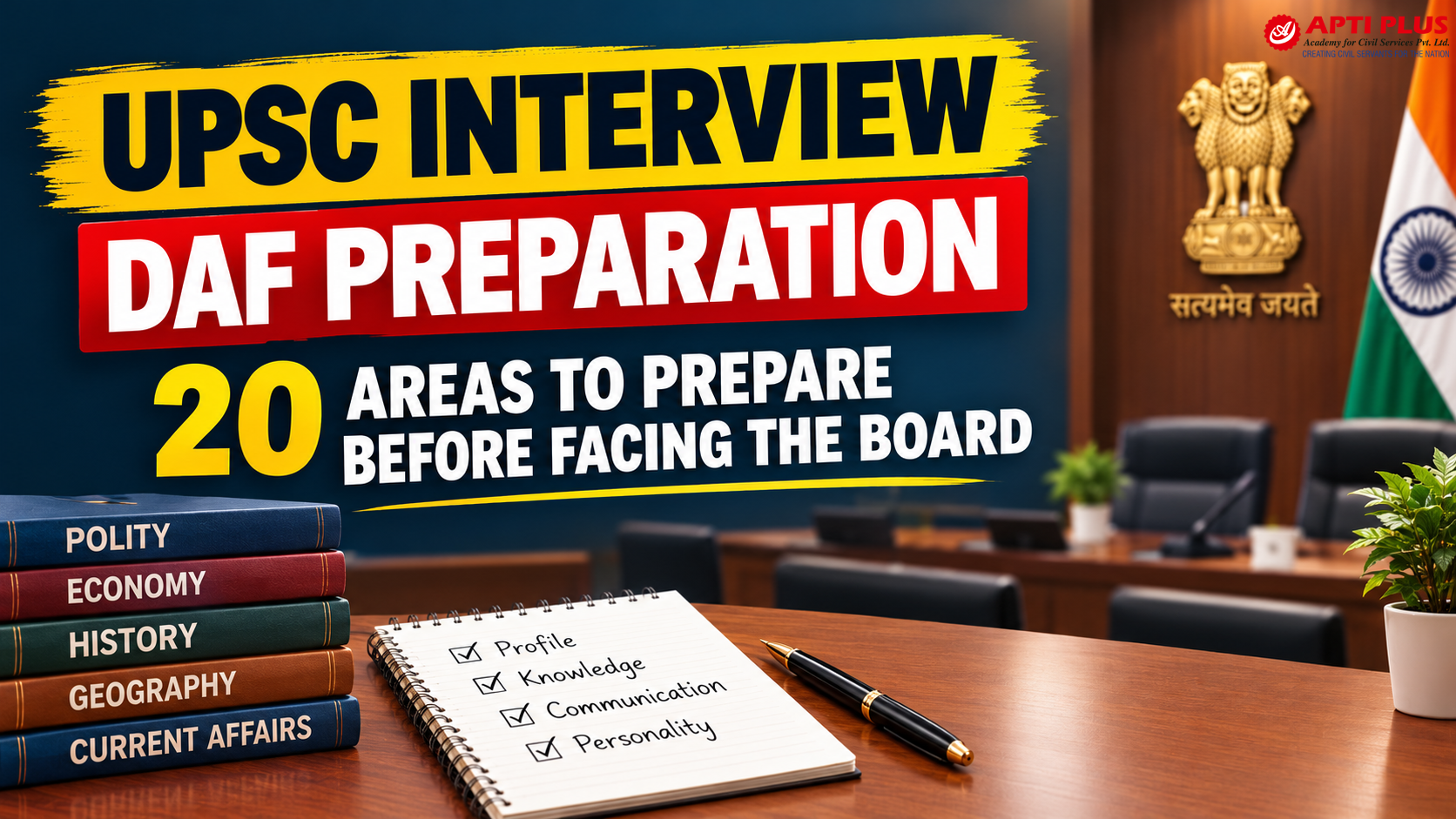
So read the UPSC personality test structure once, then sit with your DAF and prepare each line as if it were a syllabus topic of its own. The 20 areas below cover almost everything a board asks.
Part 1: Your Personal Background (Areas 1 to 6)
1. Your name
Know its meaning, its origin, and any well-known person who shares it. If your surname carries a regional or historical link, know that too.
2. Your date of birth
Be ready for an event, a personality or an anniversary linked to that day. This is a light opening question that relaxes many candidates, so use it well.
3. Your home district
Prepare its history, famous places, main crops or industries, local problems, two or three district schemes, and one idea you would try as its Collector.
4. Your home state
Know its geography, economy, culture, current political and development issues, and its biggest challenge today. Expect a follow-up question comparing your state with a neighbouring one.
5. Your family background
You may be asked about your parents’ occupation or how your family supported your preparation. Answer with dignity and without exaggeration.
6. Your schooling and your medium of study
Know your school, its town, and be ready for a question on school education policy, dropout rates or the language question if you studied in a regional medium.
Part 2: Education and Work (Areas 7 to 11)
7. Your graduation subject
Revise the basics. A Civil Engineer should expect questions on bridges or roads; a Zoology graduate on wildlife; an MBA on management ideas. The board will not go deep, but it will test whether you still know what you studied.
8. Why you left your subject for civil services
This question comes in almost every interview for engineers, doctors and management graduates. Avoid saying anything that insults your old field.
9. Your college and university
Know its founder, its famous alumni and its location. Also be ready for questions on campus issues such as placements, research quality or student politics.
10. Your work experience
Prepare your role, the skills you gained, one problem you solved, and how that experience will help you as an officer. If you are still employed, be clear about why you want to move.
11. Gaps and multiple attempts
If there is a gap year or this is your fourth attempt, prepare a calm, honest explanation. The board respects candour far more than a polished excuse.
Part 3: Hobbies and Achievements (Areas 12 to 14)
12. Your hobbies
This is where candidates lose the most marks on one casually written line. If you wrote photography, expect questions on cameras, light, and famous photographers. If you wrote gardening, expect questions on soil and seasonal plants. Never write a hobby you do not practise.
13. Your sports and extracurricular activities
Know the rules, recent tournaments and the state of that sport in India. A board member who plays the same game will ask sharper questions.
14. Your prizes, positions and volunteer work
For each achievement on the form, prepare what you did, what you learnt and what went wrong along the way. Leadership roles invite questions on handling conflict.
Part 4: Service, Cadre and Vision (Areas 15 to 17)
15. Your service preference
Be ready to explain why IAS is above IPS on your list, or why IFS is at the top. Then be ready for the follow-up: what will you do if you get the third choice instead?
16. Your cadre preference
Know the basics of your first cadre choice, its main problems, and why you placed your home state where you did.
17. Your vision as an officer
Prepare two or three specific things you would try in your first posting. Avoid grand statements about changing the country. Boards prefer small, workable ideas.
Part 5: Issues Around You (Areas 18 to 20)
18. Current affairs linked to your profile
The board joins your DAF to the news. A Kerala candidate gets questions on floods, a Punjab candidate on stubble burning, an IT professional on data protection. Track the issues that touch your state, your degree and your job through the daily current affairs you read each morning.
19. Situation and ethics questions
Expect at least one case: a transfer under political pressure, a corrupt junior, a relief fund under scrutiny. Answer by stating the facts, the options, your choice and your reason, in that order.
20. Opinion questions on contested issues
Reservation, free schemes, social media rules, climate commitments and similar topics all come up. Give both sides first, then a balanced view of your own. For quick revision of such issues, a monthly compilation like the UPSC monthly magazine is easier to carry than a pile of newspaper cuttings.
A Simple Way to Prepare All 20
1. Print your DAF and underline every noun on it: every place, subject, hobby and role.
2. Write 15 to 20 questions under each of the 20 areas above.
3. Answer them out loud, not in your head. Speaking and thinking are different skills.
4. Record yourself once a week and listen for speed, filler words and long answers.
5. Ask a friend to cross-question you on the three areas you find hardest.
A ready question bank also helps. This set of most important UPSC interview questions covers the areas boards return to most often.
Where a Mock Interview Programme Fits In
You can prepare the content alone, but you cannot judge your own delivery. That is what an IAS mock interview is for: a real panel, a recording, and feedback from people who have sat on the other side of the table.
The weak programmes start with questions. The strong ones start with your DAF, which is the right order, because the board itself starts there.
The APTI PLUS Interview Guidance Programme
APTI PLUS runs its Interview Guidance Programme, known as IGP, for every cycle, in Kolkata, Bhubaneswar and Delhi, and online for candidates who cannot travel. It is built around the DAF rather than around a question bank. The full structure is explained on the Interview Guidance Programme for UPSC page.
1. DAF analysis and a personal questionnaire
Before your first mock, the team reads your form line by line and prepares a written set of likely questions from your state, district, education, work profile, hobbies and optional subject. It also includes guidance on how to answer personal questions without contradicting yourself later in the session.
2. Panel mock interviews with real officers
The panels include retired bureaucrats, senior faculty members, defence officers and communication experts. Each session runs for 25 to 35 minutes in a setting kept close to the real board, with questions moving from your personal background to national and international issues in the same way the Commission does it.
3. Video recording and panel-wise feedback
You receive the recording of your mock, along with a score from every member and written comments on posture, tone, body language, facial expression and clarity. Watching your own session is uncomfortable, and it is also the single fastest way to improve.
4. One-to-one sessions with senior members
These sittings are not question practice. They work on voice, speaking pace, articulation, situational judgement and confidence, so that the version of you that walks into the room is the best one, not a copied one.
5. Interview study material
Registered candidates get curated interview material: DAF-based sample questions, subject-wise expected questions across Polity, Economy, History, Geography, Science and Technology, Environment, Security and International Relations, state-specific notes, and guidance on service preference.
6. Support for the issues attached to your profile
Because the board links your DAF to the news, the programme runs alongside the academy’s regular current affairs work, including the daily news analysis and editorial section that candidates use to keep their state and sector issues current until the day of the board.
The Record Behind the Programme
A programme for this stage should be judged on marks, not on advertisements. Across CSE 2022, 2023 and 2024, twelve candidates from the interview programme scored above 200 marks in the Personality Test, which is rare at any institute. Over the last five years, more than 300 selections have come through this route.
In UPSC CSE 2024, the academy recorded 77 or more selections, including AIR 13, AIR 16, AIR 24, AIR 36 and AIR 48. Its guidance programme students that year included Urmi Sinha (AIR 170), Amit Meena (AIR 320), Vivek Shukla (AIR 355) and Aashish Kumar (AIR 489).
The next cycle followed the same pattern, with rank holders such as Pakshal Secretry (AIR 8), Monika Srivastava (AIR 16), Shambhavi Tiwari (AIR 46) and Sattwik Satyakam Devta (AIR 100) in the UPSC CSE 2025 final result.
Before that result, 20 of its students had already reached the interview stage from the eastern centres. You can read the profiles of the 12 candidates from West Bengal who faced the board that year.
The profiles of the 8 candidates from Bhubaneswar who appeared for the Personality Test are listed separately.
What past students say is more useful than the numbers. Vivek Shukla said the one-to-one and panel mocks helped him frame his thoughts. Ankit Shankar Mishra (AIR 294) and Medha Anand (AIR 311) both said that many questions from the DAF questionnaire were actually asked by the board. More such accounts are on the UPSC success stories page.
Mistakes That Cost Marks
• Writing a hobby you do not practise. The follow-up question will expose it in seconds.
• Bluffing about your own district or subject. Nothing damages trust faster.
• Giving a memorised answer. It sounds flat, and the second question breaks it.
• Criticising your previous employer or field. It reflects on you, not on them.
• Preparing content but ignoring delivery. Posture, pace and eye contact are part of the score, as this guide on how to present yourself in the UPSC interview explains.
A Quick Checklist of the 20 Areas
|
Group |
Areas |
|
Personal background |
Name, date of birth, district, state, family, schooling |
|
Education and work |
Degree subject, change of field, college, job, gaps and attempts |
|
Hobbies and achievements |
Hobbies, sports, prizes and positions |
|
Service and vision |
Service preference, cadre preference, vision as an officer |
|
Issues around you |
Profile-linked current affairs, ethics cases, contested opinions |
Conclusion
The interview is the only stage where the syllabus is your own life. That is good news, because nobody knows it better than you, provided you sit down and prepare it properly instead of assuming you will manage on the day.
Work through these 20 areas, write your own questions and speak your answers aloud. Then test them in front of a panel that has read your DAF first.
Students preparing at the best IAS coaching in Kolkata begin this work as soon as the Mains is over, not after the result, because slots and time both run out quickly once the list is declared.
Do the same, and the half hour in front of the board will feel like a conversation rather than an examination.