Why In News?
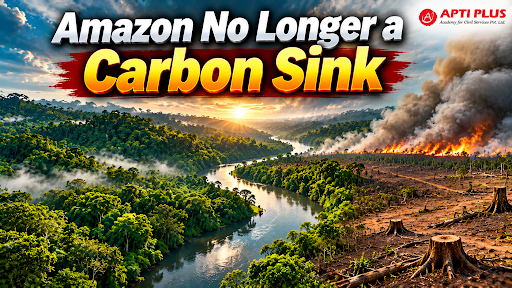
A study published in Nature, led by scientists from Brazil's National Institute for Space Research (INPE), found that the Amazon rainforest now releases more carbon than it absorbs.
What Did The Study Find?
How The Study Was Done
-
Aircraft Measurements: Scientists used research aircraft to measure CO₂ at different altitudes over the Amazon.
-
15-Year Record: Data were collected from 2010 to 2024.
-
Four Sites: Samples covered the northeast, southeast, southwest and northwest Amazon.
-
Top-Down Method: Measuring air above the forest captures the net carbon exchange of the whole region, including emissions from fires and uptake by trees.
Key Numbers (2010–2024 Annual Average)
|
Flux |
In Carbon Dioxide |
In Carbon |
|
Fire emissions |
About 1.47 billion tonnes CO₂ |
About 0.40 billion tonnes C |
|
Forest uptake |
About 0.30 billion tonnes CO₂ |
About 0.08 billion tonnes C |
|
Net emission |
About 1.17 billion tonnes CO₂ |
About 0.32 billion tonnes C |
Deforestation Alone: Clearing forest land releases about 430 million tonnes of CO₂ a year, comparable to the effect of major droughts.
Key Conclusion: Amazonia is a net carbon source rather than a sink, and it cannot offset regional human emissions.
Three Types Of Years
-
Wet Years, Low Human Activity: The Amazon was close to carbon neutral, or only a small source.
-
Mild Climate, High Deforestation And Fires: Net emissions jumped sharply, even without drought.
-
Drought Years: Emissions were high, but close to those of the second group.
Main Conclusion
-
Humans Are The Main Driver: Since high human activity alone produced emissions similar to drought years, land-use change, not climate, is the dominant control on the Amazon's carbon balance.
-
Drought Amplifies: Drought and heat make fires spread and trees die, adding to human-driven losses.
What Are Carbon Sinks And Sources?
Basic Concepts
-
Carbon Sink: A system that absorbs more carbon than it releases, such as forests, oceans and soils.
-
Carbon Source: A system that releases more carbon than it absorbs, such as burning fossil fuels or forest fires.
-
Net Biome Exchange: The balance between carbon taken up by plants and carbon released through respiration, fires and decay.
Global Importance Of Natural Sinks
-
Absorbing Human Emissions: Land ecosystems absorb roughly 30% and oceans about 25% of human CO₂ emissions each year.
-
Weakening Sinks: If major sinks turn into sources, global warming will accelerate.
Why Is The Amazon So Important?
-
World's Largest Tropical Rainforest: The Amazon covers about 5.5-7 million sq km across nine countries, with Brazil holding the largest share.
-
Countries: Brazil, Peru, Colombia, Venezuela, Ecuador, Bolivia, Guyana, Suriname and French Guiana (France).
-
Biodiversity: It is home to at least 10% of all known plant and animal species.
-
People: About 30 million people live in the Amazon, including many Indigenous communities.
Climate Roles
-
Huge Carbon Store: The Amazon stores about 123 billion tonnes of carbon in its vegetation and soils.
-
"Flying Rivers": Moisture released by Amazon trees forms airborne rivers that bring rain to large parts of South America, supporting agriculture.
-
Climate Regulator: It influences regional and global weather patterns.
What Is The Amazon "Tipping Point"?
-
Point Of No Return: Scientists warn that if deforestation and warming cross a threshold, large parts of the Amazon could turn into a drier savanna-like ecosystem.
-
Estimated Threshold: Scientists Thomas Lovejoy and Carlos Nobre estimated the tipping point at about 20–25% forest loss. Roughly 17% of the original Amazon forest has already been lost.
Why It Matters
-
Self-Reinforcing Loop: Less forest means less rain, which leads to more drought, fires and tree death, which in turn means even less forest.
-
Global Risk: Losing the Amazon would release huge amounts of carbon and worsen climate change worldwide.
What Are The Causes Of The Amazon's Decline?
Human Drivers
-
Deforestation: Forests are cleared mainly for cattle ranching, soybean farming and infrastructure.
-
Fires: Fires are often set deliberately to clear land and can spread into standing forest.
-
Illegal Mining And Logging: Illegal gold mining and logging degrade forests and harm Indigenous people.
-
Example: In 2023, Brazil declared a health emergency in the Yanomami Indigenous Territory, where illegal gold mining had polluted rivers and caused severe malnutrition and disease.
Climate Stress
-
Droughts And Heat: Climate change and El Niño events bring longer, more intense droughts.
-
Example: During the record 2023–24 drought, rivers in the Amazon fell to historic lows and fires surged, pushing the forest further towards being a carbon source.
What Does This Mean For The World And India?
Global Implications
-
Harder Climate Goals: If forests stop absorbing carbon, countries must cut emissions even faster to meet the Paris Agreement goals.
-
Overstated Offsets: Climate plans that assume forests will keep absorbing carbon may be too optimistic.
Lessons For India
-
Protect India's Forests: India's forests and trees store about 7,285 million tonnes of carbon, according to the India State of Forest Report 2023.
-
NDC Commitment: India aims to create an additional carbon sink of 2.5–3 billion tonnes of CO₂ equivalent through forest and tree cover by 2030.
-
Fire And Degradation Risks: Indian forests also face fires and degradation, which could weaken this sink.
Source: THEHINDU
|
PRACTICE QUESTION Q. Consider the following statements: Statement-I: According to the study, in years with a mild climate but high deforestation and wildfire activity, the Amazon remained close to carbon neutral. Statement-II: Fires and deforestation release carbon stored in trees and soils into the atmosphere. Which one of the following is correct in respect of the above statements? (a) Both Statement-I and Statement-II are correct and Statement-II explains Statement-I (b) Both Statement-I and Statement-II are correct, but Statement-II does not explain Statement-I (c) Statement-I is correct, but Statement-II is incorrect (d) Statement-I is incorrect, but Statement-II is correct Answer: (d) Explanation: Statement-I is incorrect: According to a landmark study on Amazon carbon emissions, in years with a relatively mild climate but high levels of deforestation and wildfire activity, the Amazon did not remain carbon neutral. Instead, net carbon emissions jumped dramatically due to increased human activity. Statement-II is correct: Deforestation and forest fires directly release carbon stored in the roots, leaves, trunks, and surrounding soil back into the atmosphere as carbon dioxide (CO2), contributing significantly to climate change. |