Why In News?
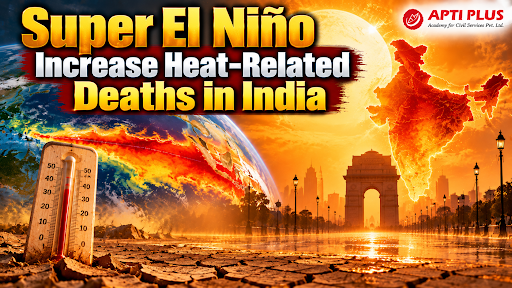
A report published by the University of Chicago warns that an intense Super El Niño event is projected to cause approximately 15,800 additional heat-related deaths in India.
Key Findings for India
Around 15,800 Additional Heat-Related Deaths
India is projected to face 15,800 excess heat fatalities over the six-month window from September 2026 through February 2027. Public health experts emphasize that thermal mortality risks will likely continue rising into the peak summer months of 2027.
44% More Extremely Hot Days
The global land surface warming driven by Super El Niño is forecast to expose populations in India to 44 per cent more extremely hot days than during a normal year.
Higher Heat Exposure During Winter Months
Nearly half of India's projected heat deaths—approximately 7,400 lives—are expected to occur between December 2026 and February 2027, which is the country's cooler winter period.
-
Regional Disparity: In Northern India, winter temperatures remain cool enough that abnormal warming rarely causes thermal mortality. However, in Southern India, baseline winter temperatures remain naturally warm; additional Super El Niño warming layered on top pushes heat exposure over lethal physiological thresholds.
India Among the Highly Affected Countries
India ranks as the 4th hardest-hit nation globally for projected heat mortality during this window, behind Nigeria, Indonesia, and Sudan. Globally, the current El Niño phase is projected to claim 451,000 lives across the Global South.
Vulnerable Population Groups
-
Outdoor & Manual Laborers: Construction workers, agricultural laborers, street vendors, sanitation staff, and gig workers facing continuous direct solar exposure.
-
Clinically Vulnerable Groups: Elderly citizens, young children, pregnant women, and individuals with underlying cardiovascular or non-communicable diseases.
-
Socio-Economically Disadvantaged: Residents of informal urban settlements and low-income rural communities lacking access to indoor cooling or reliable drinking water.
What is Super El Niño?
El Niño and Pacific Ocean Warming
-
El Niño is a periodic ocean-atmosphere climate pattern characterized by the abnormal warming of Sea Surface Temperatures (SSTs) across the central and eastern equatorial Pacific Ocean.
-
Under El Niño conditions, standard trade winds weaken or reverse, causing warm equatorial waters to shift eastward toward South America and disrupting global atmospheric pressure systems.

Link with Indian Weather
-
El Niño weakens the Indian Southwest Monsoon by shifting the Walker Circulation eastward, which replaces rising moist air over the western Pacific and Indian Ocean with sinking, dry high-pressure air over the Indian subcontinent.

Difference Between Normal El Niño and Super El Niño
A normal El Niño occurs when equatorial Pacific ocean temperatures rise 0.5°C to 1.4°C above average, whereas a super El Niño (officially called a very strong event) happens when those temperatures surge by 2.0°C or more.
|
Feature |
Normal El Niño (Weak to Moderate/Strong) |
Super El Niño (Very Strong) |
|
Temperature Anomaly |
0.5°C to 2.0°C above normal |
2.0°C or more above normal |
|
Trade Winds |
Weakened east-to-west winds |
Significantly disrupted or reversed winds |
|
Global Weather Impact |
Moderate shifts in rainfall and regional temperatures |
Extreme disruptions (severe droughts, record-breaking global heat, and massive floods) |
|
Official Terminology |
Classified as Weak, Moderate, or Strong by the National Oceanic and Atmospheric Administration |
Formally designated as "Very Strong"; "Super" is an informal term |
Source: INDIANEXPRESS
|
PRACTICE QUESTION Q. Discuss how El Niño-related warming can increase heat-related mortality in India. Suggest measures to strengthen India’s heat resilience. 150 words |