Why In News?
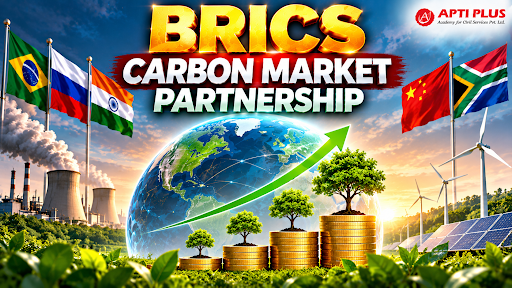
Experts argue that the BRICS Carbon Markets Partnership needs a common rulebook, not a common trading platform, to become effective.
What Is The BRICS Carbon Markets Partnership?
It is a collaborative framework established by BRICS member nations to coordinate on carbon pricing, emission reduction systems, and climate finance through a formal Memorandum of Understanding (MoU).
Reaffirmed during the 18th BRICS Summit in New Delhi via the New Delhi Declaration, the partnership currently focuses on capacity-building and experience-sharing rather than an immediate joint trading platform or binding emission targets.
Core Objectives
-
Pushback Against Unilateral Measures: Serves as a unified response from the Global South against protectionist climate-trade policies such as the European Union's Carbon Border Adjustment Mechanism (CBAM).
-
Common MRV Standards: Aims to establish a shared framework for Measurement, Reporting, and Verification (MRV) to make emission reductions transparent and comparable across different nations.
-
Mutual Recognition of Verifiers: Seeks to align verification and accreditation systems to create a consistent certification process.
-
Registry Harmonization: Plans to harmonize carbon registry data fields to prevent duplicate credit issuance and fraudulent claims.
Current Challenges
-
Fragmented Domestic Systems: BRICS members operate vastly different internal frameworks—for example, Brazil runs a cap-and-trade model (SBCE), whereas China and India use output-based emissions-intensity benchmarks (like India's Carbon Credit Trading Scheme or CCTS).
-
Varying Legal Status: Carbon units are regulated as securities in some member states (such as Brazil) while functioning as power-exchange certificates in others (such as India).
-
Lack of Direct Linkage: Compliance and voluntary carbon markets across member countries currently operate independently without cross-border credit fungibility.
What Are Carbon Markets?
-
Carbon Credit: One carbon credit usually equals one tonne of CO₂-equivalent reduced or removed.
-
Compliance Markets: Governments set legal emission limits or targets, and companies trade units to meet them.
-
Voluntary Markets: Companies and individuals buy credits voluntarily to meet their own climate goals.
Two Main Designs
|
Design |
How It Works |
Example |
|
Absolute cap-and-trade |
A fixed cap on total emissions; allowances are traded |
EU ETS, Brazil's SBCE |
|
Intensity-based (baseline-and-credit) |
Targets for emissions per unit of output |
China's ETS, India's CCTS |
Paris Agreement, Article 6
-
Article 6.2: It allows countries to transfer emission reductions bilaterally as Internationally Transferred Mitigation Outcomes (ITMOs), with corresponding adjustments to avoid double counting.
-
Article 6.4: It creates a UN-supervised crediting mechanism, the Paris Agreement Crediting Mechanism, which succeeds the Clean Development Mechanism of the Kyoto Protocol.
-
Article 6.8: It covers non-market cooperation.
Why Do BRICS Carbon Markets Matter?
Scale
-
Major Credit Suppliers: Brazil, China, India and Indonesia host over a third of carbon credit projects registered worldwide.
-
Voluntary Markets: Eight BRICS members reportedly run voluntary carbon markets.
Growing Compliance Systems
-
China: Its national Emissions Trading System, launched in 2021 for power, has been expanded to steel, cement and aluminium.
-
India: The Carbon Credit Trading Scheme (CCTS) has notified emission-intensity targets for 490 entities across nine sectors and introduced an offset mechanism.
-
Brazil: It set up the Brazilian Greenhouse Gas Emissions Trading System (SBCE) in 2024, based on an absolute emissions cap.
No Links Between Them
-
Disconnected Markets: None of these national markets is linked to another, due to differences in rules, accounting and eligibility.
What Is India's Carbon Credit Trading Scheme (CCTS)?
Legal And Institutional Framework
-
Legal Basis: The Energy Conservation (Amendment) Act, 2022 enabled the CCTS, which was notified in 2023.
-
Administrator: The Bureau of Energy Efficiency (BEE) administers the scheme.
-
Trading: Carbon credit certificates trade on power exchanges under CERC regulations.
-
Predecessor: It builds on the Perform, Achieve and Trade (PAT) scheme for energy efficiency, launched in 2012.
Global Recognition
-
UK Recognition: In August 2026, the UK recognised India's Central Electricity Regulatory Commission (CERC), showing the value of accredited verification for exporters.
What Are The Key Differences Among BRICS Markets?
|
Feature |
China |
India |
Brazil |
|
Target type |
Intensity-based |
Intensity-based |
Absolute cap |
|
Offset eligibility |
Domestic certified credits |
Projects after 1 January 2025 |
Accredited methodologies |
|
Regulator of trading |
National authorities |
CERC (power exchanges) |
Securities regulators |
Different Legal Instruments: Because of these differences, the same emission reduction becomes a different legal instrument in each country.
Why Is A Common Framework Needed?
Pressure From Carbon Border Taxes
-
EU CBAM: The European Union's Carbon Border Adjustment Mechanism entered its definitive phase in January 2026. It charges for carbon in imports of steel, aluminium, cement, fertilisers, electricity and hydrogen.
-
UK CBAM: The UK will introduce its own CBAM in January 2027.
-
Need For Verified Data: Carbon prices paid at home are recognised only with verified evidence. Exporters without reliable data risk punitive default values.
Collective Bargaining
-
Unified Voice: BRICS has opposed unilateral CBAMs. A common framework would strengthen its bargaining power and cut compliance costs.
Existing Foundation
-
2025 Principles: The 2025 BRICS Principles for Fair, Inclusive and Transparent Carbon Accounting provide a base for comparable benchmarks and interoperable systems.
What Does The Partnership Need?
Priority 1: A Common Rulebook
-
Common Monitoring Standards: Adopt consistent Measurement, Reporting and Verification (MRV) procedures, especially for sectors exposed to CBAM, using ISO 14064 standards while preserving national autonomy.
-
Mutual Recognition Of Verifiers: Accept verifiers accredited by members' national accreditation bodies.
-
Harmonised Registries: Use compatible data fields to share information and prevent double counting.
Priority 2: A Limited Pilot Exchange
-
Small Start: Two or three willing members could mutually recognise selected methodologies and allow capped transfers of authorised credits under Article 6.2.
-
Learning, Not Volume: The goal is to identify problems such as corresponding adjustments, legal classification of units and double counting, not to maximise trading.
Priority 3: Use Existing Institutions
-
New Development Bank (NDB): Set up by BRICS in 2014 and based in Shanghai, could host a shared registry data facility or buy pilot carbon units.
-
Adaptation Funding: Part of transfer proceeds could fund climate adaptation, encouraging members with limited mitigation potential to join.
What Are The Key Challenges?
Diverging National Interests
-
China's Dominance: China's huge industrial scale could make it the dominant price-setter.
-
Export Competition: Members compete in steel and aluminium exports, which discourages integration.
-
Sanctions: Sanctions on some members, such as Russia and Iran, may complicate financial settlements.
Technical Complexity
-
Linking Is Slow: Linking carbon markets takes years of negotiation, even among close partners.
-
Example: The EU and Switzerland began talks to link their emissions trading systems in 2010, but the link took effect only in January 2020, a decade later.
Market Integrity
-
Credit Quality: Concerns over low-quality or overstated credits in voluntary markets can hurt credibility.
-
Double Counting: Without corresponding adjustments, the same reduction could be claimed twice.
Burden On Small Firms
-
MSME Compliance Costs: Small exporters may struggle with the cost of measuring and verifying emissions.
What Is The Way Forward?
Phased Approach
-
Rules First, Trading Later: Build common MRV standards and registries before attempting any market linkage.
-
Learn From Article 6.2 Pioneers: Use bilateral deals as models for pilot transfers.
-
Example: In January 2024, Ghana transferred the first Internationally Transferred Mitigation Outcome (ITMOs) under Article 6.2 to Switzerland, showing how bilateral carbon transfers can work in practice.
Strengthen India's Position
-
Credible CCTS: Strengthen India's MRV systems and accredited verifiers to win wider recognition, as with the UK.
-
Support MSMEs: Provide digital carbon-accounting tools, verification subsidies and technical help.
Global Cooperation
-
Bridge With Other Initiatives: Engage with efforts such as the Open Coalition on Compliance Carbon Markets, launched by Brazil and joined by the EU and China in 2026, to align standards globally.
-
Climate Justice: Ensure carbon market rules respect common but differentiated responsibilities and support developing countries' growth.
Conclusion
The BRICS Carbon Markets Partnership can give emerging economies a stronger voice in global climate governance, but only if it moves beyond broad commitments. A common rulebook on MRV, mutual recognition of verifiers, compatible registries and small pilot exchanges, backed by the New Development Bank, offer a realistic path that respects national autonomy while countering unilateral carbon border taxes.
Source: THEHINDU
|
PRACTICE QUESTION Q. Consider the following statements: 1. Article 6.2 of the Paris Agreement allows countries to transfer mitigation outcomes bilaterally, subject to corresponding adjustments. 2. India's Carbon Credit Trading Scheme is based on an absolute cap on total emissions. 3. The European Union's Carbon Border Adjustment Mechanism entered its definitive phase in January 2026. How many of the statements given above are correct? (a) Only one (b) Only two (c) All three (d) None Answer: (b) Explanation: Statement 1 is correct: Under Article 6.2 of the Paris Agreement, countries are allowed to engage in voluntary bilateral or multilateral cooperation to trade greenhouse gas emission reductions or removals. These traded units are officially called Internally Transferred Mitigation Outcomes (ITMOs). To prevent double counting, the framework mandates that both countries apply corresponding adjustments (the seller country adds the emission reduction back to its national inventory, and the buyer country deducts it). Statement 2 is incorrect: India's Carbon Credit Trading Scheme (CCTS) is architecturally structured as an intensity-based, baseline-and-credit market rather than an absolute cap-and-trade system. Regulated entities are assigned specific greenhouse gas emission targets measured per unit of output (emissions intensity), meaning that total production can still grow as long as the production process becomes cleaner. Statement 3 is correct: The European Union’s Carbon Border Adjustment Mechanism (CBAM) concluded its transitional (reporting-only) phase at the end of 2025 and officially entered its definitive phase on January 1, 2026. In this permanent phase, importers of covered carbon-intensive goods (such as steel, aluminum, and cement) into the EU are financially obligated to purchase and surrender CBAM certificates matching the embedded emissions of those imports. |