Why In News?
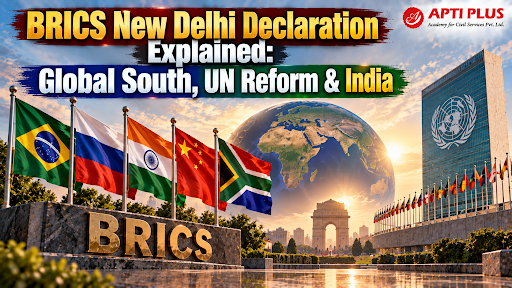
The 18th BRICS Summit in New Delhi unanimously adopted the New Delhi Declaration, demanding comprehensive reforms in global multilateral governance.
Highlights of the 18th BRICS Summit
Hosted in New Delhi under India’s rotating leadership, focusing on the theme: "Building for Resilience, Innovation, Cooperation and Sustainability".
The summit adopted the New Delhi Declaration.
-
Unanimous Commitment to Reformed Multilateralism: Called for restructuring global governance to be democratic, representative, and reflective of modern realities.
-
Firm, Uncompromising Stance Against Terrorism: Pledged to counter cross-border terrorism, eliminate safe havens, and block terror financing without double standards.
-
Advancing Local Currency Settlement Mechanisms: Promoted intra-BRICS trade in domestic currencies and linked financial networks to buffer external shocks.
-
Ethical Governance Architectures for Artificial Intelligence: Urged a transparent, non-discriminatory global AI framework to prevent corporate monopolies.
-
Reaffirming Climate Finance Obligations: Urged developed nations to fulfill climate finance pledges under the NCQG (New Collective Quantified Goal) without unilateral carbon barriers.

What is BRICS?
Coalition of Leading Emerging Economies: Originally conceptualized in 2001 by Jim O'Neill as an investment acronym (BRIC) and formalized in 2006, BRICS comprises major emerging markets and developing countries (EMDCs).
Foundational Three Pillars of Cooperation: Functions across three institutional pillars: (1) political and security cooperation, (2) economic and financial cooperation, and (3) cultural and people-to-people exchanges.
Significant Global Weight and Representation: Represents over 45% of the world’s population, nearly 30% of global landmass, and more than 35% of global GDP in Purchasing Power Parity (PPP) terms.
Alternative Financial Architecture: Established the New Development Bank (NDB) and the Contingent Reserve Arrangement (CRA) to mobilize resources for infrastructure and sustainable development in emerging economies.
Evolution into an Expanded "BRICS Plus" Platform: Transitioned from a five-nation club into a broader multilateral formation, incorporating regional leaders from the Middle East, Africa, and Latin America as highlighted in official communications.

Strategic Significance for India
Endorsement of Permanent UNSC Aspirations: The declaration reiterates support for the legitimate aspirations of India and Brazil to play a greater role in the United Nations, including the Security Council.
Consolidation of Global South Leadership: India’s 2026 Chairship reinforces its role as a bridge between the developing world and industrialized nations, building on its G20 achievements.
Strategic Autonomy and Multi-Alignment: Demonstrates India’s ability to engage with diverse global coalitions (BRICS, SCO, Quad, G20) without compromising its sovereign decision-making.
Institutional Consensus on Counter-Terrorism: Secures collective commitments condemning terrorism in all forms, preventing regional adversaries from shielding transnational terror proxies.
Expanding Footprint for Digital Public Infrastructure (DPI): Provides a platform to export India's digital public infrastructure models (such as UPI, ONDC, and Aadhaar) across partner countries as viable developmental solutions.
Source: THEHINDU
|
PRACTICE QUESTION Q. Discuss the strategic and economic significance of India's 2026 BRICS Chairship in amplifying the voice and institutional aspirations of the Global South. (15 Marks, 250 Words) |