Why In News?
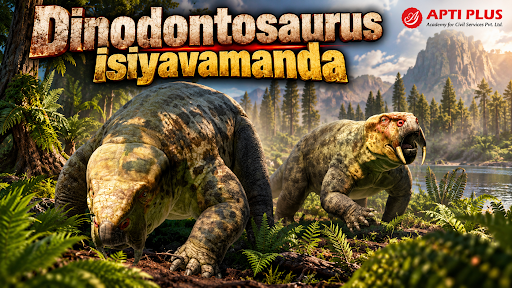
An international research team led by the University of Bristol published a study in the Journal of Vertebrate Palaeontology describing a newly identified 240-million-year-old fossil species, Dinodontosaurus isiyavamanda.
What is Dinodontosaurus isiyavamanda?
It is a newly described species of herbivorous, tusked, and beak-bearing vertebrate belonging to the dicynodont synapsids.
Discovered in the Manda Beds of Tanzania, this plant-eating synapsid marks the first time the genus Dinodontosaurus has been found outside of South America.
It lived approximately 240 million years ago during the Middle Triassic period, long before dinosaurs dominated land ecosystems.
The species name isiyavamanda honors the indigenous Wamanda people who inhabit the region where the original skeleton was unearthed.
What are its Major Features?
-
Skull lengths reaching up to 40 centimeters.
-
The lower jaw (mandible) operated with a propalinal (front-to-back) grinding motion. The species was anatomically adapted as a medium-to-large herbivore capable of processing tough, low-lying Triassic vegetation.
Significance of the Discovery
Better Understanding of Triassic Ecosystems: The find sheds light on how large herbivorous dicynodont synapsids coexisted alongside early archosaur lineages, clarifying community structures prior to dinosaur dominance.
Improved Fossil Classification: It resolves the identity of an undescribed museum specimen stored for over 60 years, expanding the known geographic distribution of the genus Dinodontosaurus.
Gondwana Connections: It establishes the first confirmed biostratigraphic link between East Africa and South America for this genus, confirming faunal movement across Gondwana during the Triassic.
Source: PHYS
|
PRACTICE QUESTION Q. With reference to recent paleontological discoveries in the Manda Beds of Tanzania, consider the following statements:
Which of the statements given above is/are correct? (a) 1 and 2 only (b) 2 and 3 only (c) 1 and 3 only (d) 1, 2 and 3 Answer: (a) Explanation: Statement 1 is correct: Dinodontosaurus isiyavamanda belongs to dicynodont therapsids (synapsids), which are non-mammalian synapsids on the distant mammalian stem-lineage. Dicynodonts are herbivorous animals characterized by turtle-like horny beaks and paired tusk-like canine teeth. Statement 2 is correct: The species, described from fossils recovered from the Lifua Member of the Manda Beds in Tanzania, marks the first confirmed record of the genus Dinodontosaurus outside South America. Statement 3 is incorrect: Correlation between the Tanzanian Dinodontosaurus fauna and equivalent South American strata provides evidence for a younger age—not an earlier one—for the Manda Beds. |