Why In News?
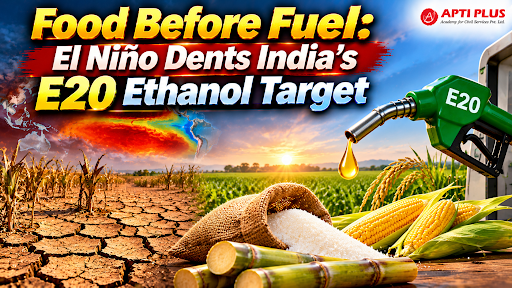
India's E20 ethanol blending target faces major delays as the government prioritizes domestic food security over fuel production following severe crop yield disruptions caused by El Niño weather patterns.
Background
Weak Monsoon And Crop Stress
-
Monsoon Deficit: A severe El Niño cut India's monsoon rainfall by nearly 13% below normal, the lowest in more than a decade.
-
Feedstock Prices Soar: Corn and sugar prices rose about 40% to record highs, while rice, another ethanol feedstock, rose about 20%.
-
Food Inflation: Retail food inflation rose to 7.74% in September 2026, from 5.97% a month earlier.
-
Corn Output To Fall: Corn production may fall by up to 15% from this year's record of 55 million tonnes.
Government's Response
-
No Sugar-Based Ethanol: In October 2026, the government directed oil marketing companies not to procure ethanol made from sugar-based feedstocks for the new supply season.
-
Lower Price For Corn Ethanol: It cut the purchase price of corn-based ethanol to ₹68.86 per litre from ₹71.86, discouraging the use of corn for fuel.
Expected Impact On Blending
-
Fall Below E20: Experts expect blending to drop to about 15%, while producers estimate 15–17%, depending largely on corn prices.
What Is India's Ethanol Blending Programme?
Evolution
-
Ethanol Blended Petrol (EBP) Programme: It was launched in 2003 to blend ethanol with petrol, reduce oil imports and support farmers.
-
National Policy on Biofuels, 2018: It originally set an E20 target for 2030. A 2022 amendment brought this target forward to 2025–26.
-
Rapid Scale-Up: India quadrupled its blending rate over six years and achieved E20 about five years ahead of the original 2030 target, helped by good monsoons.
-
Ethanol Supply Year (ESY): Ethanol procurement runs on a supply year from November to October.
Benefits Achieved
-
Import Savings: E20 has saved nearly ₹2 trillion in oil import costs since 2014, with annual savings estimated at ₹43,000 crore at 20% blending.
-
Farmer Income: Ethanol demand gives sugarcane and maize farmers an extra market.
-
Lower Emissions: Ethanol burns cleaner than petrol, reducing carbon monoxide and some other emissions.
Ethanol Feedstocks
|
Feedstock Type |
Examples |
|
Sugar-based |
Sugarcane juice, B-heavy molasses, C-heavy molasses |
|
Grain-based |
Maize (corn), FCI surplus rice, damaged food grains |
|
Second-generation (2G) |
Crop residues such as rice straw and bagasse |
What Is El Niño And How Does It Affect India?
-
Meaning: El Niño is the abnormal warming of sea surface temperatures in the central and eastern equatorial Pacific Ocean.
-
Effect On Monsoon: It weakens the moisture-bearing winds that bring the southwest monsoon, often causing below-normal rainfall and droughts in India.
-
Opposite Phase: La Niña, the cooling of the same region, usually brings above-normal rainfall to India.
-
Impact Chain: Weak Monsoon → Lower Crop Output → Higher Food Prices → Less Feedstock For Ethanol → Lower Blending.

What Is The "Food Versus Fuel" Debate?
-
Competing Uses: The same crops, sugarcane, maize and rice, feed people and animals and also produce ethanol.
-
Food Must Come First: In a drought year, using food crops for fuel can push up food prices and threaten food security.
-
Example: In December 2023, amid a weak monsoon, the government temporarily barred the use of sugarcane juice for ethanol to protect sugar supplies. This shows a recurring pattern of food security taking priority over blending targets.
-
Animal Feed Concern: Distilleries using damaged grains have raised worries about the availability of animal feed.
What Are The Key Challenges?
Climate Vulnerability
-
Monsoon Dependence: Because India's ethanol relies on rain-fed crops, blending targets are vulnerable to weather shocks like El Niño.
Costly Alternatives
-
Rice Subsidy Burden: India's large rice stocks could replace sugar and corn, but the government sells rice to ethanol makers at roughly half the cost of buying and storing it.
Distillery Distress
-
Overcapacity And Debt: Producers borrowed heavily to expand capacity to about 20 billion litres a year, so lower blending leaves them with idle capacity and squeezed margins.
Water Stress
-
Thirsty Crops: Sugarcane is highly water-intensive, and drought-hit farmers lack water to sow corn even when prices are high.
Consumer Concerns
-
Mileage And Engine Wear: Some motorists and automakers have raised concerns about fuel efficiency and engine wear with E20. The government has said it has no plans to raise blending above 20%.
Energy Security Risk
-
More Crude Imports: Lower blending means India must import more crude oil at a time of volatile prices and geopolitical uncertainty.
Way Forward
Diversify Feedstocks
-
Second-Generation Ethanol: Scale up 2G ethanol from crop residues, which avoids competition with food and reduces stubble burning.
-
Example: Indian Oil's 2G ethanol plant at Panipat, Haryana, dedicated in 2022, uses rice straw as feedstock, turning farm waste into fuel.
-
Support Advanced Biofuels: Extend financial support under the PM JI-VAN Yojana for 2G bio-ethanol projects.
Make Agriculture Climate-Resilient
-
Raise Maize Productivity: Improve seeds, irrigation and yields so maize can serve both food and fuel needs.
-
Water-Efficient Crops: Promote micro-irrigation for sugarcane and shift ethanol feedstocks towards less water-intensive crops.
Flexible Blending Policy
-
Adjust To Monsoons: Keep a flexible framework that allows blending to vary with crop output, without abandoning long-term goals.
-
Example: Brazil runs one of the world's most successful ethanol programmes, using sugarcane and flex-fuel vehicles, and raised its mandatory blend to 30% in 2025. Its success rests on high cane productivity and flexible switching between sugar and ethanol.
Broader Clean Energy Mix
-
Beyond Ethanol: Combine biofuels with compressed biogas (SATAT scheme), electric vehicles and green hydrogen to reduce oil dependence.
Conclusion
El Niño has exposed the vulnerability of India's crop-based ethanol programme to climate shocks. Putting food first is the right call, but long-term energy security needs a shift to second-generation biofuels, climate-resilient farming and a diverse clean energy mix.
Source: BUSINESS-STANDARD
|
PRACTICE QUESTION Q. How can India make its biofuel programme resilient to climate shocks while ensuring food and energy security? (15 Marks, 250 Words) |