Why In News?
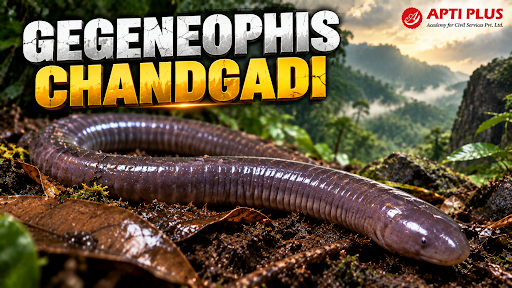
Scientists have discovered Gegeneophis chandgadi — a new species of limbless amphibian (caecilian) — from Kolhapur district, Maharashtra, in the northern Western Ghats.
About Gegeneophis chandgadi
Legless Amphibian: Newly identified burrowing amphibian belonging to the ancient, limbless order Gymnophiona.
Caecilian Genus: Classified under the blind caecilian genus Gegeneophis, family Grandisoniidae.
Soil‑Dwelling Species: Lives subterraneanly (fossorial) beneath damp humus, decaying logs, and garden soil.
Endemic Lineage: Represents an ancient, evolutionarily distinct species restricted to micro‑habitats of peninsular India.
Cultural Naming: The species name chandgadi honours the Chandgadi dialect of Marathi, celebrating local cultural identity.
Physical Features: Slender, flesh‑coloured body with primary annuli along its length and secondary rings on the posterior half.
What are Caecilians?
Limbless Amphibians: One of the three living amphibian orders (Gymnophiona), lacking limbs and pelvic girdles.
Snake‑Like Appearance: Elongated, cylindrical, ringed bodies with tiny, non‑functional eyes covered by skin.
Underground Lifestyle: Specialized fossorial burrowers using ossified skulls and retractable sensory tentacles for navigation.
Soil Ecosystem Role: Act as subterranean predators, feeding on termites, worms, and insect grubs while aerating compact soil.
Tropical Distribution: Found in moist tropical regions of South Asia, Africa, and Central/South America.
Source: DOWNTOEARTH
|
PRACTICE QUESTION Q. With reference to "Caecilians" (Gymnophiona), consider the following statements: 1. They are limbless amphibians characterized by a subterranean lifestyle and a snake-like appearance. 2. They possess chemosensory tentacles on their snouts that assist in subterranean navigation and foraging. 3. They are strictly endemic to the cold alpine tundras of the Holarctic region. Which of the statements given above are correct? A) 1 and 2 only B) 2 and 3 only C) 1 and 3 only D) 1, 2, and 3 Answer: A Explanation: Statement 1 is correct: Caecilians (belonging to the order Gymnophiona) are unique, limbless amphibians. Because of their elongated, segmented bodies, they have a snake-like or worm-like appearance and are primarily adapted to a subterranean (burrowing) lifestyle. Statement 2 is correct: Due to their fossorial (underground) lifestyle, their eyes are highly reduced or covered in skin and bone. To compensate, they possess a unique pair of chemosensory tentacles on their snouts between the eyes and nostrils. These tentacles allow them to detect chemical signals and vibrations to navigate and forage for food in dark, underground tunnels. Statement 3 is incorrect: Caecilians are definitely not endemic to the cold alpine tundras of the Holarctic region. Instead, they are completely restricted to warm, humid tropical and subtropical regions across South and Central America, Africa, and southern Asia. |