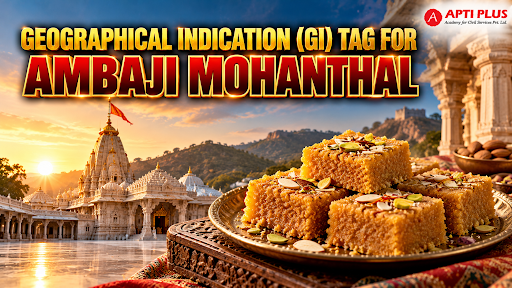
Why In News?
The Geographical Indications Registry under the Ministry of Commerce and Industry officially granted the Geographical Indication (GI) tag to Ambaji Mohanthal.
What Is Ambaji Mohanthal?
Ambaji Mohanthal is a traditional Gujarati confection made primarily from gram flour (besan), pure ghee (clarified butter), and sugar.
-
The term "Mohanthal" is a compound of "Mohan" (an epithet for Lord Krishna meaning captivating or attractive) and "Thal" (a serving platter or consecrated food offering/bhog).
-
Preparation Method: Prepared by meticulously roasting gram flour in ghee until golden brown, blending it with a precisely boiled sugar syrup (chashni) cooked to a 2–3 thread consistency, and setting it into blocks.
-
Texture & Sensory Profile: Features a distinct mustard-yellow color, a dense, coarse, and granulated texture, and a rich melt-in-the-mouth consistency enriched with cardamom, saffron, and nuts.
-
Religious Significance: Offered as Rajbhog and distributed as consecrated prasad to millions of devotees at the Ambaji Temple in Banaskantha district, Gujarat.
-
GI Tag Registration: Registered under Class 30 (confectionery and foodstuffs) by the Geographical Indications Registry.
-
National Recognition: Joins GI-tagged temple offerings, alongside Palani Panchamirtham (Tamil Nadu) and Tirupati Laddu (Andhra Pradesh).
About Ambaji Shrine
Location: Situated in Ambaji town, Banaskantha district, Gujarat, at an elevation of 480 metres on the Arasur ridge at the southwestern terminus of the ancient Aravalli Range, near the origin of the seasonal Saraswati River.
Shakti Pitha Status: Revered as one of the 51 primary Shakti Pithas in Shaktism. According to sacred tradition, it is the Hṛdaya Pīṭha—the spot where Goddess Sati's heart fell. The nearby Gabbar Hill (Gabbargadh) is venerated as the mula pitha (primordial seat).
Aniconic Worship: The inner sanctum (garbhagriha) contains no physical idol or anthropomorphic statue.
-
Worship centers on the Viśo Yantra (or Shree Visa Yantra), a sacred geometric copper plate inscribed with Vedic figures and the central syllable 'Shree', housed inside a gold-plated wall niche (gokh).
-
Direct viewing or photographing of the Yantra is strictly forbidden.
Architectural Heritage: Built in the Māru-Gurjara style of Nagara architecture using pristine white Arasur marble. It features a 103-feet-high gold-plated Kalash spire (shikhara) adorned with a red flag, and a vast central courtyard known as Chachar Chowk.
Administrative & Legal Framework: Managed by the Shri Arasuri Ambaji Mata Devasthan Trust (SAAMDT), chaired ex-officio by the District Collector of Banaskantha under the Charity Commissioner of Gujarat.
-
Town planning and infrastructure around the shrine are regulated under the Ambaji Area Development and Pilgrimage Tourism Governance Act, 2020.
Pilgrimage & Fairs: Attracts millions of pilgrims annually, peaking during the Bhadarvi Poonam Fair (featuring massive padayatras) and Sharadiya Navratri (marked by Garba dances and traditional Bhavai folk theater).
What Is A GI Tag?
A Geographical Indication (GI) is an intellectual property right (IPR) awarded to products originating from a specific geographical territory, certifying that the product possesses distinct qualities, reputation, or characteristics attributable to its origin, environment, or human craftsmanship.
Statutory Framework: Governed in India under the Geographical Indications of Goods (Registration and Protection) Act, 1999, which came into force in 2003. Complies with the World Trade Organization (WTO) TRIPS Agreement.
Issuing Authority: Administered by the Geographical Indications Registry in Chennai, Tamil Nadu, functioning under the Department for Promotion of Industry and Internal Trade (DPIIT), Ministry of Commerce and Industry.
Product Classes: Granted across 5 primary categories: Agricultural, Handicrafts, Foodstuff, Manufactured Goods, and Natural Goods.
Tenure & Legal Protection: Valid for 10 years upon registration, renewable indefinitely for successive 10-year terms. Registration prevents unauthorized commercial misuse, brand piracy, and off-market counterfeiting.
India Overall: Holds over 820 registered GI tags as of 2026 (India's first registered GI tag was Darjeeling Tea in 2004).
Source: NDTV
|
PRACTICE QUESTION Q. Which among the following was the FIRST religious temple offering (prasad) in India to receive a Geographical Indication (GI) tag? (a) Palani Panchamirtham (b) Tirupati Laddu (c) Ambaji Mohanthal (d) Puri Khaja Answer: (b) Explanation: The Tirupati Laddu of the Sri Venkateswara Temple in Andhra Pradesh was the first temple offering in India to receive a GI tag, registered in 2009. Palani Panchamirtham received it in 2019, followed by Ambaji Mohanthal in 2026. |