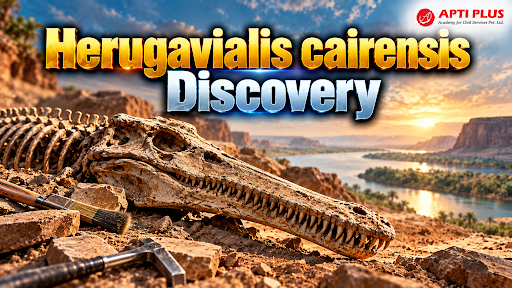
Why In News?
Scientists have identified Herugavialis cairensis, an extinct crocodilian species, in 45-million-year-old Middle Eocene limestone from Egypt’s Mokattam Formation.
What Is Herugavialis cairensis?
Herugavialis cairensis was a prehistoric, long-snouted crocodilian belonging to the gharial superfamily (Gavialoidea) that thrived during the Middle Eocene Epoch.
Origin of Name: Herugavialis refers to Heru (Horus), an ancient Egyptian deity, while cairensis refers to Cairo, Egypt.
Key Features of Herugavialis
-
Long, Narrow Snout: Its elongated jaws and sharp, pointed teeth helped it catch fish, including bony and cartilaginous species.
-
Raised Eye Sockets: Its elevated eye sockets allowed it to observe its surroundings above the water while keeping much of its body submerged.
-
Damaged Snout Tip: The fossil skull lacks its frontmost snout tip. This feature has drawn comparisons with the damaged nose of the nearby Great Sphinx, although the similarity does not establish a geological or historical connection between the two.
-
Distinct Skull Structure: High-resolution micro-CT scanning and 3D modelling revealed internal cranial features that distinguish it from Tomistoma, commonly known as the false gharial.
-
Marine Adaptation: Unlike the modern gharial, which mainly inhabits freshwater rivers, this extinct relative lived in coastal marine environments. Its precise salt-excretion abilities require further evidence.
Scientific Significance
-
Evolution of Gharial Relatives: The fossil expands scientific understanding of the historical distribution and habitat diversity of gharial-related crocodilians beyond their present-day Asian freshwater range.
-
Eocene Marine Ecosystems: It provides evidence of crocodilian diversity in warm ancient seas that also supported early whales and prehistoric sea cows.
-
Role of Modern Technology: Micro-CT scanning and 3D reconstruction can reveal hidden skeletal structures in fossils, helping scientists reassess older classifications without damaging valuable specimens.
Source: DOWNTOEARTH
|
PRACTICE QUESTION Q. The term "Herugavialis cairensis", which was recently seen in the news, refers to: (a) An extinct species of early marine whale discovered in the Sahara Desert (b) A newly identified species of freshwater gharial endemic to northern India (c) An extinct 45-million-year-old crocodilian belonging to the gharial superfamily (d) A prehistoric marine turtle species from the ancient Tethys Sea Answer: (c) Explanation: An international team of paleontologists identified Herugavialis cairensis, a new genus of extinct, semi-aquatic crocodilian that lived during the Middle Eocene epoch (45 million years ago). Its fossils were found in Egypt's Mokattam Formation, which famously supplied the limestone blocks used to build the Great Sphinx of Giza. Unlike modern gharials that live strictly in freshwater rivers, this ancient relative thrived in the warm, shallow, hyper-saline marine environments of the ancient Neo-Tethys Sea. |