Why In News?
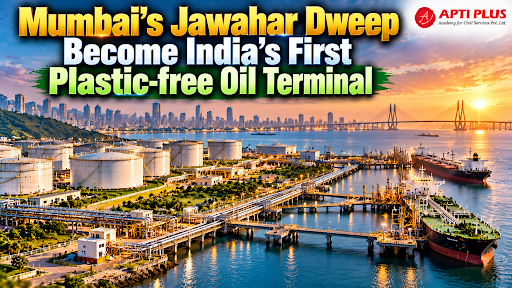
The Mumbai Port Authority (MbPA) under the Ministry of Ports, Shipping and Waterways (MoPSW) officially declared the Jawahar Dweep Marine Oil Terminal as India's 1st Plastic-Free Oil Terminal.
About Jawahar Dweep Marine Oil Terminal
Jawahar Dweep Marine Oil Terminal (historically known as Butcher Island) is a restricted offshore island terminal in Mumbai Harbour, Arabian Sea, operated by the Mumbai Port Authority (MbPA) under the Ministry of Ports, Shipping and Waterways (MoPSW).
-
Location: Situated approximately 8.25 km northeast of the Gateway of India and northwest of Elephanta Island.
-
It is a continental island remnant composed of Deccan Traps basaltic bedrock formed during late Cretaceous–early Paleogene volcanic activity.
-
National Hydrocarbon Lifeline: Serves as Mumbai Port's primary offshore intake and handling hub for bulk crude oil, Liquefied Petroleum Gas (LPG), and refined petroleum products. Petroleum cargo accounts for nearly three-fifths (60%) of Mumbai Port’s overall freight traffic.
-
Subsea Evacuation to Refineries: Bulk crude offloaded at the island's marine berths is piped via a network of subsea submarine pipelines to storage manifolds at Wadala on mainland Mumbai, directly feeding public sector refineries operated by Bharat Petroleum Corporation Limited (BPCL) and Hindustan Petroleum Corporation Limited (HPCL).
First Plastic-Free Oil Terminal
On October 2, 2026, during the national Swachhata Abhiyan 2026, Jawahar Dweep was officially declared India's 1st Plastic-Free Oil Terminal by Union Minister Sarbananda Sonowal.
-
Single-Use Plastic Elimination: The terminal implemented a complete elimination of single-use plastics (SUP) across all marine berths, operational jetties, administrative blocks, and visiting transit vessels.
-
Harit Sagar Guidelines Alignment: The initiative operationalizes the Harit Sagar Green Port Guidelines (2023) issued by MoPSW, adopting the 5R framework (Refuse, Reduce, Reuse, Repurpose, Recycle) to reduce waste and prevent marine microplastic degradation in Mumbai Harbour.
Strategic Significance
-
Cleaner Coastal Ecosystems: Stops operational debris discharge, preserving marine food webs and littoral mangrove carbon sinks.
-
Sustainable Maritime Infrastructure: Demonstrates that high-volume energy hubs handling bulk crude can expand capacity while adhering to green operational standards.
-
Support for Blue Economy: Strengthens sustainable port-led development across India's maritime sector, which handles 95% of national trade volume.
-
Better Environmental Compliance: Aligns major ports with statutory obligations under the Major Port Authorities Act, 2021 and international standards under MARPOL Annex V.
-
Alignment with Sustainable Development Goals: Directly advances SDG 14 (Life Below Water), SDG 12 (Responsible Consumption and Production), and SDG 9 (Industry, Innovation, and Infrastructure).
Source: PIB
|
PRACTICE QUESTION Q. Consider the following statements regarding Jawahar Dweep:
Which of the statements given above are correct? (a) 1 and 2 only (b) 2 and 3 only (c) 1 and 3 only (d) 1, 2 and 3 Answer: (c) 1 and 3 only Explanation: Statement 1 is correct: Jawahar Dweep, historically known as Butcher Island, is a restricted offshore island terminal located in Mumbai Harbour. Operated by the Mumbai Port Authority, it serves as an offshore marine facility for crude oil tankers. Statement 2 is incorrect: The terminal does not exclusively serve private-sector refineries. Instead, it primarily caters to major Public Sector Undertakings (PSUs) such as Bharat Petroleum Corporation Limited (BPCL), Hindustan Petroleum Corporation Limited (HPCL), Indian Oil Corporation Limited (IOCL), and ONGC via submarine pipelines to refineries in Mumbai. Statement 3 is correct: During the Swachhata Abhiyan drive on Gandhi Jayanti, the Mumbai Port Authority officially declared the Jawahar Dweep Marine Oil Terminal as India's first plastic-free oil terminal after completely eliminating single-use plastics from its operations. |