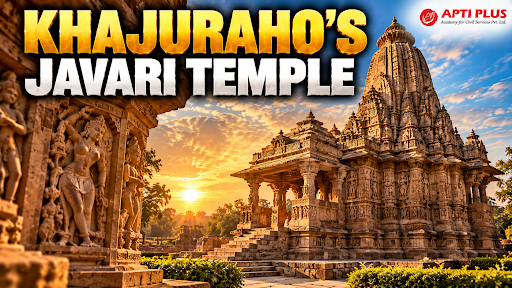
Why In News?
The Archaeological Survey of India (ASI) confirmed the recovery and planned scientific restoration of the missing head of an 11th-century seven-foot sandstone Vishnu idol enshrined within Khajuraho's Javari Temple.
About Javari Temple (Khajuraho)
-
Dedicatory Deity: Built in honor of Lord Vishnu.
-
Location: Located in the Eastern Group of Temples at Khajuraho in Chhatarpur district, Madhya Pradesh.
-
Heritage Status: Inscribed as a component of the Khajuraho Group of Monuments, designated a UNESCO World Heritage Site in 1986.
Historical Background
-
Dynastic Patronage: Built between 1075 CE and 1100 CE during the golden period of the Chandela Dynasty.
-
Name Origin: Local traditions attribute the name Javari either to a local devout landowner who commissioned/owned the land, or to a regional linguistic derivation of javara (millet), denoting local agrarian linkages.
Architectural Layout
-
Architectural Style: Built in the classical Nagara Style of North Indian temple architecture.
-
Nirandhara Layout: Designed as a compact Nirandhara temple, meaning it lacks an inner circumambulatory pathway (pradakshinapatha) around the sanctum.
-
Axial Plan: Features four linearly aligned longitudinal chambers:
-
Ardhamandapa: Entrance portico / porch.
-
Mandapa: Small assembly hall.
-
Antarala: Vestibule / connecting chamber.
-
Garbhagriha: Inner sanctum sanctorum.
Sculptural Art & Iconography
-
Ornate Makara-Torana: The entrance portico is crowned by an exquisitely carved stone archway (Makara-Torana) featuring mythical aquatic creatures with four decorated loops topped by a kirtimukha motif.
-
Spire & Plinth: Displays a slender, soaring curvilinear spire (Shikhara) decorated with minor miniature spires (urushringas) set above a raised stone plinth (jagati).
-
Exterior Bands: Outer walls feature two to three continuous horizontal sculptural bands depicting celestial nymphs (apsaras), divinities, composite mythical beasts (vyalas), and erotic pairs (mithunas).
-
Sanctum Doorway Lintel: The doorway to the sanctum showcases carvings of the Hindu Trinity (Brahma, Vishnu, Shiva) accompanied by the Nava-Grahas (nine celestial planetary deities) on the upper lintel.
-
Sanctum Image: Housed a 7-foot four-armed stone idol of Lord Vishnu, which was historically broken and beheaded.
About Archaeological Survey of India (ASI)
Organizational Profile
-
Nature: An attached office under the Ministry of Culture, functioning as the apex national body for archaeological research, protection, and cultural preservation.
-
Statutory Mandate: Administers and enforces key heritage legislations, primarily the Ancient Monuments and Archaeological Sites and Remains Act, 1958 (AMASR Act) and the Antiquities and Art Treasures Act, 1972.
Core Responsibilities & Functions
-
Monument Conservation: Responsible for the maintenance, scientific restoration, and structural protection of over 3,600 centrally protected national monuments and World Heritage Sites across India.
-
Antiquity Stores & Repositories: Manages official central and regional storage facilities to index, preserve, and safeguard recovered ancient artifacts and sculptures.
-
Excavations & Audio Guides: Conducts systematic archaeological digs and implements modern visitor facilities, including audio-guided heritage tours.
-
Jurisdictional Supremacy: Governs structural interventions, non-invasive scientific reassembly, and access permissions at protected archaeological monuments.
Source: TIMESOFINDIA
|
PRACTICE QUESTION Q. In ancient and medieval Indian temple architecture, the architectural term "Nirandhara" refers to a temple that: (a) Has a circular or elliptical sanctum sanctorum. (b) Does not possess an internal ambulatory passage around the sanctum. (c) Is constructed entirely out of terraced brick masonry without stone plinths. (d) Contains four subsidiary shrines located at the cardinal corners of the plinth. Answer: (b) Explanation: In Nagara and Dravida temple architecture, a Nirandhara temple is one that lacks an internal circumambulatory gallery (pradakshinapatha) around the garbhagriha. A temple with an enclosed ambulatory corridor is called Sandhara, while a Panchayatana temple has four subsidiary shrines at its corners. |