Why In News?
The Madurai Meenakshi Sundareswarar Temple Board of Trustees stressed the preservation of spiritual sanctity and heritage management during major religious assemblies.
About Meenakshi Sundareswarar Temple
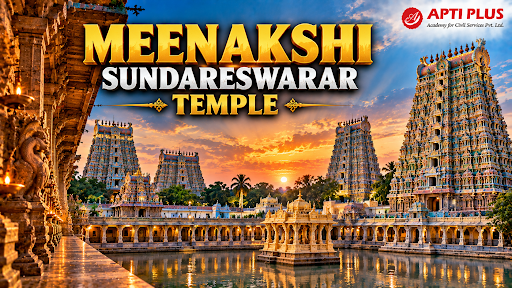
The Meenakshi Sundareswarar Temple in Madurai, Tamil Nadu, is dedicated to Goddess Meenakshi (a form of Parvati) and Lord Sundareswarar (Shiva).
Historical and Cultural Significance
-
Location: Situated on the southern bank of the Vaigai River, at the heart of Madurai, one of the world’s oldest continuously inhabited cities.
-
Deities: Goddess Meenakshi (Angayarkanni) and Lord Sundareswarar (Chokkanathar) are the presiding deities.
-
Origins: The temple is mentioned in Sangam literature (6th century CE) and was expanded by the Pandya dynasty and later by the Vijayanagara rulers in the 14th–17th centuries.
-
Religious Importance: The temple symbolizes the confluence of Shaivism, Shaktism, and Vaishnavism.
Architectural Features
Architectural Element |
Details |
|
Gopurams (Gateway Towers) |
|
|
Mandapas (Ceremonial Halls) |
|
|
Temple Tank (Pottramarai Kulam) |
|
|
Sculptures |
|
|
Pillared Halls |
|
|
Complex Temple Layout |
|
About Dravidian Architecture
Dravidian architecture is the hallmark of South Indian temple design, characterized by its pyramidal vimanas, towering gopurams, pillared halls, and intricate stone carvings.
It evolved between the 4th century BCE and 17th century CE, reaching its zenith under the Chola, Pandya, Vijayanagara, and Nayaka dynasties.
Historical Evolution
|
Period |
Dynasty / Contribution |
Architectural Milestones |
|
6th–7th CE |
Pallavas |
Rock‑cut temples (Mahabalipuram), early structural stone temples (Kailasanatha Temple). |
|
9th–13th CE |
Cholas |
Monumental granite temples (Brihadeeswarar Temple), advanced engineering and bronze art. |
|
13th CE |
Pandyas |
Expansion of temple complexes, elaborate gopurams and sculptures. |
|
14th–17th CE |
Vijayanagara & Nayakas |
Grand corridors, bazaars, Thousand Pillar Halls, and towering entrance gates. |
Key Features of Dravidian Architecture
Element |
Details |
|
Vimana (Sanctum Tower) |
The pyramidal tower built over the garbhagriha (sanctum sanctorum). Unlike the curvilinear shikhara of North India, the vimana is tiered and straight‑lined, often capped with a kalasha (finial). |
|
Gopuram (Gateway Tower) |
Monumental entrance towers that dominate the temple skyline. Larger temples feature multiple gopurams, each covered with stucco figures of deities and mythic beings. The Meenakshi Temple’s South Gopuram (52 m) exemplifies this grandeur. |
|
Mandapa (Pillared Hall) |
Spacious hypostyle halls used for rituals, dance, and discourse. Examples include the Thousand Pillar Hall and Pudhu Mandapam of Madurai, showcasing granite columns and musical pillars. |
|
Temple Tank (Pushkarini) |
Sacred water reservoirs like Pottramarai Kulam symbolize purification and cosmic creation. They often serve as centers for community gatherings and literary validation (e.g., Sangam poetry). |
|
Dvarapalakas (Gate Guardians) |
Twin guardian sculptures flanking entrances, representing divine protection and threshold symbolism. |
|
Sculptural Program |
Temples are adorned with high‑relief carvings depicting epics, celestial beings, and mythic animals such as Yalis. The art reflects narrative dynamism and devotional realism. |
|
Material & Technique |
Predominantly granite and sandstone, carved monolithically. Construction followed Agamic and Vastu Shastra principles emphasizing sacred geometry and cosmic alignment. |
|
Complex Layout |
Concentric prakaram (enclosures) arranged around the sanctum, forming a mandala‑like plan. The temple city itself radiates outward in lotus‑patterned geometry, integrating urban design with spirituality. |

Source: NEWINDIANEXPRESS
|
PRACTICE QUESTION Q. With reference to the Meenakshi Sundareswarar Temple at Madurai, consider the following statements: 1. The temple complex was extensively rebuilt and expanded during the 16th and 17th centuries under the Madurai Nayaka rulers. 2. The Hall of Thousand Pillars (Ayiram Kaal Mandapam) was constructed under the supervision of Ariyanatha Mudaliar. 3. The temple tank, Pottramarai Kulam, is traditionally associated with the validation of ancient Sangam literary works. Which of the statements given above are correct? A) 1 and 2 only B) 2 and 3 only C) 1 and 3 only D) 1, 2, and 3 Answer: D Explanation: Statement 1 is correct: The Meenakshi Temple complex was largely destroyed in the early 14th century by the Delhi Sultanate forces under Malik Kafur. It was subsequently rebuilt, extensively expanded, and given its major architectural layout in the 16th and 17th centuries during the reign of the Madurai Nayaka rulers (such as Vishwanatha Nayak and Thirumalai Nayak). Statement 2 is correct: The Hall of Thousand Pillars (Ayiram Kaal Mandapam), which actually contains 985 exquisitely carved pillars, was built in 1569 CE under the supervision of Ariyanatha Mudaliar, the prime minister and general of Viswanatha Nayaka. Statement 3 is correct: The temple tank, Pottramarai Kulam (Golden Lotus Tank), is traditionally tied to the legend of the third Tamil Sangam, where poets placed their palm-leaf manuscripts on a golden plank (Sangapalakai) in the tank to test their literary merit—superior works stayed afloat while inferior ones sank. |