Why In News?
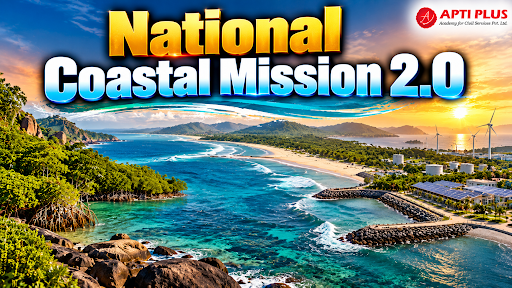
The Union Minister for Environment, Forest and Climate Change, launched the implementation guidelines for National Coastal Mission 2.0 (NCM 2.0) in New Delhi.
What Is National Coastal Mission 2.0?
It is a Central Sector Scheme under the Ministry of Environment, Forest and Climate Change (MoEFCC) designed to strengthen the climate resilience, ecological security, and sustainable development of India's coastal regions.
Officially launched with implementation guidelines in September 2026, NCM 2.0 operates with an approved financial outlay of ₹767 crore for the six-year period spanning 2025–26 to 2030–31, aligning with the 16th Finance Commission award period.
It serves as a consolidated national framework that formally subsumed the erstwhile National Coastal Mission 1.0 (2021–22 to 2025–26).
Core Objectives
-
Integrated Marine Spatial Planning: Develops Integrated Coastal Zone Management Plans (ICZMPs) and Coastal Marine Spatial Plans (CMSPs) across 1,000 km of priority coastline, alongside a uniform Cumulative Vulnerability Study of India's entire shoreline.
-
Ecosystem Restoration & Biodiversity Conservation: Focuses on restoring degraded coastal habitats, including mangrove bio-shield restoration in the Andaman & Nicobar Islands, coral reef rejuvenation, seagrass protection, and establishing dedicated conservation plans for sea water dolphins.
-
Shoreline Protection & Green Infrastructure: Formulates criteria for Green Coastal Infrastructure (GCI) to mitigate severe coastal erosion, flooding, and salinity ingress using nature-based solutions.
-
Pollution Abatement & Water Quality: Implements frameworks for deep-sea effluent discharge monitoring, Designated Best Use (DBU) coastal water criteria, decision support systems, and marine plastic litter reduction at coastal hotspots.
-
Sustainable Blue Economy & Ecotourism: Unlocks sustainable economic potential in line with Blue Economy Vision 2047 and Viksit Bharat @2047 by promoting eco-friendly beach amenities under the Beach Environment and Aesthetic Management Services (BEAMS) framework and supporting major projects like the Oceanarium at Somnath in Gujarat.
Geographical Coverage
The Mission spans all maritime territories of the country, covering:
-
Nine Coastal States: Gujarat, Maharashtra, Goa, Karnataka, Kerala, Tamil Nadu, Andhra Pradesh, Odisha, and West Bengal.
-
Four Union Territories: Dadra and Nagar Haveli and Daman & Diu, Andaman & Nicobar Islands, Puducherry, and Lakshadweep.
Five Thematic Pillars
The scheme's budget and execution are structured across five key categories:
-
Climate Resilient Blue Economic Growth: Supports eco-tourism infrastructure, deep-sea discharge studies, coral management, and the Somnath Marine Research Centre & Oceanarium.
-
Coastal Vulnerability and Risk Reduction: Directs resources toward green infrastructure guidelines, erosion abatement, and spatial plan development.
-
Climate Change Adaptation with Mitigation Co-benefits: Restores critical carbon sinks (mangroves and seagrasses) and protects marine biodiversity.
-
Capacity Building and Outreach: Enhances institutional capacity, training, and community stewardship initiatives like beach cleaning drives.
-
Committed Liabilities and Project Management: Covers legacy financial commitments from NCM 1.0 and the Green Climate Fund (GCF)-supported ECRICC project.
Source: PIB
PRACTICE QUESTIONQ. With reference to the National Coastal Mission 2.0 (NCM 2.0), consider the following statements: 1. It is a Centrally Sponsored Scheme implemented with a 60:40 fund-sharing pattern between the Centre and Coastal States. 2. The Central Pollution Control Board (CPCB) serves as the Central Nodal Agency (CNA) for fund flow and financial monitoring under the scheme. 3. It covers all nine coastal States and four Union Territories, subsuming the erstwhile National Coastal Mission 1.0. Which of the statements given above are correct? (a) 1 and 2 only (b) 2 and 3 only (c) 1 and 3 only (d) 1, 2 and 3 Answer: (b) 2 and 3 only Explanation: Statement 1 is incorrect: National Coastal Mission 2.0 (NCM 2.0) is a Central Sector Scheme (100% centrally funded with an outlay of ₹767 crore for 2025–26 to 2030–31), not a Centrally Sponsored Scheme with a 60:40 cost-sharing pattern. Statement 2 is correct: Under the implementation framework released by the Ministry of Environment, Forest and Climate Change (MoEFCC), the Central Pollution Control Board (CPCB) serves as the Central Nodal Agency (CNA) responsible for fund flow and financial monitoring. Statement 3 is correct: The mission covers all nine coastal States (Gujarat, Maharashtra, Goa, Karnataka, Kerala, Tamil Nadu, Andhra Pradesh, Odisha, West Bengal) and four Union Territories (Dadra & Nagar Haveli and Daman & Diu, Puducherry, Lakshadweep, Andaman & Nicobar Islands). It consolidates and subsumes the erstwhile National Coastal Mission (NCM 1.0). |