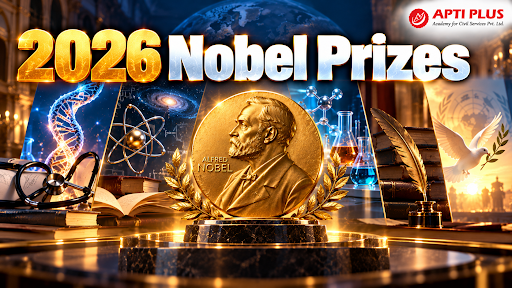
Why In News?
The 2026 Nobel Prize in Physiology or Medicine was jointly awarded to Karl Deisseroth, Peter Hegemann and Georg Nagel for their work on light-gated ion channels and optogenetics.
About Nobel Prize
The Nobel Prize honours individuals and organisations whose work has made a major contribution to humanity in fields such as science, literature and peace. The awards are administered by the Nobel Foundation.
-
Origin: The prizes were established through the will of Alfred Nobel, the Swedish chemist, engineer and inventor. Nobel directed that his wealth should fund awards for contributions that provide the “greatest benefit to humankind.”
-
First Awards: The Nobel Prizes were first presented on 10 December 1901, five years after Alfred Nobel's death. His original will provided for five categories: Physics, Chemistry, Physiology or Medicine, Literature and Peace.
-
Economic Sciences Prize: The Prize in Economic Sciences was introduced in 1968 by Sveriges Riksbank, Sweden's central bank, in memory of Alfred Nobel. It is commonly grouped with the Nobel Prizes, although it was not part of Nobel's original will.
Nobel Prize Categories
-
Physics: Awarded for important contributions to the understanding of physical phenomena and the laws of nature.
-
Chemistry: Recognises major advances in chemical science.
-
Physiology or Medicine: Honours discoveries that advance knowledge of human health and disease.
-
Literature: Recognises outstanding literary work.
-
Peace: Awarded for contributions towards peace and international cooperation.
-
Economic Sciences: Recognises significant contributions to economic research.
Who Awards the Prizes?
-
Physics: Awarded by the Royal Swedish Academy of Sciences.
-
Chemistry: Awarded by the Royal Swedish Academy of Sciences.
-
Physiology or Medicine: Awarded by the Nobel Assembly at Karolinska Institutet.
-
Literature: Awarded by the Swedish Academy.
-
Peace: Awarded by the Norwegian Nobel Committee.
-
Economic Sciences: Formally called the Sveriges Riksbank Prize in Economic Sciences in Memory of Alfred Nobel, awarded by the Royal Swedish Academy of Sciences.
Nobel Prize Award
-
Components: A laureate receives a medal, diploma and monetary award.
-
Award Ceremony: Nobel Prize ceremonies are traditionally held on 10 December, the anniversary of Alfred Nobel's death.
-
Maximum Recipients: A prize can generally be shared by up to three individuals. The Peace Prize can also go to organisations.
Alfred Nobel
Born in 1833 in Stockholm, Sweden, Nobel worked as a chemist, engineer and inventor.
-
Major Invention: Dynamite became his most famous invention and contributed significantly to his wealth.
-
Final Will: In 1895, Nobel signed the will that directed most of his fortune towards establishing the prizes.
-
Nobel Foundation: Established in 1900, the Foundation manages the financial assets and administrative framework of the Nobel Prize system.
Source: ECONOMICTIMES
|
PRACTICE QUESTION Q. Consider the following rules governing the Nobel Prizes:
Which of the statements given above are correct? A) 1 and 2 only B) 1 and 3 only C) 2 and 3 only D) 1, 2, and 3 Answer: C) 2 and 3 only Explanation: Statement 1 is incorrect: A scientific Nobel Prize can be shared among a maximum of three individuals (not four) per category. Statement 2 is correct: Nobel Prizes are not awarded posthumously, unless the person passes away after the official announcement. Statement 3 is correct: Organizations and institutions can receive the Nobel Peace Prize. |