Why In News?
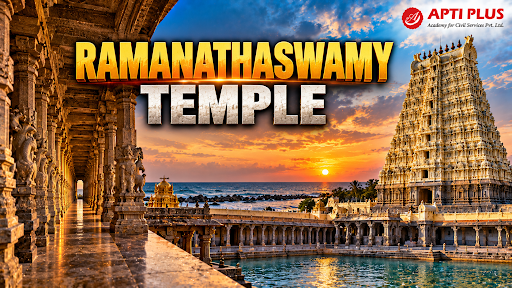
The monumental 1,212-pillared corridor of the historic Ramanathaswamy Temple in Rameswaram has been spotlighted for architectural conservation and tourism management.
About Ramanathaswamy Temple
Ramanathaswamy Temple in Rameswaram, Tamil Nadu, is dedicated to Lord Shiva (enshrined as Ramanathaswamy), it is both a Jyotirlinga and a Char Dham pilgrimage site, renowned for its 1,212‑pillar corridor—the longest in any Hindu temple.
Historical and Mythological Significance
-
Mythological Origin: According to the Ramayana, Lord Rama consecrated a lingam of sand (Ramalingam) here to worship Shiva after defeating Ravana, seeking absolution for killing a Brahmin.
-
Sacred Status: It is one of the twelve Jyotirlingas and among the 276 Paadal Petra Sthalams praised by Tamil Shaivite saints Appar, Sundarar, and Sambandar.
-
Char Dham Connection: Forms the southernmost anchor of the Char Dham pilgrimage circuit (with Badrinath, Dwarka, and Puri).
Historical Evolution
-
12th Century: Inner sanctum constructed under Pandya rulers; later expanded by Sri Lankan King Parakramabahu, marking early cross‑regional patronage.
-
15th – 18th Centuries: Major additions by Sethupathi rulers of Ramanathapuram, including the world‑famous third corridor (≈ 3,850 ft, 1,212 pillars) — the longest in any Hindu temple.
-
16th – 17th Centuries: Nayak rulers enriched the temple with ornate mandapas, subsidiary shrines, and decorative pillars, enhancing ritual spaces for large‑scale pilgrimages.
-
19th Century: Completion of the East Rajagopuram (126 ft) by the Nagarathar family of Devakottai, symbolizing community‑based temple patronage during colonial times.
-
20th Century: Recognized as one of the 12 Jyotirlingas and the southern Char Dham; conservation efforts initiated under the Madras Presidency Temple Board.
-
Modern Era (21st Century): Managed by the Tamil Nadu Hindu Religious and Charitable Endowments Department; ongoing heritage preservation, water management of 22 theerthams, and digital pilgrimage facilities introduced.
Architectural Features of Ramanathaswamy Temple
Feature |
Details |
|
Architectural Style |
Pure Dravidian architecture, characterized by monumental gopurams (gateway towers), massive corridors, and granite colonnades. The temple complex spans ≈ 15 acres, enclosed by high compound walls symbolizing the boundary between sacred and worldly realms. |
|
World’s Longest Corridor |
The outer (third) corridor measures ≈ 3,850 ft (1,200 m) in total length, lined with 1,212 carved granite pillars, each about 30 ft high. The corridor’s perfect symmetry creates a mesmerizing linear perspective where parallel lines visually converge toward a vanishing point. |
|
Gopurams (Gateway
Towers) |
The East Rajagopuram, completed between 1897 and 1904 by the Nagarathar family, rises ≈ 126 ft. Other gopurams mark entrances from all four directions, richly ornamented with stucco figures depicting scenes from Hindu mythology. |
|
Sanctum and Shrines |
Houses Ramanathaswamy (Shiva) and Parvatavardhini (Parvati); additional shrines for Vishnu, Ganesha, and Setumadhava reflect syncretic worship traditions. |
|
Nandi |
A colossal 17 ft high × 22 ft long × 12 ft wide statue of Nandi the Bull guards the sanctum, carved from a single granite block. |
|
Sacred Theerthams (Holy Wells) |
Contains 22 freshwater theerthams within the temple precincts, each with unique mineral composition and ritual significance. Pilgrims bathe in all 22 before entering the sanctum for purification. |
|
Sculptural Detailing |
Pillars feature bas‑reliefs, floral motifs, yalis (mythical beasts), and dynastic portraits of Sethupathi rulers. The craftsmanship demonstrates mastery in granite carving and optical geometry. |
|
Spatial Layout |
Built on elevated platforms with aligned columns, beams, and brackets forming a symmetrical grid, exemplifying advanced ancient engineering and aesthetic precision. |
Source: INDIANEXPRESS
|
PRACTICE QUESTION Q. With reference to the Ramanathaswamy Temple at Rameswaram, consider the following statements: 1. It is built in the Vesara style of temple architecture, combining Nagara and Dravidian features. 2. The temple is home to one of the twelve traditional Jyotirlingas of Lord Shiva. 3. Its third corridor is famous for containing over 1,200 carved granite pillars. Which of the statements given above are correct? A) 1 and 2 only B) 2 and 3 only C) 1 and 3 only D) 1, 2, and 3 Answer: B Explanation: Statement 1 is incorrect: The Ramanathaswamy Temple is a classic and premier example of the Dravidian style of architecture, native to South India. It is not built in the Vesara style (which is a hybrid style of Nagara and Dravidian predominant in the Deccan region). Statement 2 is correct: The temple is dedicated to Lord Shiva and houses one of the twelve traditional Jyotirlingas (specifically the Rameshwaram Jyotirlinga), making it highly sacred to Shaivites. It is also an integral destination of the holy Char Dham pilgrimage. Statement 3 is correct: The temple is globally renowned for possessing the longest temple corridor network in the world. Its famous third (outermost) corridor stretches about 1.2 kilometers and features 1,212 intricately carved pillars made of granite/sandstone that showcase masterful symmetry. |