Why In News?
Researchers documented shifts in the breeding locations of the Slaty Egret (Egretta vinaceigula).
What is the Slaty Egret?
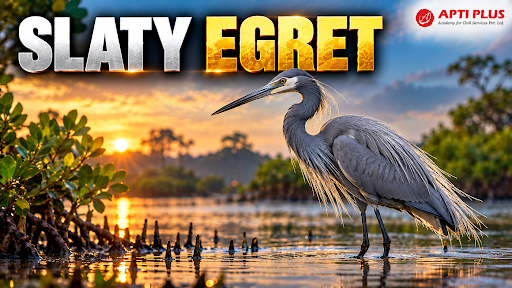
The Slaty Egret (Egretta vinaceigula) is a small, slaty-blue wading bird featuring distinct yellow legs and a reddish-slaty throat patch.
-
Population: It is a near-endemic waterbird restricted to Southern Africa (Angola, Botswana, Namibia, South Africa, Zambia, and Zimbabwe). Approximately 85% of its total global population is concentrated within Botswana's Okavango Delta.
-
Habitat Type: Shallow seasonal freshwater marshes, floodplains, and temporary wetlands.
-
Appearance: It exhibits a distinct slaty-grey plumage with a subtle purple/vinous-brown throat tint and long yellow-green legs.
-
Feeding Technique: Known as a "fishing maestro," it relies on a unique "foot-ruffling" or shuffling technique, stirring up shallow water with its feet to startle and flush out small fish, frogs, and aquatic invertebrates.
-
Conservation Status: Officially listed as Vulnerable on the IUCN Red List of Threatened Species.
-
Ecological Significance (Bioindicator): The bird is a specialized sight-hunting predator dependent on shallow, undisturbed, vegetated floodplains.
-
Shifts in its nesting frequency, distribution, or population success provide an early warning signal for broader ecological stress, including altered flood cycles, water pollution, and invasive weed growth such as Giant Salvinia (Salvinia molesta).
What is the Okavango Delta?
The Okavango Delta is one of the world's largest endorheic inland deltas, spanning 16,000 km² to 22,000 km² in northern Botswana.
-
Designated a Ramsar Site (Wetland of International Importance) and a UNESCO World Heritage Site. Core protected zones include the Moremi Game Reserve, managed under the Okavango Delta Management Plan (ODMP).
-
Situated in the Zambezian Flooded Grasslands ecoregion, the Delta hosts over 444 to 464 bird species (including the Wattled Crane and Pel's Fishing Owl), 122 mammal species, and 71 fish species.
-
Supports over 125,000 residents across settlements like Etsha and Maun through eco-tourism (mokoro rides, lodges), flood-recession (Molapo) farming, and basket weaving.

Source: DOWNTOEARTH
|
PRACTICE QUESTION Q. Consider the following statements regarding the distribution and habitat of the Slaty Egret: 1. It is an endemic waterbird species completely restricted to the freshwater river systems of the Indian Subcontinent. 2. The vast majority of its global breeding population is concentrated in the Okavango Delta of Botswana. 3. It prefers seasonal floodplains and temporary wetlands over permanent deep-water lakes. Which of the statements given above are correct? (a) 1 and 2 only (b) 2 and 3 only (c) 1 and 3 only (d) 1, 2 and 3 Answer: b Explanation: Statement 1 is incorrect: The Slaty Egret (Egretta vinaceigula) is native and near-endemic to southern and south-central Africa, not the freshwater river systems of the Indian Subcontinent. Statement 2 is correct: The vast majority of its global population (around 80–85%) and almost all known breeding colonies are concentrated in northern Botswana, centered primarily in the Okavango Delta and surrounding floodplains. Statement 3 is correct: It is a specialized forager that strongly prefers shallow, seasonally inundated floodplains, drying backwaters, and temporary freshwater marshes (typically less than 10–15 cm deep) rather than permanent deep-water lakes. |