Why In News?
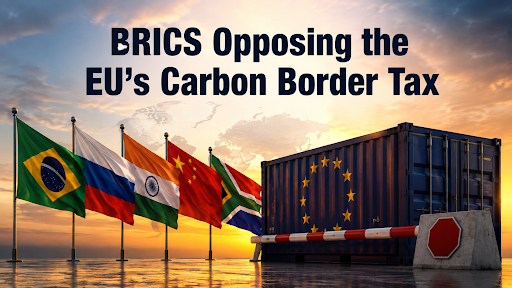
BRICS Environment Ministers opposed the European Union's Carbon Border Adjustment Mechanism (CBAM), labeling it a protectionist, unilateral trade barrier that harms developing economies.
What is the Carbon Border Adjustment Mechanism (CBAM)?
It is a trade policy enacted by the European Union (EU) to place a fair price on the carbon emitted during the production of carbon-intensive goods entering the EU market.
Core Objectives: Why did the EU introduce CBAM?
Preventing Carbon Leakage: "Carbon leakage" occurs when EU-based industries move their production to countries with laxer environmental regulations to save costs.
-
CBAM ensures that importing the cheaper, highly polluting goods faces an equal carbon price at the EU border.
Leveling the Playing Field: It protects domestic EU manufacturers who are legally bound by stringent carbon reduction targets under the EU Emissions Trading System (ETS).
Encouraging Global Decarbonisation: By taxing high-carbon imports, it financially incentivises developing nations to adopt cleaner production technologies to preserve their market share in Europe.
How CBAM Works: The Mechanism
Targeted Sectors: CBAM targets six highly carbon-intensive sectors: Steel & Iron, Cement, Aluminium, Fertilisers, Hydrogen, and Electricity.
The Process: Importers in the EU must declare the involved carbon emissions of their imported goods.
-
They must buy CBAM certificates corresponding to the carbon price that would have been paid if the goods had been produced under EU carbon rules.
The Offset Clause: If a foreign producer can prove they already paid a carbon tax or price in their home country, that exact financial amount is deducted from the CBAM requirement at the EU border.
Why is BRICS Opposing Carbon Border Taxes?
|
Pillar of Opposition |
Core Argument & Grievance |
Impact on BRICS Economies |
|
Climate Equity & Sovereignty |
• Violates the UNFCCC principle of Common But Differentiated Responsibilities (CBDR-RC). • Developed nations are historically responsible for over 70% of global greenhouse gases. • Forcing uniform carbon standards ignores the developmental realities of emerging markets. |
• Shifts the financial burden of Europe's energy transition onto developing countries. • Impedes domestic industrial expansion and limits poverty alleviation programs. |
|
WTO Trade Legality |
• Functions as a disguised, unilateral trade barrier and non-tariff restriction. • Violates WTO core norms of non-discrimination, specifically the Most-Favoured-Nation (MFN) clause. |
• Artificially penalises foreign goods at the border to shield domestic European companies from competitive global prices. |
|
Financial Siphoning |
• Creates a double standard where the EU retains border revenues. • Undermines the New Collective Quantified Goal (NCQG) to triple climate adaptation finance to developing countries by 2035. |
• Siphons critical capital out of developing economies and into the EU treasury, instead of transferring climate funds to vulnerable nations. |
|
Export Competitiveness |
• Targets foundational, energy-intensive commodities: Steel, Iron, Aluminium, Cement, Fertilisers, Hydrogen, and Electricity. |
• Imposes an estimated 20% to 35% tariff penalty on carbon-heavy manufacturing. • Threatens industrial jobs and erodes market share in Europe. |
|
Compliance Barriers |
• Imposes complex carbon accounting requiring exporters to track up to 1,000 distinct supply-chain data points. |
• Disproportionately harms MSMEs that lack the capital, technology, and access to accredited third-party carbon auditors. |
Member-Specific Vulnerabilities Within BRICS
|
Country |
Primary Export Exposure |
Strategic Domestic Constraint |
|
India & China |
Steel, Aluminium, Manufactured Goods |
High structural dependence on coal-fired power makes initial grid decarbonisation a multi-decade process. |
|
South Africa |
Aluminium, Iron, Base Metals |
Heavy reliance on Eskom’s coal grid translates into highly penalised "embedded carbon" metrics under EU calculators. |
|
Brazil & Russia |
Fertilisers, Iron Ore, Crude Minerals |
Inflation of raw material pricing directly breaks global agricultural supply chains and mineral trade agreements. |

What are the Major Challenges?
Fossil-Fuel Dominated Industrial Grids
-
The Coal Trap: India (70%-75%) and South Africa (80%-85%) rely heavily on coal-fired thermal power for heavy industrial electricity.
-
The Carbon Penalty: Because the EU calculates the border tax based on the "emissions" of a product, a tonne of Indian steel automatically carries a much higher carbon footprint (2.4 tonnes of CO₂) than the EU average (1.9 tonnes).
Legal Vulnerabilities and the "Green GATT" Loophole
The Article XX Defense: The EU has designed CBAM to align with Article XX (General Exceptions) of the GATT. This clause legally permits member states to implement trade restrictions if they are deemed "necessary to protect human, animal, or plant life" or relate to the "conservation of exhaustible natural resources."
Paralysis of WTO Mechanisms: Proving that the EU’s environmental policy is a restriction on international trade requires high legal proof. WTO's Appellate Body remains non-functional due to a lack of judges.
Severe Data Deficits and Reporting Burdens on MSMEs
The 1,000 Data-Point Burden: CBAM requires foreign firms to map out, verify, and report extensive data detailing emissions across their entire supply chain, down to raw material transit.
The Informal Sector Disadvantage: In economies like India, a significant portion of downstream manufacturing occurs within informal Micro, Small, and Medium Enterprises (MSMEs).
-
These units lack the digital tracking infrastructure, compliance capital, and access to internationally accredited third-party carbon auditors to verify their data.
Siphoning of Local Capital and the Climate Finance Gap
The Revenue Drain: Instead of developed nations transferring funds to the Global South to build climate resilience, CBAM siphons billions of dollars out of developing economies and into the EU Treasury.
The NCQG Stagnation: While BRICS has demanded the tripling of adaptation finance by 2035 under the New Collective Quantified Goal (NCQG), actual public and private financial commitments from Western nations remain highly inadequate, forcing developing countries to fund their own industrial green transitions.
Way Forward
Accelerating Defensive Carbon Pricing Mechanisms
Operationalising Domestic Trading Schemes: India must accelerate the phased rollout of its Carbon Credit Trading Scheme (CCTS) under the Bureau of Energy Efficiency (BEE).
Retaining Financial Capital: Ensuring that carbon fees are collected domestically prevents capital from being siphoned into western treasuries.
-
These collected funds can then be funneled directly into a national Green Transition Fund to subsidise domestic industrial decarbonisation.
Strategic Industrial Decarbonisation & Technology Infusion
Transitioning to Green Hydrogen: India must scale up its National Green Hydrogen Mission, particularly targeting hard-to-abate sectors.
-
Replacing coking coal with green hydrogen in steel blast furnaces (Direct Reduced Iron process) will lower the embedded emissions profile of exports below the EU penalty thresholds.
Industrial Captive Renewable Energy: Governments should provide tax incentives and cross-subsidy waivers for heavy industries (like aluminium smelting) to establish their own captive solar, wind, or round-the-clock (RTC) renewable energy setups.
Institutional Support and Financial Buffers for MSMEs
Subsidised Carbon Auditing: The government should set up a network of public sector laboratories and subsidised, internationally accredited third-party verification agencies to help MSMEs track and map their supply chain emissions without excessive costs.
Digital Carbon Accounting Platforms: Developing unified, open-source digital dashboards will allow small-scale manufacturers to seamlessly enter production data and automatically calculate compliance metrics according to global standards.
Legal Recourse and Coalition Building at International Forums
WTO Challenges via Likeminded Groups: While the WTO Appellate Body faces a judicial impasse, BRICS—in alignment with the BASIC group (Brazil, South Africa, India, China) and the G77—must continue filing formal disputes.
-
They should argue that CBAM violates the non-discrimination clauses of the GATT Article III (National Treatment) by favoring domestic EU producers through green subsidies.
Demanding Revenue Recycling: Developing nations should legally demand that if a carbon border tax is collected from a developing economy, 100% of that specific revenue must be recycled and returned to the exporting nation as official climate adaptation finance.
Trade Diversification and Market Re-alignment
Expanding South-South Trade Pipelines: India and BRICS nations should re-route high-carbon merchandise exports (like structural steel, cement, and chemical fertilisers) toward expanding infrastructure markets across Africa, Latin America, and West Asia, where unilateral carbon border penalties do not exist.
Leveraging Global Trade Agreements: Future Free Trade Agreements (FTAs)—such as the ongoing India-UK or India-EU negotiations—must include specific clauses that explicitly pause, exempt, or offer lengthy transition timelines (e.g., 10–15 years) for developing-nation MSMEs before environmental border penalties apply.
Conclusion
The Group should pursue “decarbonisation at home + climate finance abroad + fair carbon rules globally” so climate ambition does not become a new form of protectionism.
Source: INDIANEXPRESS
|
PRACTICE QUESTION Q. Discuss the implications of unilateral carbon border taxes on developing economies like India, and suggest measures India can adopt to safeguard its trade interests. (250 words) |