Why In News?
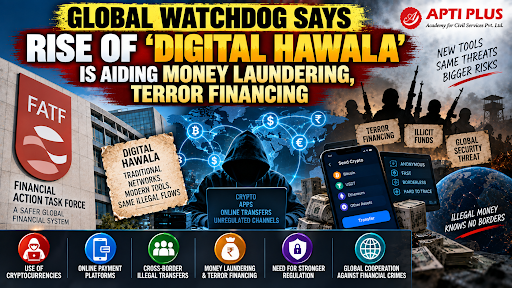
The Financial Action Task Force (FATF) has highlighted the growing risk of ‘digital hawala’, warning that the integration of virtual assets and unregulated digital platforms into informal value transfer systems is aiding money laundering and terror financing.
What is Digital Hawala?
Traditional Hawala (IVTS): An informal value transfer system operating outside formal banking rails. Fund settlements between hawaladars rely on trust, off-book balancing ledgers, physical cash couriers, and trade misinvoicing without crossing international boundaries.
The Emergence of Digital Hawala: The technological modernization of traditional hawala, integrating informal broker networks with automated fintech and blockchain rails:
-
Encrypted Communication: Coordinates transactions, codes, and tokens through ephemeral, auto-deleting messaging platforms (Telegram, Signal).
-
Virtual Digital Assets (VDAs): Uses cryptocurrencies and dollar-pegged stablecoins (predominantly USDT on the Tron blockchain) for rapid, pseudonymous cross-border account settlement.
-
Layered Banking Abuse: Disperses criminal funds through thousands of mule bank accounts via high-speed retail payment interfaces (UPI, IMPS).
|
Parameter |
Traditional Hawala |
Digital Hawala |
|
Primary Settlement Rails |
Physical cash couriers, bullion, and reciprocal trade misinvoicing. |
Stablecoins (USDT), crypto assets, and fast digital bank transfers. |
|
Operational Trail |
Physical ledger slips (chits), verbal agreements, phone calls. |
Encrypted chat bots, smart contract logs, rented digital identities. |
|
Transaction Velocity |
Takes several hours or days to physically balance ledgers. |
Near-instantaneous (settles within minutes across borders). |
|
Operational Scale |
Geographically restricted to established diaspora corridors. |
Borderless, decentralized, and accessible globally 24/7. |
|
Layering Method |
Multi-tiered human intermediaries and cash drops. |
Algorithmic micro-structuring (smurfing) across mule networks. |
What is the FATF?
Origin: Founded in 1989 by the G7 Summit in Paris to address emerging global financial crimes. India joined as its 34th member in 2010.
Global Mandate: The premier inter-governmental standard-setting body combating:
-
Money Laundering (AML)
-
Terrorist Financing (CFT)
-
Proliferation Financing of Weapons of Mass Destruction (CPF)
Oversight Mechanism: Enforces the 40 Recommendations across 200+ jurisdictions via peer-reviewed Mutual Evaluation Reports (MER), monitoring compliance through its public compliance lists (Grey List for jurisdictions under increased monitoring; Blacklist for high-risk jurisdictions subject to countermeasures).
Specific FATF Standards for Hawala (MVTS)
Governed primarily under FATF Recommendation 14 (Money or Value Transfer Services - MVTS):
-
Mandatory Licensing and Registration: Countries must ensure that all natural or legal entities providing informal remittance or value-transfer services are legally licensed or registered.
-
Customer Due Diligence (CDD): Intermediaries must conduct strict KYC checks to identify and verify the beneficial identity of senders, beneficiaries, and natural persons controlling transactions.
-
Suspicious Transaction Reporting (STR): Providers are legally obligated to report suspicious or anomalous transactions to their national Financial Intelligence Unit (FIU).
-
Record Keeping: Complete transactional, identity, and account records must be preserved for at least 5 years to facilitate criminal investigations and forensic audits.
-
Beneficial Ownership Transparency: National registers must prevent illicit actors from concealing their identities behind shell corporations, nominal owners, or complex multi-tiered trusts.
-
Infrastructure Disruption: The FATF specifically urges governments to build institutional capacity to detect, investigate, prosecute, and disrupt the core physical and digital infrastructure of professional money-laundering networks.
What are India’s Framework For Hawala ?
Statutory Framework
-
Prevention of Money Laundering Act, 2002 (PMLA): India’s core anti-money laundering statute; criminalizes the laundering of proceeds of crime and places strict reporting obligations on all Reporting Entities (REs), including registered virtual asset exchanges.
-
Unlawful Activities (Prevention) Act, 1967 (UAPA): Dedicated counter-terrorism legislation criminalizing the raising, possession, and movement of funds intended for terrorist activities or designated organizations.
-
Foreign Exchange Management Act, 1999 (FEMA): Enforces civil penalties and asset attachment for unauthorized cross-border foreign exchange transactions and illegal remittances.
|
Role of PMLA
|
Enforcement & Intelligence Unit
-
Financial Intelligence Unit - India (FIU-IND): National apex agency under the Ministry of Finance for ingesting, analyzing, and disseminating financial intelligence (CTRs, STRs, CBWTRs).
-
Enforcement Directorate (ED): Nodal agency under the Ministry of Finance empowered to investigate financial crimes, attach proceeds of crime, and prosecute offenders under PMLA and FEMA.
-
National Investigation Agency (NIA): Central counter-terrorism law enforcement agency investigating terror funding syndicates and cross-border hybrid financing modules.
-
Reserve Bank of India (RBI): Central monetary authority regulating authorized payment systems, foreign exchange dealers, and commercial banking rails.
-
Narcotics Control Bureau (NCB): Investigates financial proceeds generated through transnational drug trafficking cartels.
|
Role of FIU-IND
|
Case Studies: How Digital Hawala Operates in Practice
Mahadev Online Betting App Syndicate
-
Modus Operandi: The syndicate operated illegal online betting platforms across India, collecting user deposits through thousands of rented mule bank accounts and shell corporate accounts linked to UPI payment aggregators.
-
Digital Hawala Layering: The illicit domestic proceeds (exceeding ₹5,000+ crore) were systematically layered and converted into virtual digital assets (primarily Tether/USDT) via peer-to-peer (P2P) crypto dealers before being transferred to overseas entities in the UAE, completely bypassing formal banking audit trails.
J&K Cross-Border Drone Infiltration
-
Modus Operandi: Cross-border terror handlers utilized cryptocurrency wallets to transfer operational funds to local terror modules associated with Lashkar-e-Taiba (LeT) and The Resistance Front (TRF).
-
Liquidation via Hawala: Local operatives liquidated the crypto assets through unregistered P2P dealers and digital hawala conduits in Punjab and Jammu & Kashmir to finance logistics, arms collection from drone drops, and operational attacks without triggering conventional banking alerts.
What are the Major Challenges in Curbing Digital Hawala?
Decentralization and Unhosted Wallets: Transactions settled through private, non-custodial crypto wallets lack a centralized corporate intermediary to subpoena, freeze, or hold accountable.
Sprawling Mule Account Infrastructure: Syndicates systematically recruit students and low-income individuals to open bank accounts that process high-velocity micro-transactions, dissolving before compliance audits trigger.
Encrypted Ephemeral Communications: Operators communicate via automated bots, private Telegram channels, and disappearing messages, preventing lawful interception and post-event digital forensics.
Obfuscation Tools and Privacy Coins: The deployment of crypto-tumblers, cross-chain bridges, and privacy coins (e.g., Monero) breaks the verifiable on-chain audit trail across public ledgers.
Cross-Border Regulatory Arbitrage: Criminal clearinghouses deliberately operate out of jurisdictions with weak AML/CFT compliance or non-cooperative legal regimes, sheltering syndicate leadership.
Technological and Enforcement Latency: Mutual Legal Assistance Treaties (MLATs) require months for evidence execution, whereas digital hawala transactions clear across sovereign boundaries in sub-second intervals.
Way Forward
Enforce the FATF 'Travel Rule' Globally: Mandate that all Virtual Asset Service Providers (VASPs) collect, verify, and transmit originator and beneficiary data for all cross-border virtual asset transfers without threshold exemptions.
Operationalize a Centralized Mule Account Registry: Establish an automated, inter-bank intelligence ledger under the RBI and FIU-IND to identify and freeze interconnected mule account networks simultaneously.
Mandatory Offshore VASP Compliance & Geo-Blocking: Enforce strict domain blocking and mobile application takedowns for foreign crypto exchanges catering to Indian residents that refuse to register with FIU-IND and comply with PMLA.
Deepen Public-Private Partnerships (PPPs): Create real-time intelligence-sharing protocols linking commercial banks, payment aggregators, telecom operators, and central enforcement agencies.
Deploy Enterprise Blockchain Analytics across Agencies: Equip investigators in the ED, NIA, NCB, and State Cyber Crime Wings with advanced blockchain tracing and transaction visualization software.
Streamline Cross-Border Evidentiary Treaties: Modernize bilateral MLAT frameworks and expand rapid FIU-to-FIU evidence exchange under the Egmont Group to secure offshore asset freezes before liquidation.
Institutional Capacity Building: Establish specialized cyber-financial investigation academies to train police cadres in darknet investigations, memory forensics, and digital asset tracing.
Promote Low-Cost Formal Remittance Rails: Expand bilateral instant payment corridors (e.g., UPI-PayNow linkage with Singapore, UPI-UAE) to ensure low-cost, formal channels that disincentivize reliance on informal hawala networks
Conclusion
Combating digital hawala requires moving from reactive banking compliance to an integrated, tech-driven defense combining automated mule-account interdiction, strict VASP oversight, and real-time international cooperation.
Source: THEHINDU
|
PRACTICE QUESTION Q. The intersection of emerging financial technologies, cryptocurrencies, and informal value transfer systems has given rise to 'Digital Hawala,' posing severe challenges to India's national security and economic stability. Discuss (250 words) |