Why In News?
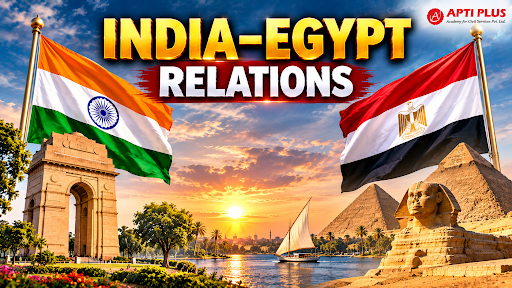
India and Egypt agreed to draft terms of reference (ToR) and assess a Preferential Trade Agreement (PTA) or a Free Trade Agreement (FTA).
Details
-
Time-Bound Working Group: A team led by a Joint Secretary of the Commerce Ministry will work with Egyptian officials on the ToR. The ToR will set the scope of any pact before formal negotiations begin.
-
Trade Level: Bilateral trade is $6.5 billion, which the Commerce Minister called short of potential. The two sides have an existing aim of $12 billion.
-
Payment Link: The Minister proposed linking the Unified Payments Interface (UPI) with Egyptian payment systems. He also stressed trade in local currencies to lower business costs.

Evolution Of India–Egypt Relations
Ancient And Freedom-Movement Links
-
Ancient Contact: The edicts of Ashoka mention his relations with Ptolemy II of Egypt in the 3rd century BC. This is among the earliest recorded state contacts between the two civilisations.
-
Nationalist Kinship: Mahatma Gandhi and Saad Zaghloul shared goals of independence from British control. Egyptian nationalists drew inspiration from India's non-violent movement.
-
Trade Routes: Red Sea and Nile routes carried Indian spices, textiles and cotton for centuries. Egypt later became an important market for Indian cotton.
Post-Independence Alignment
-
Early Diplomacy: Relations were announced at ambassadorial level in August 1947. This was among India's earliest diplomatic ties in West Asia and Africa.
-
Friendship Treaty: The friendship between Nehru and Nasser led to the 1955 Friendship Treaty. It anchored the relationship in anti-colonial solidarity.
-
Suez Crisis, 1956: India backed Egypt's nationalisation of the Suez Canal Company and urged a negotiated settlement. This built lasting goodwill in Cairo.
Non-Aligned Movement And Early Defence Links
-
NAM Founders: Both countries were founding members of the Non-Aligned Movement (NAM) in 1961, with Yugoslavia. NAM gave them a shared platform for strategic autonomy.
-
Military Training: India has trained Egyptian armed forces officers since the 1960s. Defence contact thus predates the strategic partnership by decades.
-
Joint Projects: The two countries cooperated on the HF-24 Marut fighter programme during the 1960s. It was one of the first such efforts between India and an African nation.
Economic Foundations And High-Level Visits
-
Trade Agreement: A trade agreement has been in force since March 1978, based on the most-favoured-nation clause. It remains the basic legal framework for trade.
-
Prime Ministerial Visits: Rajiv Gandhi visited in 1985, P.V. Narasimha Rao in 1995 and I.K. Gujral in 1997. Manmohan Singh went in 2009 for the NAM Summit.
-
Egyptian Presidents: Mubarak visited India in 1982, 1983 and 2008. Morsi came in March 2013.
Revival Under The Sisi–Modi Equation
-
Frequent Visits: President Abdel Fattah El-Sisi visited India in October 2015 and September 2016. He also attended meetings with Prime Minister Modi at the UN General Assembly in 2015 and BRICS Xiamen in 2017.
-
Republic Day, 2023: Sisi was chief guest on 26 January 2023. The leaders upgraded relations to a Strategic Partnership covering political, security, defence and economic cooperation.
-
Modi In Cairo: Modi made a state visit in June 2023, the first by an Indian Prime Minister since 2009. He received Egypt's highest honour, the Order of the Nile.
Consolidation In The Global South Era
-
G20 Guest: India invited Egypt as a guest country during its 2023 G20 Presidency. Sisi attended the New Delhi Summit in September 2023.
-
BRICS Membership: Egypt joined BRICS in January 2024. The two leaders met at the BRICS summit in Russia in October 2024 and at the G20 in Brazil in November 2024.
-
Structured Dialogue: The first Strategic Dialogue was held in New Delhi in October 2025. The 14th Foreign Office Consultations followed in Cairo on 8 February 2026.
-
Latest Summit: Sisi visited New Delhi for the BRICS summit in September 2026. He asked for concrete steps to raise trade.
Why Is Egypt Important To India?
The Suez Gateway
-
Chokepoint: The Suez Canal has historically handled about 12% of world shipping traffic. It cuts Asia–Europe voyages by one to two weeks.
-
Export Lifeline: An estimated $200 billion of Indian exports use the Suez–Red Sea route every year. These include automotive parts, chemicals, textiles and pharmaceuticals.
-
Cost Advantage: Suez routing can cut around two weeks from some India–Europe and US East Coast services. Faster transit lowers freight and inventory costs.
Gateway To Africa And Europe
-
Preferential Access: Egypt has trade agreements with the European Union, COMESA, the Agadir Agreement and Mercosur. It is also a member of the African Continental Free Trade Area (AfCFTA).
-
Manufacturing Base: Egypt's Qualifying Industrial Zones give duty-free access to the US market for goods with Israeli content. Indian firms can use Egypt as an export platform.
-
African Outreach: Egypt is a key node in India's Africa policy. Sisi attended the India–Africa Forum Summit in 2015.
Food And Resource Security
-
Wheat Market: Egypt is the world's largest wheat importer. It approved India as a wheat source in 2022, but only 61,000 tonnes shipped before India banned exports.
-
Agri-Exports: Indian rice, buffalo meat and cotton yarn have established demand in Egypt. A stable market diversifies India's farm export destinations.
-
Input Imports: Egypt's chemical and fertiliser exports to India reached $627 million in the first eight months of 2026, against $147 million a year earlier. This supports India's fertiliser security.
Strategic And Defence Value
-
Transit Hub: Egypt is a major transit point for Indian aircraft and naval vessels moving between India and Europe or the Atlantic. Access matters for deployments and exercises.
-
Arms Market: Egypt is among the world's leading arms importers. It has shown interest in Indian platforms such as the Tejas light combat aircraft.
-
Maritime Security: Egypt controls the northern end of the Red Sea. It is a natural partner for protecting India's western sea lanes.
Diplomatic And Soft-Power Weight
-
Arab Centre: Egypt is the most populous Arab state and hosts the Arab League headquarters in Cairo. India gains access to the Arab consensus through it.
-
Gaza Mediation: Egypt co-mediates ceasefire efforts. India sent a special envoy to the Sharm el-Sheikh Gaza Peace Summit in October 2025.
-
Religious And Cultural Authority: Al-Azhar is a leading Sunni centre of learning. India has trained students at its IT centre since 2019.
Areas Of Cooperation
Trade In Goods
-
Trade Level: Merchandise trade in FY 2025-26 comprised Indian exports of $3.9 billion and imports of $2.6 billion. India runs a surplus.
-
Export Basket: India exports petroleum products, engineering goods, chemicals, cotton yarn, buffalo meat and drugs and pharmaceuticals. These products have steady demand in Egypt.
-
Import Basket: India imports petroleum products, inorganic chemicals and metallic and non-metallic products. Fertiliser and chemical purchases are rising.
Investment Cooperation
-
Hospitality: The Taj Group and Egypt's EGOTH signed an MoU in December 2025 to manage the Intercontinental Hotel in Cairo. It is a service-sector entry.
-
Egyptian Capital In India: Egyptian investment in India is about $37 million. It includes ElSewedy Group and the firm 700 Apps.
-
Metallurgy And Industry: The Indian Institute of Foundrymen and the Federation of Egyptian Industries signed an MoU on metallurgy in September 2025. It targets technology cooperation in castings.
Defence And Security
-
Special Forces: Exercise Cyclone held its third edition in February 2025. It builds counter-terror and special operations interoperability.
-
Air And Naval Engagement: The IAF–Egyptian Air Force Tactical Leadership Programme ran at Cairo West in November–December 2024. Two Egyptian naval officers took part in MILAN-2024.
-
Bright Star-2025: More than 700 Indian personnel took part, the largest foreign contingent. The IAF Sarang team performed at the Egypt International Air Show in September 2024.
-
Defence Industry: Thirty Indian defence firms exhibited at EDEX in December 2025. More than 50 defence delegations visited Egypt in the preceding three years.
Energy And Green Transition
-
Renewable Energy Group: A Joint Working Group on renewable energy meets under the strategic partnership. It coordinates solar and wind cooperation.
-
Green Hydrogen Link: India's National Green Hydrogen Mission, launched in January 2023 with an outlay of ₹19,744 crore, matches Egypt's hydrogen ambitions in its Suez zone.
-
Fertiliser Cooperation: An Indian fertiliser delegation visited Egypt in April 2025 to strengthen supply and investment links.
Health And Pharmaceuticals
-
Health Working Group: The Joint Working Group on health supports regulatory cooperation and medicine access.
-
Medicine Supply: Drugs and pharmaceuticals are among India's major exports to Egypt. Local registration and quick approvals are key.
-
Vaccine Production: The Zydus–GennVax agreement moves cooperation from supply to joint production. It supports Egypt's regional manufacturing hub plans.
Digital, Education And Skills
-
Al-Azhar IT Centre: The Centre for Excellence in Information Technology has operated since February 2019. It has trained more than 1,500 students.
-
University Links: Amity University and ElSewedy signed an MoU in June 2023. Courses in artificial intelligence, machine learning, robotics and quantum technology started in September 2023.
Culture And People-To-People Ties
-
Cultural Centre: The Maulana Azad Centre for Indian Culture was founded in 1992. It runs Kathak, Hindi, Urdu and yoga classes. It held the first Indian Film Festival in Egypt in 2025.
-
Heritage Symbols: Cairo has streets named after Gandhi, Nehru and Zakir Hussain. Delhi has Gamal Abdel Nasser Marg.
-
Tourism And Flights: In 2024, 50,000 Indian tourists visited Egypt and 18,000 Egyptians visited India. EgyptAir flies Cairo–Delhi and Cairo–Mumbai.
What Are The Challenges And Obstacles In India–Egypt Relations?
Volatile And Under-Sized Trade
-
Sharp Swings: Bilateral trade fell from $6.06 billion in 2022-23 to $4.67 billion in 2023-24. Disruption in shipping and demand can quickly erase gains.
-
Distance From The Target: Reaching $12 billion needs trade to nearly double from $6.5 billion. Egyptian officials have noted the need to almost triple from 2025 levels.
-
Narrow Basket: Trade relies on a few product lines. Little of it is high-value or technology-driven.
Egypt's Concern Over The Trade Imbalance
-
Deficit Narrative: Egypt's minister cited a deficit of $2.84 billion with India in 2025. A pact seen as lopsided can face domestic resistance.
-
Industrial Protection: Egypt wants joint manufacturing and more exports to India. Tariff cuts without investment may widen the gap.
Market Access And Non-Tariff Barriers
-
Wheat And Cotton: India has sought accreditation among wheat suppliers for Egypt and access for raw cotton. Progress has been slow.
-
Export Policy Reliability: India's 2022 wheat export ban left Egypt with 61,000 tonnes against its approval. Policy reversals erode trust in India as a supplier.
-
Regulatory Friction: The 7th JTC agenda included non-tariff barriers and customs cooperation. Product registration and standards remain trade frictions.
Egypt's Macroeconomic Fragility
-
External Financing Pressure: The IMF warns that continued disruption in trade and commodity markets can widen external imbalances and raise borrowing costs. Currency stress limits Egypt's import capacity
-
Revenue Shock: Suez Canal revenue fell from $10.25 billion in 2023 to $3.991 billion in 2024. A Suez Canal Authority estimate expects $5.8–6 billion in 2026.
Red Sea And Hormuz Insecurity
-
Houthi Attacks: The Red Sea crisis began with the hijacking of the Galaxy Leader on 19 November 2023. Suez transits remained about 60% below pre-crisis levels more than 100 days after the last reported attack.
-
Higher Costs For Indian Exporters: Ships rerouted around the Cape of Good Hope. This raised freight rates and cut seafood and manufactured exports.
-
West Asian Conflict: The 2026 closure of the Strait of Hormuz added further shipping uncertainty. Suez revenue rose 42% in July 2026 on rerouted traffic, which shows volatile flows.
Thin Investment And Regulatory Friction
-
Active Gap: Only about 70 of more than 700 registered Indian companies are active in Egypt. Many registered firms have not invested.
-
Asymmetry: Egyptian investment in India is only about $37 million, against over $5.5 billion of Indian investment in Egypt. Egypt gets little reciprocal benefit.
Geopolitical Balancing And Connectivity Gaps
-
Competing Corridors: The India–Middle East–Europe Economic Corridor, announced at the G20 in New Delhi in 2023, bypasses Suez. Cairo may see it as a threat to canal revenue.
-
Other Partners: Egypt keeps close ties with China, Gulf funders and the West. India cannot assume a privileged position.
-
Thin Human Links: Only 18,000 Egyptian tourists visited India in 2024. Direct flights are limited to EgyptAir routes.
What Is The Way Forward For Strengthening India–Egypt Relations?
Design A Balanced Trade Agreement
-
Sequencing: Begin with a PTA covering sensitive and priority lines. Move to a full FTA once safeguards for farmers and fishermen are agreed.
-
Rules Of Origin: Draft rules to favour value addition and Egyptian inputs. This answers Egypt's concern about imbalance.
-
Leverage Egyptian Agreements: Use Egypt's links with the EU, COMESA, Mercosur and AfCFTA for export routing. Include these in the ToR assessment.
Build A Local-Currency And Digital Payments Backbone
-
Rupee–Pound Settlement: Operationalise the 2022 rupee settlement framework for Egyptian trade. Use banks and Reserve Bank of India approvals to cut dollar dependence.
-
UPI Linkage: Pursue the UPI link proposed at the JTC. It would help tourists, remittances and small businesses.
-
Credit Support: Offer export credit and insurance cover for Indian projects in Egypt. This lowers risk for mid-sized firms.
Anchor Indian Industry In Egypt's Economic Zones
-
Manufacturing Hubs: Encourage Indian pharma, textiles, auto parts and chemicals to set up in Egypt's Suez Canal Economic Zone. Use the location for exports to Europe, the US and Africa.
-
Joint Manufacturing: Pursue the Egyptian proposal for joint production to narrow its deficit. Target components that India now exports as finished goods.
-
Port Cooperation: Link Indian ports and logistics firms with Egyptian ports such as Sokhna. This follows the JTC focus on ports and logistics.
Strengthen Maritime And Supply-Chain Resilience
-
Red Sea Coordination: Coordinate Indian Navy anti-piracy and escort deployments with the Egyptian Navy. Share maritime domain awareness data.
-
Alternate Routing Plans: Prepare contingency routing and insurance for Indian exporters. Expand cold-chain and reefer services for perishables.
-
Corridor Complementarity: Position Egypt as a complement to the India–Middle East–Europe corridor, not a rival. Invite Egypt to dialogue on connectivity.
Deepen Defence And Multilateral Coordination
-
Defence-Industrial Cooperation: Move from exercises to co-production, maintenance and training. Build on the 2022 defence MoU and the Joint Defence Committee.
-
Counter-Terror Coordination: Share intelligence on extremist financing and cyber threats. Use the Joint Working Group on counter-terrorism.
-
Global South Platforms: Coordinate positions in BRICS, the UN and G20 on development finance and reform. Back Egypt's mediation on Gaza.
Secure Food, Fertiliser And Energy Supply
-
Wheat And Agri Access: Settle the accreditation of Indian wheat and raw cotton. Offer predictable export policy for agreed volumes.
-
Fertiliser Offtake: Sign long-term supply contracts for Egyptian urea and phosphates. Link them with Indian plant investment.
-
Green Hydrogen: Connect India's National Green Hydrogen Mission with Egyptian projects for joint offtake.
Deepen Technology, Health, Skills And People-To-People Links
-
Digital Public Infrastructure: Share India's digital identity, payments and health platforms with Egypt. Provide technical teams and training.
-
Skills And Education: Expand ITEC slots and joint degrees. Build on the Al-Azhar IT centre and university MoUs.
-
Tourism And Flights: Add direct flights and joint tourism promotion. Use the cultural centre and school programmes to reach more Egyptians.
Conclusion
India–Egypt relations have moved from Nehru–Nasser solidarity to a strategic partnership with a trade pact now under study. Egypt offers the Suez route, an African gateway and a defence and diplomatic partner. Success will depend on balanced trade, investment, secure sea lanes and shared Global South positions.
Source: BUSINESS-STANDARD
|
PRACTICE QUESTION Q. Egypt is both a gateway to Africa and a chokepoint for India's trade with Europe. Examine the importance of Egypt for India's strategic and economic interests. (15 Marks, 250 Words) |