Why In News?
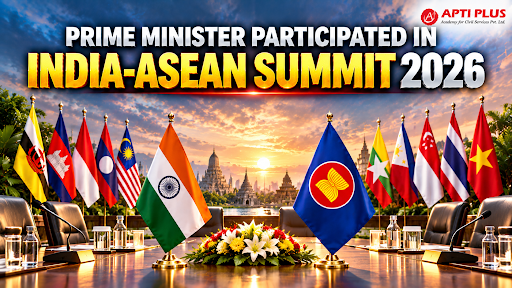
Prime Minister Narendra Modi participated in the 23rd ASEAN-India Summit and the 21st East Asia Summit (EAS) in Manila on 17 November 2026, hosted by the Philippines as ASEAN Chair for 2026.
What Is The ASEAN-India Summit?
The Association of Southeast Asian Nations (ASEAN) is an 11-member bloc after the admission of Timor-Leste. Its members are Brunei, Cambodia, Indonesia, Laos, Malaysia, Myanmar, the Philippines, Singapore, Thailand, Vietnam and Timor-Leste.
Summit Mechanism: The annual ASEAN-India Summit is the highest forum of the partnership, held alongside the ASEAN Summit. It reviews the Comprehensive Strategic Partnership, which India and ASEAN adopted in 2022.
East Asia Summit: The East Asia Summit (EAS) is a leaders-led forum of ASEAN and eight partners. It discusses political, security and economic issues of the Indo-Pacific.
Strategic Weight: ASEAN sits at the centre of India's Act East Policy and its Indo-Pacific vision. It links India to the Pacific through the Malacca Strait and the South China Sea.

How The India–ASEAN Partnership Evolved?
-
Look East Origins: India launched the Look East Policy in 1991 to re-engage Southeast Asia economically. It became a sectoral dialogue partner of ASEAN in 1992 and a full dialogue partner in 1996.
-
Summit-Level Engagement: The first ASEAN-India Summit took place in 2002. The relationship was upgraded to a Strategic Partnership in 2012.
-
Act East Shift: The Act East Policy of 2014 added security, connectivity and cultural cooperation to the economic agenda. It aligned India's priorities with the ASEAN Outlook on the Indo-Pacific (AOIP) adopted in 2019.
-
Recent Milestones: At the 22nd Summit in October 2025, leaders adopted the ASEAN-India Plan of Action 2026–2030. Its priorities include the digital economy, clean energy, sustainable infrastructure and healthcare.
-
Maritime Theme: PM Modi declared 2026 as the Year of ASEAN-India Maritime Cooperation, citing growing collaboration on humanitarian assistance and disaster relief (HADR), sea security and the blue economy.
India–ASEAN Economic Relation
-
Trade Scale: Bilateral merchandise trade reached US$128 billion in 2025–26, and ASEAN accounted for 10.55% of India's global trade. The partnership is India's second-largest regional trading relationship after the European Union bloc.
-
Trade Growth Since 2010: Bilateral trade rose from about $56 billion in 2010–11 to $128 billion in 2025–26.
-
Export–Import Gap: India exported $38.42 billion to ASEAN in 2025–26, implying imports of about $89.6 billion and a deficit near $51.2 billion.
-
Deficit: The deficit was under $5 billion in 2010–11, a ten-fold rise in fifteen years.
-
Import Basket: Major imports from ASEAN include steam coal, cooking coal and crude petroleum. Industrial inputs such as machinery, electronics and chemicals also feature prominently.
-
Services And Investment: The ASEAN-India agreements on services and investment came into force in 2015. They cover areas that the goods pact excludes.
ASEAN-India Trade In Goods Agreement (AITIGA)
-
Origins: The ASEAN-India Trade in Goods Agreement (AITIGA) was signed in August 2009 and came into force on 1 January 2010. It covers only physical goods.
-
Review Mandate: In August 2023, both sides announced a complete review of the goods agreement. Indian industry has long sought it to correct asymmetries in trade.
-
Negotiating Rounds: The 12th AITIGA Joint Committee met at the ASEAN Secretariat in Jakarta in March 2026. India then hosted the 13th Joint Committee in New Delhi from 6 to 10 July 2026.
-
Pending Chapters: In October 2026, both sides agreed to expedite pending chapters and set time-bound deliverables. The next Joint Committee meeting is slated for January 2027.
-
Core Issues: The talks cover rules of origin, tariff liberalisation, non-tariff barriers, trade facilitation and digitised customs procedures. Rules of origin are central because of concerns over third-country goods entering through ASEAN.
Maritime And Strategic Cooperation
-
South China Sea Stakes: The 2002 Declaration on the Conduct of Parties (DOC) is non-binding. ASEAN and China have negotiated a Code of Conduct (COC) formally since 2018.
-
Philippine Push: The Philippines, as ASEAN Chair, says concluding an effective COC is urgent amid risky incidents and coercive actions at sea. The 48th ASEAN Summit in Cebu in May 2026 called for the immediate conclusion of a legally binding COC.
-
India's Position: India supports freedom of navigation and peaceful settlement under the United Nations Convention on the Law of the Sea (UNCLOS). It backed the 2016 arbitral award in the Philippines' case against China.
-
Defence Ties: The Philippines has received shore-based BrahMos anti-ship missile systems from India. It was the first export of the missile, under a 2022 contract valued at about $375 million.
-
Maritime Exercises: The first ASEAN-India Maritime Exercise was held in 2023. India has proposed a second exercise and a second ASEAN-India defence ministers' meeting.
Connectivity, Digital And Energy Cooperation
-
Physical Connectivity: The India-Myanmar-Thailand Trilateral Highway and the Kaladan Multi-Modal Transit Transport Project link the Northeast to Southeast Asia. Both remain incomplete due to Myanmar's conflict.
-
Digital Payments: The Unified Payments Interface (UPI) was linked with Singapore's PayNow in 2023. The linkage allows instant cross-border remittances.
-
Energy Security: The recent Strait of Hormuz crisis exposed the vulnerability of Asian energy supply chains. India has offered to train 400 professionals in renewable energy to support ASEAN.
-
Supply Chains: India and ASEAN economies are integrating through electronics, pharmaceuticals and energy trade. Both seek diversification of manufacturing away from single-country dependence.
Challenges In Deepening India–ASEAN Relations
Widening Trade Imbalance
-
Persistent Deficit: Between fiscal 2011 and 2024, India's exports to ASEAN grew at about 3% annually, while imports grew at 7.5%. The deficit rose from $5 billion to $51.5 billion (FY2025–26).
-
Weak Export Momentum: India's exports to ASEAN fell 5.77 per cent to $38.96 billion in 2024–25, while imports rose 5.65 per cent to $84.16 billion.
-
Wider Pattern: NITI Aayog found the trade deficit with FTA partners widened 59.2% in Q1 of 2025–26. Weak utilisation of trade pacts by Indian exporters remains a structural problem.
Rules Of Origin And Third-Country Routing
-
Circumvention Risk: Indian industry fears Chinese goods entering through ASEAN at preferential tariffs. Stricter origin rules are therefore a key demand in the AITIGA review.
-
Verification Gaps: Weak customs verification and certificate-of-origin systems allow misuse of preferences. Digitised origin data sharing remains incomplete.
Non-Tariff Barriers And Market Access
-
Barriers Faced: Indian exporters report standards, licensing and sanitary barriers in several ASEAN markets. Agriculture, pharmaceuticals and processed foods are most affected.
-
Regional Alternatives: India stayed out of the Regional Comprehensive Economic Partnership (RCEP) in 2019 over deficit concerns. It therefore lacks integration with the wider regional value chains that RCEP members enjoy.
South China Sea Uncertainty
-
COC Delay: The Philippines wants a legally binding COC by end-2026, and Malaysia hopes it will be finalised at the 49th Summit. Chatham House assesses that tensions between China and the Philippines make this unlikely in 2026.
-
Divergent Interests: Brunei, Malaysia, the Philippines and Vietnam have overlapping claims against China. Cambodia and Laos have historically avoided positions that irritate Beijing.
-
India's Exposure: About half of India's trade passes through Indo-Pacific sea lanes. Disruption in the South China Sea would raise freight and insurance costs.
Myanmar Conflict And ASEAN Cohesion
-
Stalled Peace Plan: ASEAN's 2021 Five-Point Consensus on Myanmar has not ended violence. The Philippines holds the chair that Myanmar would have held after its suspension from chairing.
-
Project Delays: The conflict stalls the Trilateral Highway and the Kaladan project. Instability near the Northeast border also raises refugee and security concerns.
Capacity And Integration Gaps In ASEAN
-
New Member Strain: Timor-Leste's admission brings development disparities into the bloc. The ASEAN Community Vision 2045 will test the bloc's ability to absorb a much poorer member.
-
Slow Consensus: ASEAN decisions need consensus, which dilutes outcomes on contentious matters. This limits what India can negotiate collectively with the bloc.
Competing Great-Power Presence
-
China's Weight: China is ASEAN's largest trading partner and a major investor in infrastructure. India's connectivity projects are smaller and slower to deliver.
-
United States And Others: The 2026 EAS draws leaders from several major powers, and US attention to the region is shifting with trade tensions. India must keep its position distinct without being drawn into rivalry.
What Is The Way Forward For India–ASEAN Relations?
Conclude A Balanced AITIGA Upgrade
-
Time-Bound Closure: Complete the pending chapters by the January 2027 meeting and conclude negotiations in 2026–27. The review aims at modernising the pact and making trade more efficient.
-
Strong Origin Rules: Adopt product-specific rules with higher regional value content and digitised verification. Tie tariff concessions to safeguards against circumvention.
-
Market Access Reciprocity: Seek reductions in non-tariff barriers for Indian pharmaceuticals, agriculture and engineering goods. Use the ASEAN-India Business Council to track barriers.
Raise Indian Export Competitiveness
-
Manufacturing Push: Link Production Linked Incentive schemes and electronics component incentives to ASEAN supply chains. Aim to move India from raw materials to value-added exports.
-
Trade Pact Utilisation: Run awareness drives for MSME exporters on the certificates and concessions available under AITIGA. NITI Aayog has flagged low utilisation as a main reason for the deficit.
Anchor A Maritime Security Architecture
-
Operational Cooperation: Institutionalise the ASEAN-India Maritime Exercise and expand information-sharing at the Information Fusion Centre in Gurugram. Include HADR, anti-piracy and search-and-rescue training.
-
Rules-Based Order: Press for a COC consistent with UNCLOS and the 2016 arbitral award. Support ASEAN centrality while pursuing bilateral capacity building with Vietnam, Indonesia and the Philippines.
-
Blue Economy: Develop joint fisheries, port and marine research projects under the 2026 maritime theme.
Accelerate Land And Digital Connectivity
-
Complete Corridors: Prioritise completion of the Kaladan project and the Myanmar section of the Trilateral Highway. Extend the road to Cambodia, Laos and Vietnam to form a continuous corridor.
-
Payment Linkages: Extend UPI-type linkages with more ASEAN states and settle trade in local currencies. Share digital public infrastructure, such as identity and payment systems, with ASEAN partners.
Build Energy And Supply Chain Resilience
-
Energy Cooperation: Create a joint strategic reserve and renewable energy grid pilots. The Hormuz crisis has shown that a shared response lowers price shocks.
-
Diversified Chains: Co-develop semiconductor, battery and critical mineral supply chains. Offer joint investment frameworks that avoid dependence on a single supplier.
Support ASEAN Cohesion And Myanmar Peace
-
Constructive Role: Back the ASEAN chair's envoy on Myanmar and the Five-Point Consensus. Provide humanitarian aid and development support without recognising any party to the conflict.
-
Capacity Building: Offer training for Timor-Leste through the Indian Technical and Economic Cooperation programme. Extend similar support to Cambodia, Laos, Myanmar and Vietnam.
Deepen People-To-People And Knowledge Ties
-
Education And Skills: Expand scholarships, university partnerships and the ASEAN-India Network of Think Tanks. Strengthen the Nalanda-inspired cultural diplomacy with Buddhist and Ramayana circuits.
-
Tourism And Diaspora: Improve direct flights and visa facilitation with Southeast Asia. Engage the Indian diaspora as a bridge for investment and cultural exchange.
Conclusion
The Manila summit comes at a moment when ASEAN centrality, a widening trade deficit and an unsettled South China Sea all demand sharper Indian diplomacy. A balanced AITIGA upgrade, a credible maritime security role and faster connectivity will decide whether the Act East Policy delivers. India's partnership with ASEAN can become a stabilising pillar of the Indo-Pacific.
Source: THEHINDU
|
PRACTICE QUESTION Q. Trace the evolution of India's relations with ASEAN from the Look East Policy to the Act East Policy. (10 Marks, 150 Words) |