Why In News?
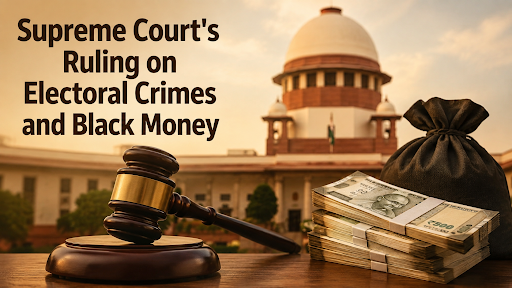
The Supreme Court, in the State of Karnataka & Anr. vs Prathik Parasrampuria, rules that black money in elections corrupts democracy and issues time-bound directions to the Election Commission of India (ECI), Union government, and States/UTs to curb unaccounted cash in polls.
Why Is Black Money a Threat to Democracy?
Electoral Distortion: Unaccounted money creates an uneven contest where financial capacity can outweigh merit, ideology and public support, producing the “anti-democratic effects” identified in Kanwar Lal Gupta.
Voter Autonomy: Cash inducements can convert a free electoral choice into a choice imposed by external financial influence, directly weakening voter sovereignty.
Unequal Competition: Financially powerful candidates can deploy greater resources for mobilisation and campaigning, creating structural inequality despite statutory expenditure ceilings.
Expenditure Evasion: The 2024 Lok Sabha election recorded ₹10,106.20 crore in total seizures, including ₹1,066.59 crore cash, indicating the scale of illicit or suspicious election-linked flows detected by enforcement agencies.
Transactional Politics: Vote-buying shifts democracy from policy-based consent to immediate material exchange, weakening accountability between voters and elected representatives.
Corruption Nexus: Campaign expenditure creates incentives for elected representatives to recover political investments through rent-seeking and patronage, deepening the crime–politics–corruption nexus, as identified by the Vohra Committee.
Public Trust: When voters perceive elections as financially manipulated, confidence in electoral institutions, political parties and democratic legitimacy can decline.
Historical Warning: Justice P.N. Bhagwati warned in 1975 that unchecked financial disparity between candidates could produce “anti-democratic effects”, a principle reaffirmed by the Supreme Court in 2026.
Institutional Response: The Supreme Court has now mandated 24-hour reporting of cash/asset seizures, one-year investigation targets and High Court approval for withdrawal of electoral prosecutions.
Democratic Principle: Black money is therefore not merely an electoral-finance violation, but a threat to the constitutional ideal of free and fair elections under Article 324.
Legal Framework To Curb Black Money In Electoral System
Representation of the People Act, 1951 (RPA 1951): The Act regulates elections, corrupt practices, electoral offences, disqualifications and election disputes, forming the principal statutory framework for electoral integrity.
-
Section 123: Bribery, undue influence and expenditure beyond the statutory limit constitute corrupt practices; bribery includes offering gratification to induce an elector to vote or abstain.
-
Section 77: Candidates must maintain a separate and correct account of election expenditure, while expenditure must remain within the prescribed statutory ceiling.
-
Section 123(6): Incurring or authorising expenditure in contravention of Section 77 constitutes a corrupt practice, creating a direct legal link between expenditure control and electoral fairness.
-
Section 8A: A person found guilty of a corrupt practice can face disqualification for up to six years, strengthening the consequences of electoral malpractice.
Candidate Disclosure: Section 75A requires elected candidates to furnish declarations relating to assets and liabilities, while Supreme Court jurisprudence has expanded disclosure of criminal antecedents and financial information.
False Affidavit: Section 125A penalises false information or concealment in election affidavits, strengthening voter access to reliable candidate information.
Recent Enforcement: The Supreme Court has directed that election-related investigations should ordinarily be completed within one year, with reasons for delay reported to the ECI.
Special Courts: High Courts have been directed to designate special courts for expeditious disposal of cases against candidates and sitting MPs/MLAs, addressing the five-year electoral-cycle problem.
India's framework combines Article 324 oversight + RPA restrictions + expenditure ceilings + candidate disclosure + judicial enforcement to protect the integrity of electoral choice.
What Are the Major Challenges?
Delayed Investigation: For Assembly elections during 2019–2025, 2,01,894 FIRs were registered, with 79,148 cases pending trial, showing how delayed justice weakens electoral deterrence. (Source: Supreme Court)
Enforcement Capacity: Election-period enforcement operates under severe time pressure, requiring coordination among Flying Squads, Static Surveillance Teams, police, ECI and tax authorities.
Complex Money Trails: Black money can move through cash, informal networks and layered transactions, making real-time attribution to candidates or campaigns difficult.
Cash-Based Financing: The 2024 Lok Sabha election recorded ₹10,106.20 crore in total seizures, 290% higher than 2019, demonstrating the scale of election-linked illicit/suspicious financial flows.
Inter-Agency Coordination: Cash exceeding ₹10 lakh detected by Static Surveillance Teams must be shared with Income Tax authorities, showing the need for seamless ECI–police–tax coordination.
Political Influence: Withdrawal of electoral-offence cases weaken accountability; the Supreme Court now requires High Court approval before withdrawal of cases against election candidates.
Informal Distribution Networks: The 255th Law Commission highlighted the movement of electoral cash from large-scale transport to “suitcases” and voters’ pockets, illustrating the difficulty of tracing last-mile inducements.
Digital Enforcement Gap: The ECI introduced Election Seizure Management System (ESMS) nationwide in 2024 for real-time seizure monitoring, but integrating this with investigation and prosecution remains critical.
Institutional Reform Gap: The 255th Law Commission Report called for a multi-pronged approach covering money power, criminalisation, faster election litigation, stronger ECI and political-party financial transparency.
Black Money–Criminalisation Nexus
Money–Crime Nexus: In 2024, 251/543 winners (46%) declared criminal cases, while 504 (93%) were crorepatis, highlighting the overlap between financial power and criminalised politics.
Winning Advantage: Candidates with declared criminal cases had a 15.3% probability of winning, against 4.4% for candidates with clean backgrounds, indicating the electoral advantage associated with money/muscle networks.
Wealth Advantage: A crorepati candidate had a 19.6% winning probability, compared with only 0.7% for candidates below ₹1 crore assets, showing the strong role of financial capacity in electoral competition.
Party Accountability: The Supreme Court requires parties to publish candidates’ criminal antecedents and explain their selection based on qualifications, achievements and merit, not merely “winnability”.
Disclosure Gap: Candidate affidavits rely substantially on self-declared information, making independent verification of assets, liabilities and criminal cases critical for meaningful voter awareness.
Political Incentive: When candidates with criminal cases demonstrate higher electoral success, parties may face incentives to prioritise electoral winnability over clean political credentials, reinforcing the crime–money–politics cycle.
Way Forward
Dedicated Electoral Offence Mechanism: Create specialised investigation–prosecution units with a one-year investigation benchmark and dedicated judicial capacity, building on the Supreme Court’s 2026 directions.
Fast-Track Justice: Designate special courts/benches for electoral offences so prosecution does not stretch across successive election cycles.
Digital Expenditure Tracking: Expand ECI’s ESMS/ENCORE architecture into real-time expenditure analytics, linking candidate accounts, bank transactions and seizure records. ECI Expenditure Monitoring.
Party-Level Transparency: Extend disclosure beyond candidates to political-party donations, expenditure and third-party campaign spending; ECI already requires online filing of contribution and expenditure statements (Source: ECI).
Stronger Candidate Verification: Move from affidavit-based disclosure towards cross-verification with court, tax, property and corporate databases, reducing reliance on self-reporting.
Inter-Agency Coordination: Institutionalise a permanent ECI–Police–Income Tax–ED–FIU coordination mechanism, addressing the fragmented enforcement highlighted by the Vohra Committee.
Election-Finance Reform: Revisit state funding of elections, tighter donation disclosure and expenditure controls to reduce dependence on opaque private financing.
Prosecutorial Independence: Separate investigation from political influence by placing prosecution decisions with independent public prosecutors, while retaining ECI’s election-management role.
Global Learning: Examine international models where public prosecutors control prosecution/withdrawal decisions, using comparative evidence from jurisdictions studied before the Supreme Court.
Political–Criminal Nexus: Implement the Vohra Committee’s institutional coordination approach to disrupt the crime–politics–bureaucracy nexus rather than treating electoral offences as isolated violations.
State Funding: The 255th Law Commission Report recommended examining state funding alongside broader electoral-finance reforms, but cautioned that public funding cannot work effectively without stronger political-party financial transparency and regulation.
Disqualification: Stronger disqualification norms should distinguish between mere accusation and conviction, while ensuring speedy trials so criminal charges do not become either a political weapon or an ineffective deterrent.
Conclusion
The Supreme Court's directions in State of Karnataka vs Prathik Parasrampuria convert judicial concern over black money into an enforceable, time-bound compliance framework, positioning the ECI, police, and High Courts as joint guarantors of a voter's free and informed choice.
Source: THEHINDU
PRACTICE QUESTIONQ. Examine the institutional and procedural challenges in ensuring speedy investigation and trial of electoral offences in India. Suggest reforms to strengthen deterrence against the criminalisation of politics. (250 words) |