Why In News?
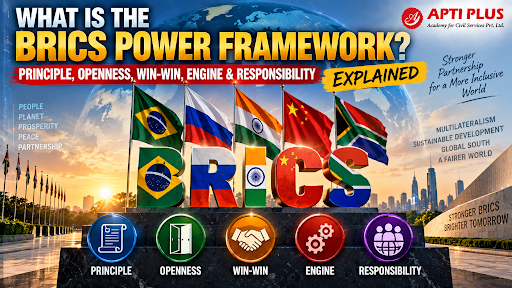
India’s 2026 BRICS Chairship seeks to operationalize the "POWER" framework to establish the expanded eleven-member bloc as a robust, non-confrontational engine for inclusive global growth and multipolar stability.
What is BRICS?
Origins: Conceived in 2001 by Goldman Sachs as BRIC, held its first summit in Russia in 2009, and inducted South Africa in 2010.
Membership Expansion (BRICS+): Expanded to eleven sovereign members including Brazil, Russia, India, China, South Africa, Saudi Arabia, UAE, Iran, Egypt, Ethiopia, and Indonesia.
-
Partner Countries: Belarus, Bolivia, Kazakhstan, Cuba, Malaysia, Nigeria, Thailand, Uganda, Uzbekistan and Vietnam
Formidable Global Demographic Footprint: Represents approximately 47% of the world's population and 36% of the global terrestrial landmass.
Economic Weight Surpassing G7: Generates over 37% of global GDP in Purchasing Power Parity (PPP) terms, outstripping the G7 bloc's collective 30% share.
Dedicated Financial Institutions: Established the New Development Bank (NDB) in Shanghai with $100 billion authorized capital alongside the $100 billion Contingent Reserve Arrangement (CRA).

What Does the ‘POWER’ Framework Mean?
-
P — Principle: Respect for the UN Charter and Sovereign Equality: Reaffirms non-interference, territorial integrity, and peaceful settlement of disputes without selective unilateral sanctions.
-
O — Openness: Support for an Open Multilateral Trading System: Champions the World Trade Organization (WTO) dispute settlement mechanism while opposing protectionist green tariffs like the EU Carbon Border Adjustment Mechanism.
-
W — Win-Win: Promote Inclusive Development and Mutual Benefits: Rejects zero-sum Cold War bloc mentalities by scaling shared agricultural corridors and local currency trade arrangements.
-
E — Engine: Drive Global Growth via Economic and Tech Strengths: Deploys the bloc's demographic dividend, industrial supply chains, and AI digital public goods to revitalize sluggish post-pandemic global growth.
-
R — Responsibility: Foster Peace, Stability and Global South Unity: Assumes collective historical responsibility to champion climate justice, debt restructuring, and reform of the United Nations Security Council.
|
Core Pillar |
Meaning |
Strategic Mandate |
Example |
|
P — Principle |
Every country is equal and independent; no big power should dictate terms or attack another nation. |
Respect for the UN Charter & Sovereign Equality |
New Development Bank (NDB) gives equal 20% voting shares to founding members with zero single-country veto power. |
|
O — Openness |
Global trade must stay open, transparent, and fair without rich nations blocking developing countries' goods. |
Support for an Open Multilateral Trading System |
Joint opposition against the European Union’s Carbon Border Adjustment Mechanism (CBAM) tax on developing steel exports. |
|
W — Win-Win |
Nations work together so that every partner benefits equally instead of one country winning at another’s loss. |
Promote Inclusive Development & Mutual Benefits |
Direct Rupee-Dirham trade settlement between India and the UAE under the Local Currency Settlement (LCS) framework. |
|
E — Engine |
Using huge populations, energy reserves, and modern technology to power the world's economic recovery. |
Drive Global Growth via Economic & Tech Strengths |
Generates over 37% of global GDP in PPP terms and controls 43% of global crude oil production following BRICS+ expansion. |
|
R — Responsibility |
Taking collective action to protect world peace, solve debt crises, and secure climate funding for poor nations. |
Foster Peace, Stability & Global South Unity |
India convened 125 developing nations at the Voice of the Global South Summit, successfully securing African Union membership in the G20. |
Why Can BRICS Become an ‘Engine’ of Global Growth?
Command of Global Energy Reserves: The expanded bloc controls 43% of global crude oil production and 38% of natural gas reserves following the accession of Saudi Arabia, UAE, and Iran. (Source: IEA)
Dominance in Industrial Raw Materials: Controls over 70% of global rare earth processing, graphite refining, and agricultural fertilizer exports like potash and urea. (Source: USGS)
World's Largest Consumer Market: Houses over 3.7 billion consumers driving middle-class consumption across fast-growing urban hubs in India, China, and Indonesia. (Source: World Bank)
Leading Global Clean Energy Transition: Accounts for over 50% of global installed solar and wind capacity, led by massive installations like India's Bhadla Solar Park. (Source: IRENA)
Alternative Trade Logistics Corridors: Develops sovereign multi-modal transit networks like the International North-South Transport Corridor (INSTC) to bypass traditional maritime transit choke-points.
How Can BRICS Empower the Global South?
Democratizing Global Development Lending: New Development Bank (NDB) has cumulatively approved around $43 billion across 135+ infrastructure and sustainable projects without imposing rigid structural adjustment conditionalities. (Source: NDB)
De-Risking from US Dollar Hegemony: Promotes bilateral local currency invoicing, exemplified by India-UAE Rupee-Dirham settlement and the pilot BRICS Pay cross-border payment messaging system.
Democratizing Digital Public Infrastructure (DPI): India exports open-source digital rails like UPI, Aadhaar, and DigiLocker to African and Latin American partners under the G20 DPI framework.
Demanding UN Security Council Expansion: Unifies developing world consensus demanding permanent UNSC seats for India, Brazil, and African representatives under the Ezulwini Consensus.
Championing Global Food & Health Security: Establishes the BRICS Vaccine R&D Center and coordinated agricultural grain reserves to buffer vulnerable economies against trade embargoes.
What are India’s Priorities under BRICS 2026?
Reform Multilateralism at Bretton Woods: Demands formula-based quota realignment at the IMF and World Bank to reflect emerging economies' true economic weight.
Institutionalizing Zero Tolerance Against Terror: Operationalizes the BRICS Counter-Terrorism Action Plan to cut off digital cross-border terror funding networks and hawala channels.
Scaling Digital Public Goods for the Global South: Offers modular, open-access fintech architecture through India Stack to enable financial inclusion across African member states.
Promoting Traditional Medicine & Bio-Innovation: Expands global research partnerships under the WHO Global Centre for Traditional Medicine established at Jamnagar, Gujarat. 5. Fostering Climate
Justice & Green Hydrogen Pacts: Champions the International Solar Alliance (ISA) and the Global Biofuels Alliance to mobilize affordable green capital.
Strengthening Resilient Supply Chains: Promotes regional manufacturing clusters to prevent single-source supply chokepoints in active pharmaceutical ingredients (APIs) and semiconductors.

What are the Major Challenges before BRICS?
Divergent Internal Geopolitical Alignments: Internal contestations persist between members pursuing non-aligned multi-alignment (India, Brazil) and those pursuing anti-Western balancing (Russia, Iran).
Post-Disengagement Trust Deficit & Border Stabilization: While formal troop disengagement was achieved at Depsang and Demchok following the 2024 Kazan consensus, managing residual trust deficits and executing long-term boundary delimitation along the LAC remains an institutional bottleneck.
Heterogeneity of Expanded Governance Regimes: Managing consensus across eleven nations spanning democracies, absolute monarchies, and theocracies creates severe procedural inertia.
Western Apprehensions & Counter-Pressures: G7 nations perceive the expanded BRICS as a revisionist threat, increasing scrutiny on secondary sanctions against trade partners.
Operational Bottlenecks in Common Currency Creation: Vast macroeconomic disparities, capital controls, and fiscal deficits make launching a unified 'BRICS Currency' impractical.
Way Forward for BRICS
Focus on Practical Interoperability Over Single Currency: Interlink national digital payment switches like India’s UPI with member central bank payment systems rather than forcing a common currency.
Expand Local Currency Project Loans via NDB: Progress from the current NDB General Strategy (2022-2026) target of 30% local currency denomination toward an expanded 50% horizon to firmly protect emerging economies from Western interest rate tightening cycles.
Establish a Formal Secretariat and Charter: Transition from an informal annual consultative summit into a rules-governed international organization with permanent secretarial wings.
Institutionalize Regular Bilateral De-Escalation: Utilize BRICS sidelines to facilitate peaceful diplomatic dialogue and disengagement on unresolved border issues between members.
Operationalize the BRICS Agricultural Research Platform: Deploy climate-resilient millet seed banks and desert drip technology developed by ICAR across drought-prone African members.
Learn from Successful Model
-
ASEAN Consensus-Based Integration Model: Maintained non-aligned regional neutrality and economic integration across divergent political regimes via the 'ASEAN Way'
-
Chiang Mai Initiative Multilateralisation: Deployed a $240-billion currency swap safety net among East Asian central banks to manage liquidity crises without Western IMF diktats.
Conclusion
India’s 2026 BRICS Chairship presents a historic opportunity to steer the expanded eleven-member bloc into a constructive, non-confrontational pillar of global economic resilience and multipolar peace.
Source: THEHINDU
|
PRACTICE QUESTION Q. Critically evaluate how the expanded BRICS+ grouping can serve as an engine of global economic growth and democratic multilateral governance. (10 Marks, 150 Words) |