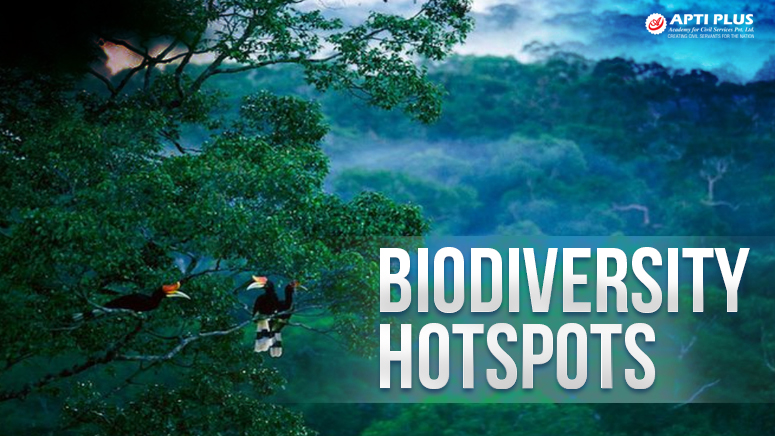
What are Biodiversity Hotspots?
Biodiversity hotspots are among most critical & biologically rich regions on Earth. These areas are characterized by an extraordinary concentration of endemic species that are not found anywhere else on planet coupled with significant habitat loss which increases their vulnerability to environmental threats. Concept of biodiversity hotspots was first proposed by Norman Myers in 1988 & it has since become a key criterion in global conservation efforts.
To fully understand biodiversity hotspots we need to delve into their ecological, geographical & socio-economic aspects. APTI Plus UPSC Coaching offers targeted guidance in mastering complex topics like biodiversity conservation.
Definition & Criteria for Biodiversity Hotspots
A biodiversity hotspot is a biogeographic region that:
- Has at least 1,500 species of vascular plants as endemics (species that occur nowhere else on Earth).
- Has lost at least 70% of its original habitat (often through human activity such as deforestation, urbanization & agriculture).
These criteria reflect dual importance of protecting regions that are both biologically unique & under severe threat.
Global Hotspot framework established by Conservation International includes 36 hotspots covering around 2.3% of Earth land surface but supporting 50% of world plant species & 43% of bird, mammal, reptile & amphibian species.

Characteristics of Biodiversity Hotspots
-
Richness in Endemism
Endemism refers to species that are native to & found only in a specific geographical area. Higher endemism means more critical it is to protect area. Some hotspots have extremely high levels of plant endemism with species adapted to specific ecological niches (such as tropical rainforests, savannahs or mountain ranges).
- Example: Madagascar one of world most famous hotspots is home to over 90% of its plant & animal species being endemic including lemurs, baobabs & unique reptiles such as chameleons.
- Biodiversity Value: These regions are like natural laboratories offering key insights into evolutionary processes, ecological relationships & adaptations. Their biodiversity is vital not just for ecological balance but also for practical applications in fields like medicine, agriculture & biotechnology.
-
Habitat Loss
Habitat destruction is threat to biodiversity in these hotspots. Over exploitation of natural resources for agriculture, logging, urbanization & mining among other factors has resulted in massive habitat fragmentation & loss.
- Tropical Rainforests: These forests particularly in places like Amazon, Sundaland & Central Africa have been drastically reduced by agriculture, logging & illegal trade leading to decline of several species.
- Coral Reefs: Coral reef hotspots like Great Barrier Reef are under threat from ocean acidification, climate change & destructive fishing practices.
-
Ecological Importance
Biodiversity hotspots often correspond with biomes (large ecological areas) such as rainforests, grasslands & savannahs which provide numerous ecosystem services:
- Pollination: Hotspots like Amazon Rainforest & Indo-Burma are critical for pollination of plants including many food crops.
- Carbon Sequestration: Forests in Congo Basin & Southeast Asia act as carbon sinks playing key role in regulating Earth climate.
- Water Regulation: Wetlands in hotspots such as Mediterranean Basin & Amazon help to regulate water cycles & prevent floods.
Major Biodiversity Hotspots
-
Himalayas (India, Nepal, Bhutan, China)
- Richness: Himalayas are considered one of world most biodiverse regions. They are home to numerous endemic species like Himalayan blue poppy, snow leopards & red pandas.
- Ecological Value: region serves as water source for millions of people feeding major river systems such as Indus, Ganges & Brahmaputra.
- Threats: Deforestation for agriculture, climate change & infrastructure development pose threats to flora & fauna of region.
-
Sundaland (Indonesia, Malaysia, Brunei)
- Richness: islands of Borneo & Sumatra are hotspots of tropical rainforest biodiversity home to unique species like orangutan, Sunda pangolin & Sumatran tiger.
- Ecological Value: These forests are crucial for region air quality, act as habitats for migratory species & provide economic benefits like timber & medicinal plants.
- Threats: conversion of rainforests into oil palm plantations, illegal logging & mining are major causes of habitat destruction.
-
Amazon Rainforest (South America)
- Richness: Amazon is world largest tropical rainforest, rich in species such as Jaguar, Poison dart frogs & Harpy eagles.
- Ecological Value: It generates 20% of world oxygen & stores carbon playing vital role in climate regulation.
- Threats: Deforestation due to agriculture, cattle ranching & logging as well as climate change are reducing this hotspot integrity at an alarming rate.
-
Indo-Burma (Vietnam, Laos, Cambodia, Thailand, Myanmar)
- Richness: Known for its incredible biodiversity this hotspot is home to species such as Indochinese tiger, Yangtze giant softshell turtle & bamboo lemur.
- Ecological Value: hotspot includes vast wetlands & forests that regulate local climate & water systems.
- Threats: Poaching, illegal trade, deforestation for agriculture & hydropower development have affected its biodiversity.
-
Madagascar
- Richness: Nearly 90% of species in Madagascar are endemic making it one of most biologically unique places on Earth.
- Ecological Value: Madagascar forests help maintain soil fertility & provide water for its agriculture.
- Threats: Slash & burn agriculture, deforestation & hunting of endemic species are major threats.
-
Mediterranean Basin (Europe, North Africa, Western Asia)
- Richness: Mediterranean Basin is hotspot for plant endemism with unique species like Mediterranean monk seal & Spanish imperial eagle.
- Ecological Value: This hotspot is essential for pollination, agriculture (especially olive cultivation) & supports fisheries.
- Threats: Urbanization, agricultural intensification & climate change are accelerating degradation in this hotspot.
Through expert faculty, detailed study materials & mock tests APTI Plus IAS Coaching in Bhubaneshwar equips students with necessary knowledge & analytical skills to excel in environment & ecology section of UPSC exam ensuring a deeper understanding of global & national biodiversity hotspots.

Conservation Efforts
Efforts to conserve these hotspots include a combination of scientific research, protected area creation & sustainable practices.
Protected Areas: Governments & NGOs often establish national parks, biosphere reserves & nature reserves to protect ecosystems & prevent further habitat destruction. Amazon has several protected areas such as Jaua-Sarisariñama National Park though illegal encroachment is still a challenge.
International Agreements: Global conservation frameworks like Convention on Biological Diversity (CBD), International Union for Conservation of Nature (IUCN) & United Nations Environment Programme (UNEP) promote protection of biodiversity hotspots through treaties, funding & policies.
Community Involvement: Empowering local communities in sustainable farming & eco tourism can help reduce human pressures on biodiversity hotspots while providing economic benefits to those communities.
Restoration Projects: Habitat restoration projects, such as reforestation & wetland rehabilitation, aim to bring back damaged ecosystems & create corridors for wildlife movement.
Monitoring & Research: biodiversity monitoring & scientific research are critical to assessing state of hotspots & implementing conservation strategies.
Challenges in Conserving Biodiversity Hotspots
- Climate Change: Rising temperatures & altered weather patterns threaten species adapted to specific conditions.
- Illegal Wildlife Trade: Poaching & trafficking of endangered species for pet trade or traditional medicine contribute to species decline.
- Economic Pressures: Development & economic activities (like agriculture & mining) are often seen as more immediate needs for local communities & balancing these with conservation efforts is challenging.
36 biodiversity hotspots
| No. | Biodiversity Hotspot | Location |
| 1 | Indo-Burma | Southeast Asia (Vietnam, Laos, Cambodia, Thailand, Myanmar) |
| 2 | Sundaland | Southeast Asia (Indonesia, Malaysia, Brunei) |
| 3 | Wallacea | Indonesia (Sulawesi, Maluku Islands, East Nusa Tenggara) |
| 4 | Amazon Rainforest | South America (Brazil, Peru, Colombia, Ecuador, Venezuela, etc.) |
| 5 | Atlantic Forest | Brazil, Paraguay, Argentina |
| 6 | Mesoamerica | Mexico, Central America (Guatemala, Belize, Honduras, El Salvador, Nicaragua, Costa Rica, Panama) |
| 7 | Madagascar | Madagascar |
| 8 | Philippines | Philippines |
| 9 | Mountains of Southwest China | China (Yunnan, Sichuan, Tibet) |
| 10 | Caucasus | Armenia, Azerbaijan, Georgia, Russia (Caucasus region) |
| 11 | Mediterranean Basin | Southern Europe, North Africa, Western Asia |
| 12 | Tropical Andes | South America (Colombia, Ecuador, Peru, Bolivia, Venezuela) |
| 13 | Guinean Forests of West Africa | Guinea, Liberia, Sierra Leone, Ivory Coast, Ghana, Togo, Benin, Nigeria |
| 14 | Horn of Africa | Ethiopia, Somalia, Djibouti, Eritrea, Kenya |
| 15 | New Zealand | New Zealand |
| 16 | Western Ghats & Sri Lanka | India (Western Ghats), Sri Lanka |
| 17 | South-Central China | China (Hubei, Sichuan, Guizhou, Yunnan & Guangxi) |
| 18 | Heart of Borneo | Indonesia, Malaysia (Borneo) |
| 19 | Central Asia | Kazakhstan, Kyrgyzstan, Uzbekistan, Tajikistan, Turkmenistan, Afghanistan |
| 20 | East Melanesian Islands | Papua New Guinea, Solomon Islands, Vanuatu, New Caledonia, Fiji |
| 21 | Coastal Forests of East Africa | Kenya, Tanzania, Mozambique, Somalia |
| 22 | Chilean Winter Rainfall Valdivian Forests | Chile, Argentina |
| 23 | Japan’s Temperate Forests | Japan |
| 24 | New Guinea | Papua New Guinea, Indonesia (Western New Guinea) |
| 25 | Central American Pine-Oak Forests | Mexico, Central America (Guatemala, Honduras, El Salvador, Nicaragua) |
| 26 | Borneo & Sumatra | Indonesia, Malaysia (Borneo, Sumatra) |
| 27 | East Himalayas | India (Northeast), Bhutan, Nepal, Myanmar |
| 28 | South West Australia | Australia (South West region) |
| 29 | South Asia | India, Pakistan, Nepal, Bangladesh |
| 30 | Karakoram, Hindukush & Western Himalayas | India (Northwest), Pakistan, Afghanistan, China |
| 31 | Indochina | Cambodia, Vietnam, Laos, Thailand, Myanmar |
| 32 | Central & South American Pacific Coast | Chile, Peru, Colombia, Ecuador |
| 33 | Papua New Guinea Highlands | Papua New Guinea, Indonesia |
| 34 | Patagonian & Subantarctic Region | Argentina, Chile |
| 35 | Alps | France, Switzerland, Italy, Austria, Slovenia, Germany |
| 36 | Mekong River Basin | Cambodia, Vietnam, Laos, Thailand, Myanmar |
Conclusion
Biodiversity hotspots are critical focus for global conservation efforts. These regions contain wealth of species many of which are found nowhere else on Earth. However they are also among most threatened areas facing habitat destruction, climate change & over-exploitation. Protection of biodiversity hotspots is vital not only for conserving unique species but also for maintaining planet ecological balance which sustains life for all organisms including humans.
With its comprehensive approach covering current affairs, static syllabus & case studies APTI PLUS IAS institute in Kolkata ensures that aspirants are not only prepared for exam but also well equipped to contribute to India environmental policies & global conservation efforts.
For more such articles, please refer to IAS GYAN
Practice Questions
UPSC Prelims
- Which of the following is considered biodiversity hotspots?
- Western Ghats
- Amazon Rainforest
- Himalayan Region
- All of the above
Answer: D.
- Consider the following statements regarding biodiversity hotspots:
-
- A biodiversity hotspot is a biogeographic region that is both a significant reservoir of biodiversity and is threatened by human activities.
- There are a total of 36 biodiversity hotspots in the world. Which of the statements given above is/are correct?
- 1 only
- 2 only
- Both 1 and 2
- Neither 1 nor 2
Answer: C.
- Which of the following regions is part of the Indo-Burma biodiversity hotspot?
- Vietnam
- South Africa
- Madagascar
- Australia
Answer: A.
- The concept of ‘biodiversity hotspot’ was first introduced by which of the following scientists?
- E.O. Wilson
- Charles Darwin
- Richard Dawkins
- David Attenborough
Answer: A.
UPSC Mains
- India is home to four biodiversity hotspots The Western Ghats, the Himalayas, Indo-Burma, Sundaland. Discuss the importance of preserving these hotspots for ecological balance & national sustainable development.
- The loss of biodiversity is one of most pressing issues in current global scenario. Examine major threats to biodiversity hotspots & discuss steps required to mitigate these threats.
- The role of biodiversity hotspots in climate change mitigation cannot be overstated. Evaluate how conservation of these hotspots can contribute to global climate goals.
- Critically analyze role of the Convention on Biological Diversity (CBD) in protecting biodiversity hotspots across the globe & India commitment to it.
Discuss socio-economic implications of preserving biodiversity hotspots in India. How can local communities be involved in conservation efforts while ensuring their development needs are met?