
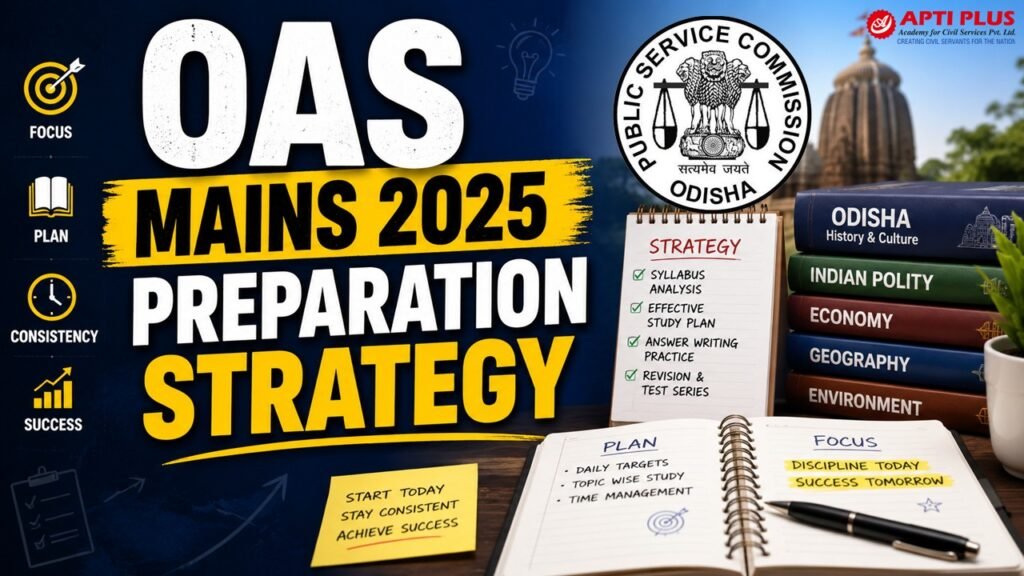
OAS Prelims Ends on 7 June. The Real Examination Starts on 8 June.
On 7 June, thousands of aspirants will appear for the OPSC OAS Preliminary Examination. For many candidates, the examination journey revolves around prelims. They spend months preparing MCQs, solving test papers, and analysing current affairs.
However, the harsh reality is that prelims is only a screening examination.
It helps you enter the competition.
It does not help you win it.
The final merit list is determined primarily by your performance in the mains examination and interview.
Every year, hundreds of candidates clear prelims but fail to secure a final rank because they start mains preparation too late.
They wait for answer keys.
They wait for cut-off predictions.
They wait for results.
Unfortunately, OPSC OAS Mains does not reward waiting.
The candidates who eventually secure top ranks are usually those who begin their OAS 2025 Mains Preparation immediately after prelims.
If you are serious about becoming an Odisha Administrative Service officer, 8 June should not be a break.
It should be Day One of your mains journey.
Why Most OAS Aspirants Fail in Mains Despite Clearing Prelims
Many aspirants assume that clearing prelims automatically puts them on the path to selection.
This is one of the biggest misconceptions.
The reality is that opsc ocs mains demands an entirely different skill set.
Most candidates struggle because they:
- Read more than they write
- Keep collecting study material
- Ignore answer-writing practice
- Delay optional preparation
- Neglect essay and ethics
- Revise inadequately
- Avoid mock tests
- Never get their answers properly evaluated
OPSC OAS 2025 Mains is not a test of information.
It is a test of presentation, analysis, structure, and administrative thinking.
The sooner aspirants understand this, the better their chances of success.
Pillar 1: Daily Answer Writing Must Start from 8 June
One habit separates serious rankers from average aspirants. They write answers every day.
Many candidates spend six to eight hours reading but struggle to write even one quality answer.
This creates a major problem during mains.
The examiner is not evaluating your notes.
The examiner is evaluating your answer sheet.
Therefore, daily answer writing must become a non-negotiable part of your routine.
Follow the 2–3 Answers Daily Rule
Start with:
- One GS answer
- One current affairs-based answer
- One optional answer
Over time, increase your writing volume.
Practice from PYQs
OPSC Mains Previous Year Questions reveal:
- OPSC’s thought process
- Frequently asked themes
- Expected depth of analysis
PYQs should become the foundation of answer-writing practice.
Integrate Current Affairs
Good answers connect static concepts with contemporary developments.
For example:
A governance answer becomes stronger when linked with recent schemes, reports, or Odisha government initiatives.
Use Diagrams and Flowcharts
Visual presentation improves readability.
Simple diagrams often communicate more effectively than lengthy paragraphs.
Master the 7–9 Minute Rule
One of the biggest reasons candidates lose marks is poor time management.
You may know the answer.
But if you cannot complete the paper, marks are lost.
Train yourself to write:
- 10-mark questions in approximately 7 minutes
- 15-mark questions in approximately 9 minutes
Timed practice is essential.
Remember:
A completed average answer generally scores better than an incomplete excellent answer.
Pillar 2: Learn the OPSC Mains Answer Framework
Many candidates write everything they know.
High-scoring candidates write exactly what is required.
A strong answer generally consists of:
Introduction
The introduction may contain:
- Definition
- Constitutional provision
- Data
- Committee recommendation
- Current context
Multi-Dimensional Body
Depending on the question, include:
- Social perspective
- Economic perspective
- Political perspective
- Administrative perspective
- Environmental perspective
- Ethical perspective
- Odisha-specific perspective
This multidimensional approach demonstrates maturity and analytical ability.
Conclusion
The conclusion should be:
- Positive
- Practical
- Reform-oriented
- Future-focused
This simple framework significantly improves answer quality.
Pillar 3: Optional Subject Will Decide Your Rank
Many aspirants focus heavily on General Studies after prelims while postponing optional preparation.
This is a serious mistake.
Optional subjects often become the biggest differentiator in final rankings.
A difference of even 40–50 marks in optional can dramatically change rank outcomes.
Whether your optional is:
- Public Administration
- Geography
- History
- Political Science
- Sociology
- Anthropology
- Odia Literature
or any other subject, preparation must begin immediately after prelims.
Optional Preparation Strategy
- Analyse the syllabus
- Study PYQs
- Prepare concise notes
- Practice answer writing
- Revise repeatedly
Common Mistakes in Optional Preparation
- Ignoring Paper II
- Delaying answer writing
- Studying without PYQ analysis
- Lack of revision
Candidates who score highly in optional generally revise their material multiple times and write regularly.
Pillar 4: Essay Can Be Your Biggest Rank Booster
Essay remains one of the most underestimated papers in OAS 2025 Mains.
Many candidates prepare extensively for GS but leave essay preparation for the final weeks.
This often proves costly.
A good essay reflects:
- Clarity of thought
- Depth of understanding
- Administrative maturity
- Logical organisation
Prepare Diverse Themes
Practice essays on:
Philosophical Themes
- Success and failure
- Happiness and development
- Ethics and leadership
Social Themes
- Women empowerment
- Education
- Social justice
- Technology and society
Governance Themes
- Cooperative federalism
- Good governance
- Inclusive development
Odisha-Specific Themes
- Disaster resilience
- Tribal development
- Sustainable growth
Regular essay practice creates confidence and improves expression.
Pillar 5: Ethics Can Become Your Highest Scoring Paper
Many aspirants fear Ethics because they consider it abstract.
In reality, Ethics is one of the most scoring papers.
The challenge is not content.
The challenge is application.
Focus on:
- Integrity
- Accountability
- Transparency
- Empathy
- Compassion
- Emotional Intelligence
- Probity
Practice Ethics Case Studies
Case studies should become a regular part of preparation.
Learn:
- Stakeholder analysis
- Conflict resolution
- Administrative decision-making
High-scoring Ethics answers combine ethical principles with practical solutions.
Pillar 6: Odisha-Specific Preparation Gives You an Extra Edge
This is where OPSC Mains 2025 differs from many other examinations.
OPSC expects candidates to understand Odisha’s unique challenges and opportunities.
Focus on:
Odisha Economy
- Agriculture
- Industrial development
- Tourism
- MSMEs
Odisha Governance
- Welfare schemes
- Administrative reforms
- Service delivery
Tribal Development
- Inclusion
- Livelihoods
- Education
Disaster Management
- Cyclone preparedness
- Climate resilience
- Community participation
Culture and Heritage
- Language
- Art forms
- Historical contributions
Whenever possible, enrich answers with Odisha-specific examples.
This significantly improves answer quality.
Pillar 7: Revision Is the Real Secret of OAS Mains 2025 Success
Many candidates study continuously but revise very little. This is one of the biggest reasons for poor mains performance.
Revision converts information into usable knowledge.
Successful candidates typically revise multiple times before mains.
Aim for 3–5 Revision Cycles
Each revision improves:
- Recall
- Clarity
- Confidence
- Speed
Condense Notes
Reduce each GS paper into:
- 20–30 pages
- Issue-wise summaries
- Quick revision sheets
Use Mind Maps
Mind maps help:
- Establish linkages
- Improve retention
- Develop multidimensional thinking
Use Flashcards
Useful for:
- Schemes
- Reports
- Committees
- Constitutional provisions
- Important data
Revision is not repetition.
Revision is strategic refinement.
Pillar 8: Spend More Time on Weak Areas
Many aspirants repeatedly revise subjects they already enjoy.
This creates a false sense of progress.
The real improvement comes from addressing weaknesses.
After prelims, identify:
- Weakest GS paper
- Weakest optional section
- Weakest essay theme
- Weakest ethics area
A practical approach is:
- 40% effort on strengths
- 60% effort on weaknesses
This leads to balanced preparation and balanced scores.
Pillar 9: Why a Good OAS 2025 Mains Test Series Matters
Mock tests are not merely evaluation tools.
They are improvement tools.
A quality OAS 2025 Mains Test Series should provide:
PYQ-Based Question Framing
Questions should reflect:
- Previous Year Questions
- Latest trends
- OPSC’s evolving demand
Daily Answer Writing Opportunities
Consistency is the foundation of improvement.
Faculty Interaction
Candidates should understand:
- Why marks were deducted
- What dimensions were missing
- How answers can improve
Examiner-Oriented Model Answers
Model answers should teach:
- Structure
- Approach
- Keywords
- Presentation
Detailed Personalised Evaluation
Quality feedback should include:
- Strengths
- Weaknesses
- Missing dimensions
- Presentation suggestions
- Content enhancement
Keyword Enrichment
High-scoring copies often contain terms such as:
- Inclusive Growth
- Cooperative Federalism
- Social Justice
- Climate Resilience
- Human Development
- Ethical Governance
This is precisely why many serious aspirants prefer structured programmes such as the APTIPLUS OAS 2025 Mains Test Series, which focuses on OPSC-oriented question framing, daily answer-writing practice, faculty mentorship, examiner-oriented model answers, and detailed personalised evaluation designed specifically for OAS aspirants.
Last 30 Days Strategy for OAS 2025 Mains
The final month should focus on refinement, not expansion.
Revise Only
Avoid:
- New books
- New coaching material
- Random PDFs
Practice PYQs
Write:
- 8–10 answers daily
- Frequently asked themes
- Odisha-specific topics
Write Full-Length Mocks
Attempt:
- Two full-length mocks every week
Focus on Presentation
Improve:
- Diagrams
- Flowcharts
- Maps
- Underlining
- Keywords
Continue Essay and Ethics Practice
Maintain:
- Essay frameworks
- Ethics case studies
Prioritise Health
- Sleep 7–8 hours
- Stay physically active
- Avoid burnout
The final month is about converting preparation into performance.
The Real Secret Behind High OAS Mains Scores
Most aspirants search for shortcuts.
There are none.
The candidates who secure top ranks generally follow a simple cycle:
Learn→ Revise → Write → Evaluate → Improve → Repeat
They do not wait for motivation.
They build discipline.
They do not collect endless resources.
They repeatedly improve their answer sheets.
As OAS Prelims concludes on 7 June, remember that your mains journey begins immediately thereafter.
The next 120 days will not test how much you have studied.
They will test how effectively you can present your knowledge under examination conditions.
Start early.
Write daily.
Revise repeatedly.
Get evaluated consistently.
That is how successful aspirants transform preparation into ranks.
Frequently Asked Questions (FAQs)
1. When should I start OAS 2025 Mains Preparation?
Immediately after prelims. Waiting for results often leads to loss of valuable preparation time.
2. How many answers should I write daily?
At least 2–3 quality answers every day.
3. How important is the optional subject?
Optional papers often become rank-defining because of their significant contribution to mains marks.
4. How many revisions should I complete before mains?
Ideally 3–5 revision cycles.
5. How should I prepare for Essay?
Practice philosophical, social, governance, and Odisha-specific themes regularly.
6. Is Ethics a scoring paper?
Yes. Ethics can become one of the highest-scoring papers if prepared through case studies and practical application.
7. How many mock tests should I write?
Ideally 8–12 quality full-length mocks before the examination.
8. Why are Odisha-specific examples important?
They make answers more relevant and aligned with OPSC’s expectations.
9. What should I look for in an OAS Mains Test Series?
Look for:
- PYQ-based questions
- OPSC-oriented approach
- Faculty interaction
- Examiner-oriented model answers
- Detailed personalised evaluation
10. What is the biggest mistake candidates make after prelims?
Waiting for results instead of beginning answer writing, revision, optional preparation, essay practice, and mock testing immediately.
| About the Author Agam Mohan Sharma is a Civil Services mentor and content strategist. An alumnus of IIT Roorkee (B.Tech), he has appeared in multiple UPSC Mains and UPSC Personality Tests and has mentored thousands of aspirants preparing for UPSC CSE and various State Civil Services examinations, including OPSC OAS. |