
ABOUT THE AUTHOR:
Agam Mohan Sharma is a Civil Services mentor and content strategist. An alumnus of IIT Roorkee (B.Tech), he has appeared in multiple UPSC Mains and UPSC Personality Tests and has mentored thousands of aspirants preparing for UPSC CSE and various State Civil Services examinations. He specialises in translating dense government orders and policy changes into clear, exam-ready insight for serious aspirants.
Selection Is Only Half the Story
Most aspirants spend years chasing one thing — clearing the UPSC Civil Services Examination. But a quieter, equally decisive step begins the moment your name appears on the final list: cadre allocation. It decides where you will serve — which state, which region, the geography of your entire career.
And contrary to popular belief, it is not decided by luck, lobbying or preference alone. It follows a precise, rule-based national exercise — now revised for 2026.
What Is a ‘Cadre’ and Why It Matters
A cadre is the State, group of States, or Union Territory to which an All India Service officer is permanently assigned — for example, the Bihar, Uttar Pradesh, Kerala or AGMUT cadre. It is where an officer spends most of their working life.
Cadre allocation is therefore not a formality. It balances three competing demands: federal needs (every State must get officers), administrative efficiency (vacancies filled fairly), and national integration (officers should not cluster only in their home regions).
What Decides Your Cadre? Five Factors
Allocation is not driven by preference alone. Five interlocking factors shape the outcome:
- Cadre-wise and category-wise vacancies
- Merit rank — your All India Rank within your category
- Category — UR, OBC, SC, ST (EWS adjusted within UR)
- The insider–outsider principle
- Cycle-based distribution across groups of states
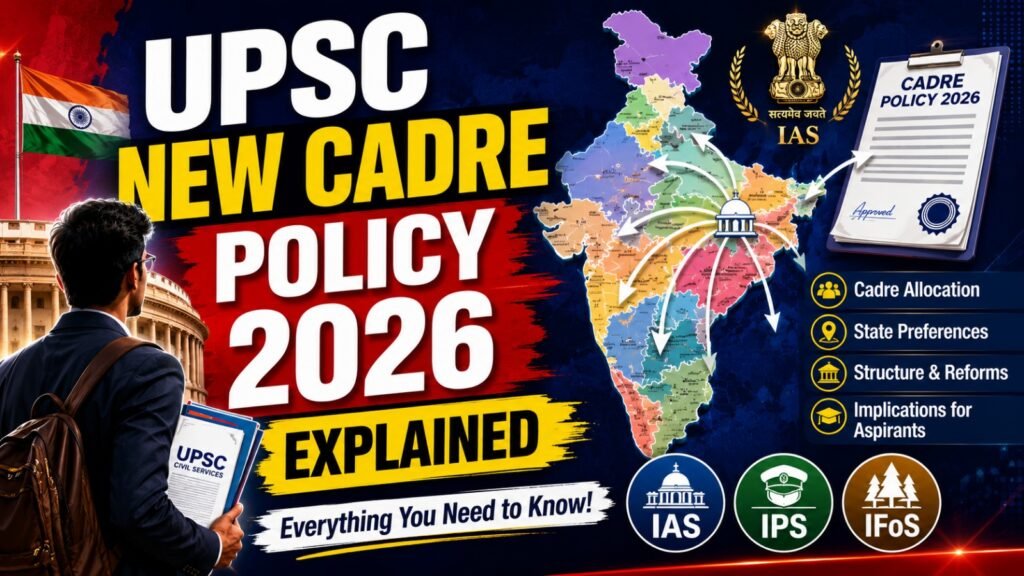
The 2026 Revision: From Five Zones to Four Groups
For nearly a decade, allocation followed the 2017 zonal policy, which grouped cadres into five geographical zones. The intent was integration, but clustering persisted — candidates simply stacked neighbouring zones at the top.
Through a Department of Personnel & Training (DoPT) Office Memorandum, the Government has issued a revised policy that replaces the five zones with a four-group alphabetical framework, applicable from CSE 2026 and IFoS 2026 onwards. The insider–outsider ratio of roughly 1:2 — about one home-state officer for every two outsiders — is preserved.
Step 1: Determining Vacancies
Everything begins with a vacancy map. Before any preference is exercised, a detailed cadre-wise and category-wise statement of open posts is prepared. Key rules:
- States must send their vacancy requirements within a fixed timeline; late requisitions are not counted for that year.
- EWS is treated within the UR category — it creates no separate vacancy pool.
- Vacancies are led by DoPT (IAS), the Ministry of Home Affairs (IPS) and the Ministry of Environment, Forest & Climate Change (IFoS).
| Takeaway: Even before a single preference is filled, the “vacancy map” is locked — and this structure, not your wish list, drives the entire allocation. |
Step 2: The Four-Group Framework
All State and Joint Cadres are organised alphabetically into four groups, which set the sequence for outsider allocation:
| Group | Cadres / Joint Cadres |
| Group I | AGMUT, Andhra Pradesh, Assam–Meghalaya, Bihar, Chhattisgarh |
| Group II | Gujarat, Haryana, Himachal Pradesh, Jharkhand, Karnataka, Kerala, Madhya Pradesh |
| Group III | Maharashtra, Manipur, Nagaland, Odisha, Punjab, Rajasthan, Sikkim, Tamil Nadu |
| Group IV | Telangana, Tripura, Uttarakhand, Uttar Pradesh, West Bengal |
Step 3: Insider Allocation (Your Home Cadre)
An insider is allotted to their home cadre. Three conditions must hold together:
- Willingness is mandatory — if you don’t explicitly opt for your home cadre, you are not considered an insider at all.
- An insider vacancy exists in that cadre and your category.
- Your rank is high enough within your category list to claim it.
Separate category-wise merit lists (UR/OBC/SC/ST) are prepared, and insiders are allotted strictly by rank. Because there are 25 cadres, the policy works in cycles (1–25, 26–50, and so on) — an operational method to distribute insider allotments fairly, not a separate preference rule.
What If an Insider Vacancy Can’t Be Filled?
If a category’s insider vacancy has no eligible candidate, a structured exchange mechanism kicks in:
- It may be adjusted using an insider of another category, if a matching outsider vacancy exists to balance the swap.
- PwBD candidates get priority in such adjustments.
- If still unfilled, it converts to an outsider vacancy — and is not carried forward to the next year.
Step 4: Outsider Allocation
Once insider allotments are done, the rest are filled as outsiders.
PwBD candidates first
PwBD candidates who miss their home cadre are considered first. They may name one additional preferred cadre; if no vacancy exists there, they can be accommodated via a supernumerary post.
Everyone else — the cycle
- In the first cycle, cadres that received no insider are allotted one outsider each in merit order.
- The process moves group to group: Group I → II → III → IV → I.
- If someone lands their own home cadre as an outsider, an exchange preserves the insider–outsider balance.
Rotation, Timing & Applicability
To keep things fair over the long run, the group order rotates every year — the group placed first this year drops to the bottom next year. No region permanently enjoys first priority.
For the IAS, allocation is completed as early as possible, preferably before the professional course; for the IPS and IFoS, soon after appointment. The revised policy supersedes all earlier ones and applies from CSE 2026 and IFoS 2026 onwards.
What This Means for Aspirants
- Drop the zone-stacking mindset — treat your list as one ranked preference of cadres.
- Place your home cadre first if you want it — the insider check runs before group rotation, so it costs nothing strategically.
- Fill every slot thoughtfully — the roster reads down your list mechanically.
| Bottom line: Cadre allocation is not a lottery. It is a transparent equation of rank, category, vacancy and the insider–outsider rule. |
FAQs on Cadre Allocation Policy 2026
1. What is the cadre allocation policy?
A rule-based system that allots selected IAS, IPS and IFoS officers to State cadres based on rank, category, vacancies and the insider–outsider principle.
2. What changed in 2026?
The 2017 five-zone system is replaced by four alphabetical groups of cadres, with a rotational, cycle-based mechanism, from CSE 2026 and IFoS 2026 onwards.
3. What do ‘insider’ and ‘outsider’ mean?
An insider is allotted to their home State cadre; an outsider to any cadre other than their home State.
4. Can I get my home state cadre?
Yes — if you explicitly opt for it (willingness is mandatory) and an insider vacancy is available in your category at your rank.
5. Does rank matter?
Yes. Allocation is strictly based on merit rank within your category, combined with vacancy availability.
6. How is EWS treated?
EWS is treated within the unreserved (UR) category and does not create a separate vacancy pool.
7. From which year is it applicable?
From CSE 2026 and IFoS 2026 onwards. It supersedes all earlier cadre allocation policies.