
About the Author:
Agam Mohan Sharma is a Civil Services mentor and content strategist. An alumnus of IIT Roorkee (B.Tech), he has appeared in multiple UPSC Mains and UPSC Personality Tests and has mentored thousands of aspirants preparing for UPSC CSE and various State Civil Services examinations.
UPSC Mains 2026 Starts on 21 August. The Real Examination Starts Today.
For most aspirants, UPSC preparation revolves around completing the syllabus.
They spend months reading standard books.
Preparing notes.
Following current affairs.
Solving PYQs.
Attending classes.
Yet every year, thousands of candidates who clear prelims comfortably fail to perform in Mains.
Why?
Because UPSC CSE Mains is not a test of preparation.
It is a test of execution.
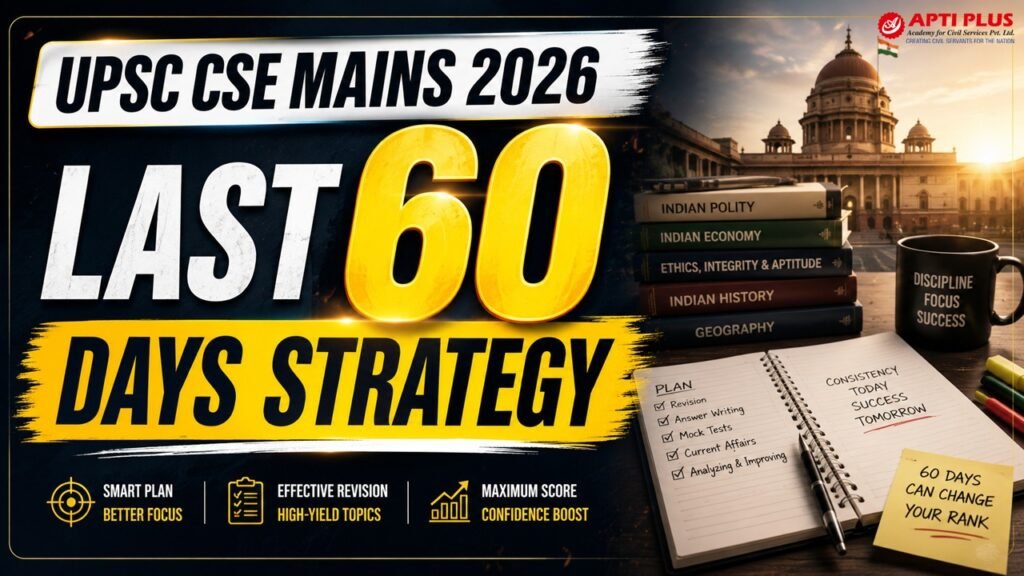
The UPSC CSE 2026 Mains begins on 21 August 2026, but the battle that decides ranks will be fought in the sixty days before it.
Unfortunately, many aspirants spend these crucial weeks doing exactly the wrong things.
They start new books.
They download fresh PDFs.
They watch endless current affairs videos.
They keep collecting content.
They postpone answer writing because they feel they are “not fully prepared.”
This is precisely why many well-prepared candidates underperform every year.
The final sixty days are not about learning more.
They are about converting preparation into marks.
Why Most UPSC Aspirants Underperform in Mains Despite Years of Preparation
One of the biggest misconceptions among aspirants is that knowledge automatically translates into marks.
It does not.
The reality is that UPSC CSE Mains 2026 demands a completely different skill set.
Most candidates struggle because they:
- Read more than they write
- Keep collecting study material
- Delay answer writing
- Ignore presentation
- Neglect Essay preparation
- Underestimate Ethics
- Avoid full-length mocks
- Revise inadequately
- Never get answers evaluated properly
UPSC CSE 2026 Mains is not testing how much you know.
It is testing how effectively you can communicate your knowledge within a limited time.
The sooner aspirants understand this, the greater their chances of securing a rank.
Pillar 1: Revision Must Become Your Primary Activity
The biggest mistake aspirants make in the final two months is trying to study new material. Top performers do the opposite.
They revise. Relentlessly.
By this stage, most aspirants have already covered the syllabus at least once.
The challenge is no longer learning. The challenge is recall.
Revision converts information into examination-ready content.
A practical target should be:
- Three revision cycles for GS
- Three revision cycles for Optional
- Multiple revisions of Ethics examples
- Continuous revision of Essay content
Condense your preparation into:
- One-page notes
- Issue-wise summaries
- Mind maps
- Data repositories
- Committee repositories
- Current affairs examples
Remember:
Revision creates recall. Recall creates speed. Speed creates marks.
Pillar 2: Daily Answer Writing Must Continue Till the Examination
One habit consistently separates rankers from non-rankers. They write. Every day.
Many aspirants spend eight hours studying but struggle to write even one quality answer.
This becomes a major problem in Mains. The examiner is not evaluating your notes. The examiner is evaluating your answer sheet.
Therefore, answer writing cannot be postponed.
A practical approach is:
- Two GS answers daily
- One Ethics answer daily
- Two Optional answers daily
UPSC Mains Previous Year Questions reveal:
- UPSC’s thought process
- Frequently asked themes
- Expected depth of analysis
PYQs should become the foundation of answer-writing practice.
Focus on:
- Understanding question demand
- Structured introductions
- Multi-dimensional analysis
- Effective conclusions
- Presentation
- Time management
Writing is not a separate activity. Writing is preparation itself.
Pillar 3: Why Most Aspirants Remain Stuck Despite Completing the Syllabus
This is perhaps the most frustrating stage of UPSC preparation.
Many aspirants entering the final sixty days have:
- Completed the syllabus
- Prepared notes
- Solved PYQs
- Revised multiple times
Yet their marks remain stagnant.
The problem is not content. The problem is answer quality.
As the ABHYUDAY 2026 programme correctly highlights:
“Same Question. Same Syllabus. Phir Bhi Marks Alag Kyun?”
The difference lies in:
- Structure
- Flow
- Presentation
- Writing approach
Many answers are informative. Few are effective.
Average answers fill pages. High-scoring answers fulfil the demand of the question.
This distinction often determines whether an aspirant remains stuck at average scores or progresses towards a rank.
Pillar 4: Writing Answers Is Not Enough. Correction Creates Ranks.
Most aspirants follow this cycle:
Write → Check Marks → Write Again
Top rankers follow a different cycle:
Write → Evaluate → Identify Mistakes → Correct → Improve
This is precisely the philosophy behind ABHYUDAY 2026.
The programme is built around what it calls the ABHYUDAY Loop:
- Write
- Dissect
- Identify
- Correct
- Improve
- Repeat
Its core philosophy is simple:
“This is not a comfort programme. This is a correction programme.”
Most aspirants repeatedly make the same mistakes:
- Generic introductions
- Weak conclusions
- Missing dimensions
- Poor examples
- Weak presentation
- Lack of analytical depth
Without correction, these mistakes continue until the examination.
Consistent correction creates consistent improvement. And consistent improvement creates ranks.
Pillar 5: Feedback Matters More Than Testing
Many aspirants write tests.
Very few improve from them.
The reason is simple.
Most evaluations are superficial.
A score alone does not improve an answer.
Improvement happens when candidates understand:
- Why marks were deducted
- Which dimensions were missing
- Which examples could be added
- How the structure could improve
ABHYUDAY’s evaluation framework focuses precisely on these aspects through detailed assessment of:
- Question demand
- Structure
- Content accuracy
- Analytical ability
- Current affairs integration
- Use of examples
- Value addition
- Keywords
- Conclusion quality
- Overall examiner impression
Rather than generic remarks, the emphasis is on actionable feedback and measurable improvement.
This becomes particularly valuable during the final two months when every test should contribute to score improvement.
Pillar 6: Optional Subject Can Decide Your Rank
Many aspirants become overly focused on GS after prelims. This is a serious mistake.
Optional papers continue to be one of the biggest rank differentiators.
A difference of even 40–50 marks can dramatically alter rank outcomes.
The final sixty days should focus on:
- PYQ analysis
- Repeated revision
- Topic-wise answer writing
- Full-length tests
- Model answer preparation
Common mistakes include:
- Ignoring Paper II
- Delaying answer writing
- Reading without revision
- Neglecting test practice
Candidates who score highly in Optional usually revise repeatedly and write regularly.
Pillar 7: Essay Remains the Most Underestimated Paper
Many aspirants prepare seriously for GS but casually for Essay. This often proves costly.
Essay is not merely a writing exercise.
It is a test of:
- Clarity of thought
- Depth of understanding
- Administrative maturity
- Logical organisation
Write at least one essay every week. More importantly, build frameworks. Frameworks create structure. Structure creates marks.
Pillar 8: Ethics Can Become Your Highest Scoring GS Paper
Many aspirants fear Ethics.
In reality, Ethics is often one of the most scoring papers in UPSC Mains.
The challenge is not content. The challenge is application.
Prepare:
- Definitions
- Thinkers
- Administrative examples
- Case studies
- Stakeholder frameworks
High-scoring Ethics answers combine ethical principles with practical administrative solutions.
Pillar 9: Stop Collecting Current Affairs. Start Integrating Them.
One of the biggest mistakes during the final sixty days is excessive current affairs consumption. At this stage, aspirants should focus on integration.
Every major issue should enrich:
- GS-II
- GS-III
- Essay
- Ethics
Build:
- Data repositories
- Case study repositories
- Examples bank
- Issue-wise notes
Current Affairs should strengthen answers. Not become a separate subject.
Pillar 10: Why Full-Length Mocks Become Critical in the Final Sixty Days
Knowledge alone cannot prepare you for writing twenty questions in three hours.
Only practice can.
Full-length mocks help aspirants:
- Improve writing speed
- Build stamina
- Complete papers
- Improve time management
- Simulate examination pressure
This is where the final phase of UTKRISHTI 360 becomes particularly important.
The programme’s last stretch includes multiple full-syllabus GS papers, Essay papers and simulator tests specifically designed to replicate actual UPSC examination conditions and improve performance under pressure.
Most aspirants know the syllabus.
Very few know how to execute it efficiently under examination conditions.
Last 30 Days Strategy for UPSC CSE Mains 2026
The final month should focus on refinement, not expansion.
Revise Only
Avoid:
- New books
- New coaching material
- Random PDFs
Continue Answer Writing
Maintain:
- 4–6 answers daily
- Ethics case studies
- Essay brainstorming
Attempt Full-Length Mocks
At least:
- Two GS papers every week
- One Essay paper every week
Improve Presentation
Focus on:
- Flowcharts
- Diagrams
- Maps
- Keywords
- Underlining
Prioritise Health
- Sleep 7–8 hours
- Maintain routine
- Avoid burnout
The final month is about converting preparation into performance.
The Real Secret Behind High UPSC Mains Scores
Most aspirants search for shortcuts.
There are none.
Successful candidates follow a simple cycle:
Learn → Revise → Write → Evaluate → Improve → Repeat
They do not keep changing resources.
They do not wait for motivation.
They continuously improve their answer sheets.
As UPSC CSE Mains 2026 approaches on 21 August 2026, remember that the next sixty days will not test how much you have studied.
They will test how effectively you can present your knowledge under examination conditions.
Start revising. Write daily. Get evaluated. Improve relentlessly.
That is how preparation gets converted into ranks.
And that is precisely why serious aspirants increasingly rely on structured answer-writing ecosystems like ABHYUDAY 2026 for continuous feedback and mentorship, along with full-syllabus simulation platforms like UTKRISHTI 360 to master execution before the examination.
Frequently Asked Questions (FAQs)
1. How many answers should I write daily in the last two months?
Ideally 4–6 quality answers covering GS, Ethics and Optional.
2. How many revision cycles should I complete before Mains?
Aim for at least three complete revision cycles.
3. How important is Optional during the final sixty days?
Extremely important. Optional often becomes the rank differentiator.
4. Should I start new books now?
No. Focus on revision and consolidation.
5. How many full-length mocks should I write?
Ideally 8–12 quality full-length tests before Mains.
6. How should I prepare for Essay?
Write one essay weekly and maintain a repository of examples, quotes and case studies.
7. Is Ethics a scoring paper?
Yes. Ethics can become one of the highest-scoring papers with proper case-study practice.
8. Should I read newspapers extensively now?
Focus on integrating current affairs into GS, Essay and Ethics rather than excessive reading.
9. Why is answer evaluation important?
Evaluation identifies weaknesses and enables targeted improvement.
10. What is the biggest mistake aspirants make in the last sixty days?
Trying to learn new content instead of revising, writing, evaluating and improving.