
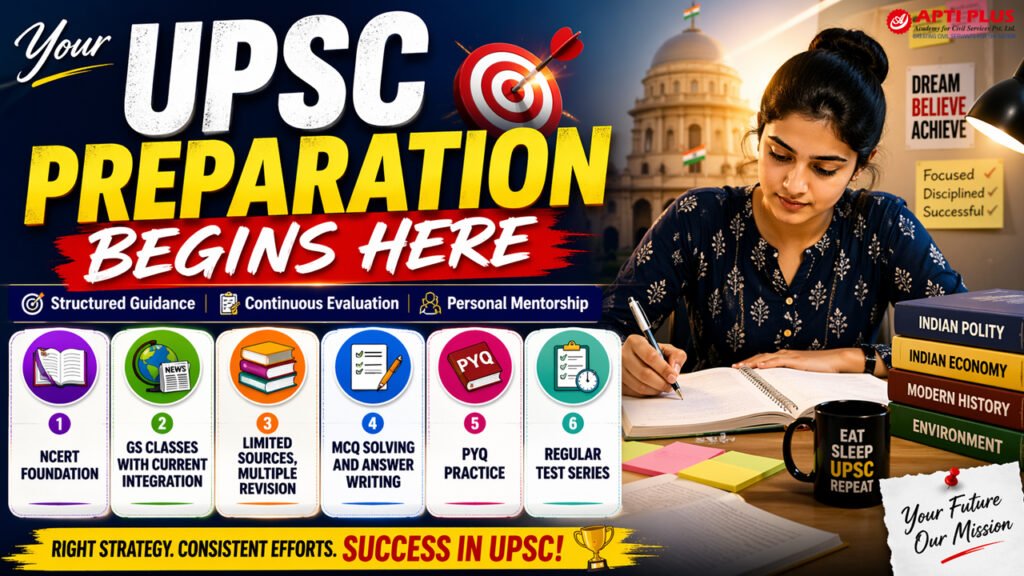
Preparing for the Civil Services Examination conducted by the Union Public Service Commission requires a well-planned strategy, conceptual clarity, and consistent effort. For beginners, the journey may appear complex due to the vast syllabus and dynamic nature of the exam. However, with the right approach and access to the best IAS coaching in Kolkata like APTIPLUS Academy, even a complete beginner can build a strong foundation and succeed.
What is UPSC and Why is it Challenging?
The UPSC Civil Services Examination is conducted in three stages:
- Preliminary Examination which tests objective knowledge and screening ability
- Mains Examin1ation which evaluates analytical depth, writing skills, and conceptual clarity
- Personality Test or Interview which assesses decision-making, awareness, and personality traits
The exam is considered challenging because:
- The syllabus is vast and spans multiple disciplines
- Questions are analytical rather than factual
- There is uncertainty and unpredictability in question patterns
- It requires sustained preparation over a long period
- Very low selection ratio increases competition
For beginners, understanding this nature helps in aligning expectations and IAS preparation strategy.
Join APTIPLUS Academy, the Best IAS Institute in Kolkata to begin your UPSC Journey Today.
How to Start Preparation for UPSC
Starting UPSC CSE preparation from zero requires clarity, discipline, and proper guidance. The following steps should be followed in a structured manner.
Understand the Syllabus and Exam Pattern
The UPSC syllabus is the foundation of preparation as it clearly defines what to study and what to avoid. Beginners often make the mistake of studying randomly without referring to the syllabus, which leads to confusion and wasted effort. Therefore, developing clarity of the syllabus is the first and most important step.
Aspirants should read the syllabus multiple times, break it into smaller topics, and identify their strengths and weaknesses. Link syllabus topics with previous year questions. At APTIPLUS, structured guidance ensures that aspirants understand the syllabus in a focused and exam-oriented manner.
Stage 1: Preliminary Examination
The Preliminary Examination consists of two objective papers conducted on the same day. It is a screening stage, and its marks are not counted in the final merit list.
There is negative marking of one-third for incorrect answers.
General Studies Paper I evaluates knowledge across subjects such as current affairs, history, geography, polity, economy, environment, and science. This paper determines qualification for the Mains stage.
CSAT (Paper II) assesses aptitude in areas like comprehension, reasoning, and basic mathematics. Although it is qualifying in nature, securing at least 33 percent is mandatory.
At APTIPLUS, the Nischay Prelims Test Series is designed to build conceptual clarity, accuracy, and exam temperament required to clear this stage.
Stage 2: Mains Examination
The Mains Examination is a descriptive test that evaluates analytical ability, conceptual clarity, and answer writing skills.
There are nine papers, out of which seven are counted for merit, totaling 1750 marks. These include Essay, four General Studies papers, and two papers of the optional subject.
The optional subject plays a crucial role as it carries 500 marks and can significantly impact the final rank.
At APTIPLUS, programs like Abhyuday Mains Enrichment Program and Utkrishti Mains Test Series help aspirants develop structured answer writing, improve content quality, and gain continuous feedback.
Stage 3: Personality Test
The final stage is the Interview, which carries 275 marks and assesses overall personality rather than academic knowledge.
The panel evaluates qualities such as confidence, communication skills, decision-making ability, leadership, and awareness of national and international issues.
At APTIPLUS, focused mentorship and interview guidance ensure that aspirants are well-prepared to perform confidently in this stage.
APTIPLUS Approach
At APTIPLUS, preparation begins with strong syllabus clarity, followed by structured coverage, continuous evaluation, and focused mentorship. Through integrated programs like Nischay, Utkrishti, Abhyuday, and Samiksha, aspirants are guided at every stage of the UPSC journey in a systematic and result-oriented manner.
Build a Strong Foundation with NCERTs
NCERT books are the backbone of preparation, especially for beginners. They help in:
- Building conceptual clarity in simple language
- Understanding basic frameworks of subjects
- Creating a base for advanced books
Recommended approach:
- Start from class 6 to 10 for basic understanding
- Move to class 11 and 12 for advanced clarity
- Make short notes while reading
- Revise multiple times to retain concepts
Subjects like History, Geography, Economics, and Polity should be prioritized.
Read Newspaper Daily
Newspaper reading is essential for current affairs preparation. Aspirants should:
- Read one standard newspaper daily for 60 to 90 minutes
- Focus on editorials, government schemes, international relations, and economic developments
- Make short notes of important issues
- Link current affairs with static syllabus
Avoid wasting time on irrelevant news such as local crime or political statements.
Choose Standard Reference Books
After completing NCERTs, aspirants should move to limited and standard sources. Important points:
- Select one book per subject
- Avoid multiple sources for the same topic
- Revise the same book multiple times
- Focus on conceptual understanding rather than memorization
This approach prevents confusion and ensures depth in preparation.
Make Notes for Revision
Notes play a crucial role in revision and retention. Effective note-making includes:
- Writing in bullet points for easy recall
- Keeping notes concise and exam-oriented
- Regularly updating notes with current affairs
- Using diagrams, flowcharts, and keywords
Good notes reduce revision time significantly before exams.
Best Strategy for UPSC Preparation for Beginners
A well-defined strategy is essential for efficient preparation.
Focus on Conceptual Clarity
UPSC does not reward rote learning. It tests understanding and application. Aspirants should:
- Understand the why and how behind concepts
- Relate topics with real-life examples
- Practice application-based questions
- Focus on interlinking subjects
Integrate Prelims and Mains Preparation
Preparation should not be done separately. Effective integration involves:
- Studying topics in depth for Mains while preparing facts for Prelims
- Practicing MCQs along with answer writing
- Linking current affairs with static subjects
- Covering overlapping syllabus areas together
Practice Answer Writing Early
Answer writing is crucial for Mains success. Beginners should:
- Start with basic questions and gradually increase difficulty
- Follow introduction, body, and conclusion format
- Use headings and subheadings for clarity
- Practice time-bound writing
- Get answers evaluated for improvement
Solve Previous Year Questions
Previous year questions provide valuable insights. They help in:
- Understanding important topics
- Analyzing question patterns
- Identifying frequently asked areas
- Improving answer framing
Solving them regularly improves confidence and direction.
Attempt Regular Tests
Joining a Test series for UPSC is essential for performance evaluation. Benefits include:
- Understanding exam environment
- Improving time management
- Identifying strengths and weaknesses
- Tracking progress over time
Role of Coaching in UPSC Preparation
While self-study is important, structured guidance can accelerate preparation. A good UPSC coaching institute provides:
- Structured timetable and syllabus coverage
- Expert faculty guidance
- Regular doubt resolution
- Peer learning environment
- Motivation and discipline
For beginners, coaching reduces confusion and provides direction.
Choosing the Best Coaching Institute
Selecting the right IAS training institute is crucial. Aspirants should look for:
- Experienced and qualified faculty
- Updated and comprehensive study material
- Regular Test Series for UPSC
- Answer writing support
- Personal mentorship
- Proven track record
A good institute acts as a complete best IAS training institute guiding aspirants through all stages.
In search of best coaching for UPSC in Kolkata? Book your Free Counselling Today!
Self Study vs Coaching: What Should Beginners Choose
Both methods have their advantages.
Self Study
- Flexible schedule and pace
- Cost effective
- Requires high discipline and self-motivation
- Suitable for experienced learners
Coaching
- Provides structured guidance and clarity
- Reduces confusion and saves time
- Offers regular evaluation and feedback
- Helps beginners build consistency
A combination of both is ideal for most aspirants.
Common Mistakes Beginners Should Avoid
- Not understanding the syllabus properly
- Referring to too many books and sources
- Ignoring revision and note-making
- Delaying answer writing practice
- Neglecting current affairs
- Lack of consistency in preparation
Avoiding these mistakes can significantly improve preparation quality.
Ideal Study Plan for Beginners
Daily Plan
- Study for 6 to 8 hours with focused sessions
- Read newspaper and make notes
- Cover one core subject topic
- Revise previously studied topics
- Practice MCQs or answer writing
Weekly Plan
- Complete one subject or major topic
- Revise entire week’s study
- Practice answer writing regularly
- Attempt sectional tests
Monthly Plan
- Revise full syllabus covered so far
- Analyze performance in tests
- Identify weak areas and improve
- Adjust strategy based on progress
Confused with how to structure your UPSC routine? Get help from the experts.
Importance of Consistency and Discipline
Consistency is the most important factor in UPSC preparation. Aspirants should:
- Maintain a daily study routine
- Avoid long breaks and distractions
- Track progress regularly
- Stay motivated and focused on the goal
Even small daily efforts accumulate into significant progress over time.
UPSC preparation for beginners is a structured journey that requires clarity, consistency, and the right guidance. Starting from zero is completely possible with a focused approach.
By following a disciplined strategy, practicing regularly, and choosing the right guidance, aspirants can successfully navigate the UPSC journey and achieve their goals.
FAQs on UPSC Preparation for Beginners
How long does it take to prepare for UPSC?
It usually takes 1 to 2 years of dedicated preparation depending on the individual’s background and consistency.
Is coaching necessary for UPSC?
Coaching is not mandatory, but joining a UPSC coaching institute can provide direction and structured preparation.
Why Kolkata is Emerging as a UPSC Preparation Hub?
Kolkata is becoming a preferred destination for UPSC aspirants. Reasons include:
- Availability of quality institutes offering the best UPSC coaching in Kolkata
- Affordable cost of living compared to Delhi
- Growing academic culture and peer groups
- Access to experienced faculty and mentorship
Students no longer need to relocate far when they can access the best IAS coaching in Kolkata itself.
Why APTI PLUS is Among the Best?
APTI PLUS is widely regarded as a structured and result-oriented institute and is often considered as the best IAS institute in Kolkata. The reasons include:
- Faculty from top institutes ensuring high-quality teaching
- Study material aligned with top institutes
- Affordable fee structure compared to major coaching hubs
- Strong mentorship model with personalized attention
- Focus on answer writing and exam-oriented preparation
What are the Courses Offered by APTI PLUS?
General Studies for Prelims and Mains with complete syllabus coverage
- Optional subject coaching with conceptual clarity
- CSAT preparation focusing on aptitude and reasoning
- Interview guidance with mock sessions and personality development
This makes it a complete best coaching centre for UPSC CSE.
What are the key features of the Courses Offered by APTI PLUS?
- Experienced Faculty with strong subject expertise
- Comprehensive Study Material updated with current trends
- Structured Courses ensuring complete syllabus coverage
- Regular Test Series for UPSC with detailed feedback
- Dedicated Answer Writing Practice sessions
- Personalized Mentorship and doubt resolution
- Consistent Results and performance track record
- Both offline and online learning options, making it suitable for aspirants seeking the best IAS preparation institute as per their convenience.
What are the UPSC Coaching locations of APTI PLUS in Kolkata?
APTI PLUS Salt Lake Branch Address : Office No 407, 4th floor, AG 112, Amp Vaisaakkhi Mall, AG Block, Sector II, Bidhannagar, Kolkata, West Bengal 700091
Phone: 088203 41777 , Google Location Link
APTI PLUS Bhowanipore Branch Address: 4th Floor, 88, Jawaharlal Nehru Rd, next to PC Chandra Jewellers, Gokhel Road, Bhowanipore, Kolkata, West Bengal 700020
Phone: 081007 65577 , Google Location Link