Why In News?
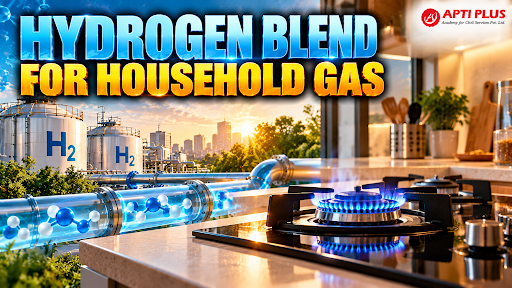
The Petroleum and Natural Gas Regulatory Board (PNGRB) draft guidelines propose permitting up to 5% hydrogen blending in natural gas distributed via domestic Piped Natural Gas (PNG) networks.
Highlights of the PNGRB Draft Guidelines
-
Blending Cap Limit: Maximum commercial threshold of 5% hydrogen blending by volume into existing piped natural gas (PNG) networks.
-
Target Consumer Segment: Strictly limited to domestic household installations. It does not cover commercial/industrial users, Compressed Natural Gas (CNG) used for vehicles, or bulk transmission pipelines.
-
Infrastructure & Implementation Restrictions:
-
Hydrogen injection must happen at a single point into localized, hydraulically isolated sections of the city gas grid.
-
City Gas Distribution (CGD) companies like GAIL and Mahanagar Gas Ltd (MGL) must complete pipeline integrity checks, security safety audits, and network upgrades before getting a go-ahead.
-
Safety & Compliance Safeguards: Commercial deployment can only begin after full statutory permission and an independent technical assessment. The PNGRB retains the power to halt or reduce supply if billing, leakage, or safety concerns emerge.
-
Economic Impact: Hydrogen-blended gas is expected to incur higher processing costs. CGD entities will either have to absorb this cost or pass it on to retail consumers.
What is the PNGRB?
It is a statutory body established in 2006 under the Ministry of Petroleum and Natural Gas. Based in New Delhi, it regulates downstream petroleum and natural gas activities, including pipelines, tariffs, and City Gas Distribution (CGD) networks.
Key Responsibilities
-
Regulation & Infrastructure: Authorizes the laying and operation of petroleum and natural gas pipelines, determines transportation tariffs, and oversees City Gas Distribution (CGD) networks for PNG and CNG.
-
Market & Consumer Interests: Promotes competitive markets and fair trade, safeguards consumer interests, and ensures adequate supply.
-
Standards: Enforces technical, safety, and quality standards for downstream operations.
What Is Hydrogen?
Hydrogen is the lightest, simplest, and most abundant chemical element in the universe (constituting about 75% of normal matter), existing as a colorless, odorless, tasteless, and highly combustible diatomic gas (H2) under standard conditions.
-
Grey Hydrogen: Produced from fossil fuels (primarily natural gas via Steam Methane Reforming). It releases significant carbon dioxide (CO2) into the atmosphere.
-
Blue Hydrogen: Also produced from fossil fuels using natural gas, but the CO2 emissions are captured and stored using Carbon Capture and Storage (CCS) technology.
-
Green Hydrogen: Produced via the electrolysis of water (2H2O2H2+O2) powered entirely by renewable energy sources (solar, wind, or hydro). It emits zero greenhouse gases.
-
Pink Hydrogen: Produced via water electrolysis using electricity generated from nuclear power.
-
Yellow Hydrogen: Produced via water electrolysis using electricity generated strictly from solar energy.
-
Black/Brown Hydrogen: Produced from coal (black uses bituminous coal; brown uses lignite coal) and is the most polluting form.
Significance
-
Decarbonization of Hard-to-Abate Sectors: Replaces fossil fuels in steelmaking, chemical/fertilizer production (green ammonia), and heavy-duty transport/aviation.
-
Energy Security & Independence: Reduces reliance on costly crude oil and gas imports.
-
Renewable Energy Integration: Excess solar or wind electricity can be converted into hydrogen via electrolysis, serving as a long-term energy storage medium to balance grid fluctuations.
-
Fuel Cell Technology: Hydrogen fuel cells combine H2 and oxygen to generate electricity, water vapor, and heat with high efficiency and zero tailpipe emissions.
Initiatives & Targets
-
National Green Hydrogen Mission: Launched with a nodal ministry approach under the Ministry of New and Renewable Energy (MNRE), aiming for:
-
Annual production capacity of at least 5 million metric tonnes (MMT) by 2030.
-
Addition of about 125 GW of renewable energy capacity.
-
Abatement of nearly 50 MMT of annual greenhouse gas emissions by 2030.
-
SIGHT Scheme (Strategic Interventions for Green Hydrogen Transition): Financial incentives for domestic electrolyzer manufacturing and green hydrogen production.
Source: THEHINDU
|
PRACTICE QUESTION Q. What is "Hydrogen Embrittlement", often cited as a technical challenge in hydrogen pipeline transport? (a) The rapid condensation of hydrogen gas into cryogenic liquid at high pressures. (b) The structural degradation and cracking of metal alloys caused by the diffusion of hydrogen atoms into the crystal lattice. (c) The biological breakdown of polymer pipe linings by hydrogen-consuming soil bacteria. (d) The chemical reaction of hydrogen with natural gas to form solid paraffin blockages. Answer: (b) Explanation: Hydrogen embrittlement is a metallurgical phenomenon in which atomic hydrogen diffuses into high-strength steels and metals, reducing their ductility and load-bearing capacity, which can lead to cracking and brittle failure under stress. |