Why In News?
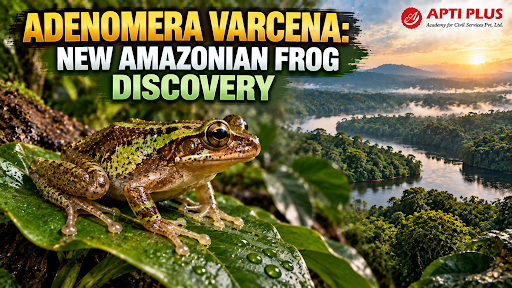
Scientists have discovered Adenomera varcena, a new terrestrial foam-nesting frog species inhabiting the várzea flooded forests of western Amazonia.
What is Adenomera Varcena?
The genus Adenomera comprises small, terrestrial Neotropical frogs distributed across South America east of the Andes.
They belong to the family Leptodactylidae and are known for constructing foam nests in leaf litter or subterranean chambers to protect their eggs.
Characteristics
-
Size & Morphology: Adult males range between 21.2–23.0 mm in snout-vent length (SVL).
-
Diagnostic Marking: Unlike several closely related species, Adenomera varcena lacks a dark spot or solid stripe on the ventral surface of its forearm.
-
Reproductive Behavior: Males construct terrestrial foam nests under leaf litter among root systems to deposit eggs during calling season.
Geographic Distribution
The species found in western Amazonia, recorded across the upper Amazon basin in Brazil (Acre), Ecuador, and Peru. Its distribution is linked to várzea floodplain forests adjacent to major white-water river tributaries.
Environmental Significance
Amphibians possess highly permeable skin and dual life stages, making them sensitive to shifts in temperature, humidity, water quality, and hydrologic flooding regimes. They serve as vital bioindicators of tropical floodplain health.
Adenomera varcena has not yet been formally evaluated on the IUCN Red List of Threatened Species.
Source: DISCOVERWILDLIFE
|
PRACTICE QUESTION Q. Consider the following statements regarding the newly discovered species Adenomera varcena:
Which of the statements given above is/are correct? (a) 1 and 2 only (b) 2 and 3 only (c) 1 and 3 only (d) 1, 2, and 3 Answer: (a) 1 and 2 only Explanation: Statement 1 is correct: Adenomera varcena belongs to the frog family Leptodactylidae. It was officially described in 2026 from the seasonally flooded várzea forests in the upper Juruá River region of Acre, Brazil. Statement 2 is correct: While most members of the genus Adenomera primarily occupy unflooded dryland terra firme forests or open areas, Adenomera varcena is uniquely specialized and adapted to the seasonally flooded várzea floodplain ecosystems. Statement 3 is incorrect: The species was not identified exclusively by visual morphology. Its discovery and distinction from the closely related Adenomera simonstuarti complex relied heavily on an integrated taxonomic approach combining molecular markers (mt- and nuDNA) and acoustic data (advertisement call characteristics) along with comparative morphology. |