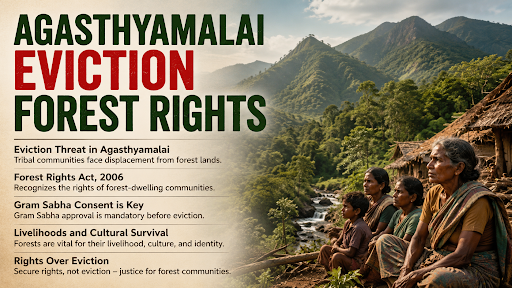
Why In News?
The Supreme Court ordered a time-bound eviction plan for the Agasthyamalai landscape, directing action against government servant encroachers and closure of illegal resorts across Tamil Nadu and Kerala.
About Agasthyamalai
-
The Agasthyamalai lies at the southernmost tip of the Western Ghats, spanning Tamil Nadu and Kerala.
-
The region is recognised as a globally significant biodiversity hotspot within the Western Ghats mountain chain.
-
The Agasthyamalai Biosphere Reserve carries UNESCO recognition and forms the ecological core of the landscape.
-
Inducted into UNESCO’s Man and the Biosphere (MAB) Programme in 2016.
Vegetation Types: Continuous canopy of tropical wet evergreen forests, semi-evergreen, moist-deciduous forests, and high-altitude Shola-grassland ecosystems.
Flora Significance: Possesses over 2,254 species of higher plants, out of which 405 are endemic.
-
It functions as a generic reservoir for wild relatives of commercial crops like cardamom, nutmeg, pepper, and jamun.
-
It is home to the rare Neelakurinji flower (blooms once every 12 years) and the highly valued medicinal herb Arogyapacha.
Fauna: Continuous wildlife corridor protecting the Asian Elephant, Bengal Tiger, Nilgiri Tahr, Lion-Tailed Macaque, Sloth Bear, and the Great Pied Hornbill.
River Systems: Important perennial rivers originate here, including the Thamirabarani River (Tamil Nadu's only perennial river), Neyyar River, and Karamana River.
Indigenous Tribe: Predominantly inhabited by the Kani (or Kanikaran) tribe. They have deep traditional ecological knowledge regarding medicinal herbs.
Cultural History: Named after Sage Agastya (one of the Saptarishis). The region finds prominent mentions in ancient Tamil Sangam literature and the Ramayana.
What Is the Forest Rights Act 2006?
Formally the Scheduled Tribes and Other Traditional Forest Dwellers (Recognition of Forest Rights) Act, 2006, enacted to legally recognise the rights of forest-dwelling communities over land and resources they have traditionally occupied.
-
Individual Forest Rights (IFR): rights to cultivate and reside on forest land held individually by eligible claimants.
-
Community Forest Rights (CFR): rights over community forest resources, including grazing, minor forest produce collection, and management of common forest areas.
-
Rights of forest-dwelling communities: covers both Scheduled Tribes and Other Traditional Forest Dwellers who have resided in forests for generations.
-
Role of Gram Sabha: the Act mandates that claims originate at the Gram Sabha level, which verifies and recommends claims before they proceed to sub-divisional and district-level committees.
Significance
-
Historical injustice: the Act was designed to "undo the historic injustice" done to forest-dwelling communities whose traditional occupation was never formally recorded under colonial and post-colonial forest law.
-
Tribal livelihoods: legal tenure security allows forest-dependent communities to sustainably use land and resources without fear of arbitrary eviction.
-
Community participation: Gram Sabha-based verification embeds local, democratic decision-making directly into forest governance.
-
Forest conservation: community forest rights holders often have strong incentives to protect forest resources they depend on, aligning conservation and livelihood goals when implemented properly.
-
Secure tenure: formal titles convert previously informal, vulnerable occupation into legally protected tenure.
Source: THEHINDU
|
PRACTICE QUESTION Q. The Forest Rights Act, 2006 seeks to undo historic injustice, but high claim rejection rates undermine this objective. Examine (150 words) |