Why In News?
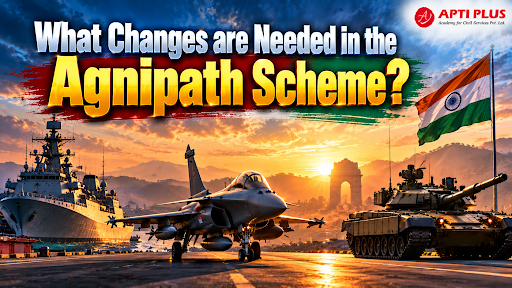
As the first batch of Agniveers nears the end of their four-year tenure, the Army, Navy, and Air Force have submitted official recommendations to improve the implementation of the Agnipath scheme.
What Is The Agnipath Scheme?
Short-term Military Recruitment: Introduced in June 2022, the Agnipath Scheme is a pan-India, merit-based recruitment framework designed to enroll Personnel Below Officer Rank (PBOR) into the Indian Army, Indian Navy, and Indian Air Force.
Agniveer Recruitment: Recruits enrolled under the scheme are designated as Agniveers. Recruitment targets youth aged 17.5 to 21 Years (relaxed to 23 Years for technical streams and the inaugural batch) across non-commissioned ranks.
Four-year Service Period: Enlists personnel for a fixed contractual tenure of 4 Years, which incorporates an initial compressed military training phase.
Limited Permanent Retention: Under the baseline 2022 mandate, up to 25% of each graduating batch is selected for permanent enrolment in the regular cadre based on centralized performance evaluations, serving an additional minimum tenure of 15 Years.
Seva Nidhi Package: The 75% non-retained personnel exit active service with a tax-free, lump-sum Seva Nidhi severance corpus of Rs 11.71 Lakh (built through monthly salary deductions matched equally by the Central Government) without eligibility for lifelong Pension or Gratuity.
Skill Certification: Exiting personnel receive a formal military Skill Certificate, a non-contributory Life Insurance Cover of Rs 48 Lakh during service, and priority in civilian re-employment pathways.

What Are The Objectives?
Reduce Average Age of Armed Forces & Build a Younger Military: Lower the average age profile of combat personnel from 32 Years down to 26 Years within 6 to 7 Years, enhancing physical agility, endurance, and operational combat effectiveness.
Improve Technological Adaptability: Modernize human resources to counter multi-domain threats, including hybrid warfare, cyber warfare, electronic warfare, and space operations.
Reduce Long-term Pension Burden: Arrest burgeoning defense revenue expenditure and pension liabilities, thereby liberating capital budget for defense modernization and indigenous production under Aatmanirbhar Bharat.
Create a Skilled Youth Pool: Instill military discipline, technical capabilities, and civic values in a disciplined youth workforce to support national productivity, emergency response, and Viksit Bharat@2047.
What Are The Major Concerns?
Short Service Period: A brief 4-Year Tenure provides inadequate time for recruits to master complex tactical skills or develop deep operational expertise required for high-intensity warfare.
Limited Permanent Retention & Troop Shortfalls: Restricting regular absorption to 25% risks deepening troop deficits across operational arms; the Indian Army currently faces an accumulated shortfall of nearly 1.8 Lakh PBOR personnel.
Career Uncertainty & Psychological Pressure: The steep 25% retention threshold fosters intense intra-batch competition rather than squad-level collaboration, causing psychological pressure and eroding regimental camaraderie ("Naam, Namak, Nishan").
Training Duration Deficit: Basic military training was reduced from the traditional 37 to 42 Weeks down to 24 Weeks, negatively impacting skill acquisition, weapon handling, and drill standards.
Pension Concerns & Benefit Exclusions: Exiting Agniveers are excluded from statutory Gratuity, lifelong Pension, and Ex-Servicemen (ESM) status, creating long-term financial insecurity.
Recruitment Continuity & Unit Cohesion: Contractual turnover risks weakening unit spirit and tactical trust during active field deployments and counter-insurgency operations.
Post-service Employment Obstacles: Lateral absorption faces friction due to variable state reservation policies, lack of pay/seniority protection in Central Armed Police Forces (CAPFs), and dependence on service-compiled eligibility rosters.
What Improvements Are Being Considered?
Review of Retention Ratio
-
The Indian Navy has proposed retaining 70% to 75% of its Agniveer sailors to recover heavy investments made in technical naval training.
-
The Indian Army and Indian Air Force have recommended raising regular absorption to 50% to 70% for regular troops and up to 75% for technical specialists and Special Forces units like the Bhairav Battalions.
Training Improvements & Extension of Service: Proposals advocate extending active contractual service from 4 Years to 7 to 8 Years, alongside restoring basic military training to its historical duration of 37 to 42 Weeks.
Better Skill Certification & Technical Pathways: Recommendations include professional exit management agencies, direct lateral entry for technical/engineering graduates, and specialized skill conversions to fill senior technical vacancies by 2035.
Stronger Post-service Employment Support: The Ministry of Home Affairs (MHA) has mandated a 50% Reservation for ex-Agniveers in Constable (General Duty) recruitments across CAPFs (such as BSF, CRPF, CISF, ITBP, SSB, Assam Rifles, and NSG), fully waiving written exams, PST, and PET requirements.
Improved Welfare Measures: Suggestions propose granting statutory Gratuity and Ex-Servicemen (ESM) status post 7-year service, ex-gratia disability compensation during training, and combat death subsistence allowances for families.
Recruitment Process Improvements: Recommendations advocate extending the entry age ceiling for technical trades to 23 Years and progressively scaling up annual recruitment intake (e.g., up to 90,000 vacancies in the Army) to eliminate force shortfalls.
Way Forward
Evidence-based Review: Evaluate the scheme through operational feedback across all three services, allowing customized retention ceilings based on specific operational and technical demands.
Balance Between Youth and Experience: Reframe the initial 4-Year Tenure as an "Extended Probationary Commission" to psychologically integrate recruits into regimental traditions without causing contract-driven anxiety.
Improve Retention Opportunities: Expand regular absorption quotas (up to 50%–75%) for tech-intensive trades, special operations, and core combat arms.
Strengthen Resettlement & Skill Recognition: Connect exiting cohorts directly to defense manufacturing hubs in the UP Defence Industrial Corridor and Tamil Nadu Defence Industrial Corridor, defense PSUs (such as BrahMos Aerospace), and private defense R&D.
Expand Civilian Employment Linkages: Standardize CAPF intake rules, protect military seniority/pay upon civilian transition, and utilize graduate Agniveers within a structured defense civilian pool.
Maintain Military Effectiveness: Mandate biennial reviews by the Parliamentary Standing Committee on Defence—drawing on structural review models like the Shekatkar Committee (2015)—to continuously audit combat readiness, fiscal balance, and force morale.
Conclusion
Reforming the Agnipath Scheme requires shifting from a strictly fiscal calculation to a strategic human capital approach, ensuring the Indian Armed Forces retain a young, agile fighting force while preserving the deep tactical expertise and regimental cohesion necessary for modern warfare.
Source: THEHINDU
|
PRACTICE QUESTION Q. With reference to the Agnipath Scheme and Agniveer recruitment in India, consider the following statements:
Which of the statements given above is/are correct? (a) 1 and 2 only (b) 2 and 3 only (c) 1 and 3 only (d) 1, 2, and 3 Answer: (a) 1 and 2 only Explanation: Statement 1 is correct: Under the official provisions of the Agnipath Scheme published by the Ministry of Defence, recruits who exit after completing their four-year contract receive a one-time lump-sum tax-free Seva Nidhi package. They are explicitly not entitled to any regular pensionary benefits, gratuity, or ex-serviceman status. Statement 2 is correct: The Ministry of Home Affairs created a dedicated category providing a 50% reservation for former Agniveers in Constable (General Duty) and Rifleman vacancies across Central Armed Police Forces (CAPFs) and Assam Rifles. Statement 3 is incorrect: Former Agniveers are exempted from the Physical Efficiency Test (PET), Physical Standard Test (PST), and written examination for entry into these CAPF Constable cadres, recognizing their prior military training and active physical service. |