Why In News?
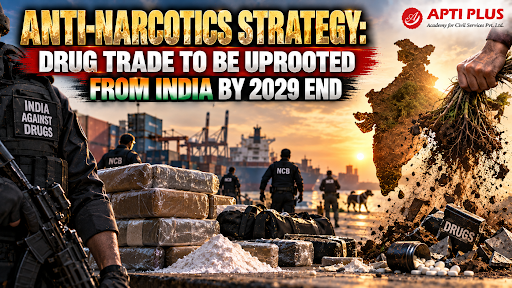
The Union Home Minister Amit Shah set a national deadline of 31 December 2029 to eliminate the illicit drug trade from India, unveiling the Vision Document 2026–2029.
Deadline to Uproot the Drug Trade by 2029
Replaces Seizure Policing with Network Dismantling
The Home Minister announced that enforcement must shift from merely recording contraband seizures to dismantling entire transnational and inter-state cartel syndicates.
Vision Document 2026–2029
Drafted across 35 central and state ministries and departments, the blueprint sets institutional benchmarks to disrupt the entry, transportation, and retail distribution of narcotics over a three-year implementation cycle.
Prioritizes End-to-End Financial Disruptions
Agencies must target the proceeds of crime by tracing hawala transactions, shell bank accounts, darknet platforms, and cryptocurrency wallets under the Prevention of Money Laundering Act (PMLA), 2002.

What Operational Transitions Anchor the 2029 Target?
Enforcing Preventive Detention Under the PITNDPS Act
The Centre directed states to maximize use of the Prevention of Illicit Traffic in Narcotic Drugs and Psychotropic Substances (PITNDPS) Act, 1988, enabling preventive detention of habitual narco-traffickers for up to one to two years without formal bail.
Executing Deportations and Extraditions
Authorities will launch a targeted campaign to deport foreign nationals convicted of or facing trial for trafficking, bar their re-entry, and deploy Interpol Red Notices to extradite fugitive kingpins operating from abroad.
Transforming Case Handling into Conviction Records
Law enforcement units must collaborate with designated special public prosecutors from the initial FIR stage to ensure water-tight forensic trials, raising the national conviction rate under the Narcotic Drugs and Psychotropic Substances (NDPS) Act.

How India Address Geopolitical Vulnerabilities from the Crescent and Triangle?

Golden Crescent Channels Opiates and Methamphetamine
Situated to India's west (encompassing Iran, Afghanistan, and Pakistan), the region traffics refined heroin, opium, and synthetic methamphetamine across the maritime Arabian Sea route and via drone drops along the Punjab and Rajasthan international borders.
Golden Triangle Floods the Northeast with Synthetics
Positioned to India's east (encompassing Myanmar, Laos, and Thailand), the corridor routes high-grade methamphetamine, Yaba tablets, and heroin across the porous 1,643-kilometre Indo-Myanmar border into Manipur, Mizoram, and Nagaland.
Maritime Routes Expand via Dhow Smuggling
International drug syndicates increasingly deploy unmarked deep-sea fishing dhows transiting the Indian Ocean, utilizing the "Southern Route" to ferry multi-tonne consignments toward India's western coastline.
Way Forward to Achieve a Drug-Free India by 2029
Integrate Supply Interdiction with Demand Reduction
Pair law enforcement crackdowns under the MHA with community de-addiction programs under the Nasha Mukt Bharat Abhiyaan (NMBA), administered by the Ministry of Social Justice and Empowerment, across priority districts to lower consumption demand.
Deploy Anti-Drone Technologies Along Western Borders
Deploy comprehensive anti-drone systems, tethered aerostats, and ground-penetrating radar along sensitive border stretches in Punjab, Rajasthan, and Jammu & Kashmir to intercept aerial payload deliveries.
Regulate Dual-Use Chemical Precursors
Tighten regulatory controls and digital tracking under the NDPS (Regulation of Controlled Substances) Order over precursor chemicals—including acetic anhydride, ephedrine, and pseudoephedrine—to prevent diversion into clandestine manufacturing labs.
Deepen Regional Maritime Intelligence Partnerships
Expand multilateral intelligence coordination through the Colombo Security Conclave and the Indian Ocean Rim Association (IORA) to monitor and intercept motherships across the Arabian Sea and Bay of Bengal.
Institutionalize Fast-Track NDPS Special Courts
Establish dedicated fast-track courts equipped with modern digital evidence presentation tools to clear trial backlogs and enforce procedural compliance under Section 52A, raising the national conviction rate.
Conclusion
India's 2029 plan shifts anti-drug strategy from localized seizures to dismantling syndicates through multi-agency intelligence and financial disruption.
Source: THEHINDU
|
PRACTICE QUESTION Q. Analyze the strategic transition from seizure-centric enforcement to network dismantling in India’s anti-narcotics policy. 150 words |