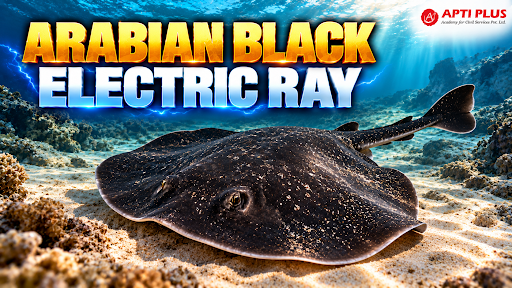
Why In News?
Researchers discovered the Arabian Black Electric Ray (Tetronarce ramanamurthyi), a new species, in deep southeastern Arabian Sea waters.
What is Arabian Black Electric Ray?
It is a newly discovered species of cartilaginous fish found in the deep waters of the southeastern Arabian Sea off the coast of Kerala.
-
Scientific Name: Tetronarce ramanamurthyi
-
Significance: It is the first confirmed record of the genus Tetronarce in the northern Indian Ocean.
-
Evolutionary Status: Genetic testing confirmed that it forms an independent evolutionary lineage well-separated from all other known electric ray species globally.
-
Named in honor of Dr. M. V. Ramana Murthy, an Indian marine scientist and ocean engineer who serves as the Mission Director of the Deep Ocean Mission and Director of the National Centre for Coastal Research (NCCR) under the Ministry of Earth Sciences.
Key Morphological and Biological Features
-
Appearance: Uniform dark bluish-black or dark brown upper body (dorsal) surface with a whitish belly (ventral).
-
Spiracles & Skin: Characterized by the absence of skin bumps (papillae) around its breathing holes (spiracles).
-
Body Shape: Its disc is wider than it is long (disc length is 1.0–1.2 times in disc width).
-
Electric Organs: Possesses smaller kidney-shaped electric organs (measuring 23.3–28.9% of total length) capable of generating electrical discharges to stun prey.
-
Bycatch Context: Hauled up accidentally as commercial fishing bycatch, highlighting gaps in deep-sea biodiversity documentation and the urgent need to monitor deep-water fisheries.
About Electric Rays
Electric rays are a group of specialized cartilaginous fish belonging to the order Torpediniformes, famous for their ability to generate bioelectricity.
-
Body Shape: Flattened body with enlarged, rounded pectoral fins fused to the head, forming a circular or oval disc.
-
Tail & Swimming: Unlike typical rays that flap their pectoral fins to swim, electric rays have a stout, muscular tail with a well-developed caudal fin and swim more like sharks. They are generally slow-moving, sluggish bottom-dwellers.
-
Skin: Soft, loose, and flabby skin lacking sharp dermal denticles or thorns.
-
Electric Organs:
-
A pair of kidney-shaped (or bean-shaped) electric organs derived from modified muscle cells (electrocytes) located on either side of the head.
-
These function like biological batteries (stacked columns with a negative lower side and positive upper side).
-
Voltage Output: Ranges from 8 volts up to 220 volts depending on the species and size (e.g., larger Atlantic torpedo rays produce 220V, smaller ones 37V).
-
The electric discharge can stun prey or ward off predators, but the organs can deplete their energy ("run down") after repeated discharges and require rest to recharge.
Habitat, Distribution, and Ecology
-
Distribution: Found worldwide in tropical, subtropical, and temperate marine waters.
-
Depth: Most species inhabit shallow coastal waters, though some deep-sea genera (Benthobatis) live down to 1,000 meters or more.
-
Behavior:
-
Nocturnal and solitary; they often spend the day partially buried in sand or mud to ambush prey or hide from predators.
-
Diet & Trophic Level:
-
Acting as mesopredators in the marine food web, they feed on small fish, crustaceans, worms, and invertebrates.
-
They use electroreception and electrical discharges to immobilize active prey before swallowing them whole.
-
Reproduction:
-
They are ovoviviparous (females give birth to live, fully-formed young that can produce small electric shocks right from birth).
Source: RESEARCHMATTERS
|
PRACTICE QUESTION Q. Consider the following statements regarding the recently discovered marine species Tetronarce ramanamurthyi:
Which of the statements given above is/are correct? (a) 1 only (b) 1 and 2 only (c) 2 and 3 only (d) 1, 2 and 3 Answer: (b) Explanation: Statement 1 is correct: Tetronarce ramanamurthyi (commonly referred to as the Arabian Black Electric Ray) is a newly described species of electric ray discovered in the deep waters (depths of approximately 400–700 meters) of the southeastern Arabian Sea off the coast of Kerala, India. Statement 2 is correct: The discovery marks the first confirmed record of the genus Tetronarce in the northern Indian Ocean, extending the known geographic range of these rays. Statement 3 is incorrect: A key diagnostic feature of Tetronarce ramanamurthyi (and a defining characteristic separating Tetronarce from Torpedo) is the complete absence of skin bumps or papillae around its spiracles (breathing openings), which have smooth margins. |