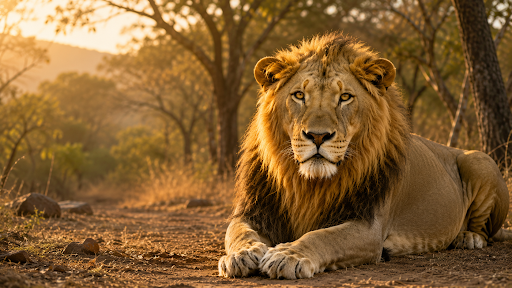
Why In News?
On World Lion Day (August 10, 2026), the Union Environment Minister announces the Asiatic lion population has grown from 523 in 2015 to 891 in 2025.
About Asiatic Lion
The Asiatic Lion (Panthera leo persica), an apex predator and keystone species of India's dry deciduous forests, is the only wild population of lions existing outside of Africa.
In India, it is natively restricted entirely to the Gir National Park and Wildlife Sanctuary and its surrounding Greater Gir Landscape in Saurashtra, Gujarat.
|
|
Asiatic Lion (Panthera leo persica) |
African Lion (Panthera leo melanochaita) |
|
Size |
Slightly smaller (Males: 160–190 kg). |
Larger (Males: up to 250 kg). |
|
Belly Fold |
A distinctive, longitudinal skin fold along the abdomen. |
Rarely present or absent. |
|
Mane (Males) |
Shorter and moderate; ears always remain visible. |
Fuller and luxuriant; often covers the ears. |
|
Pride Structure |
Smaller prides. Males only join females for mating or large kills. |
Larger prides. Males continuously live and hunt with the group. |
|
Skull Feature |
Bifurcated (divided) infraorbital foramina (small skull holes). |
Single infraorbital foramen on either side. |
Conservation Status
-
IUCN Red List: Vulnerable (Moved from Endangered in 2025 due to population recovery).
-
Wildlife (Protection) Act, 1972: Schedule-I (Affords the highest legal security and penalties).
-
CITES: Appendix-I (Completely bans international commercial trade).
Natural Habitat
-
The Asiatic lion naturally inhabits dry deciduous forests, scrublands, and grasslands, distinct from the denser rainforest habitats of tigers.
Historical Distribution
-
Historically, Asiatic lions ranged from the Mediterranean coast, through Persia (Iran), and across northern India up to Bihar.
-
Intensive hunting during the 19th century, especially by British colonial officers and Indian rulers, reduced the population to just about a dozen individuals by the end of that century
Source: LIVEMINT
|
PRACTICE QUESTION Q1. Consider the following statements regarding the Asiatic lion:
Which of the statements given above is/are correct? (a) 1 and 2 only (b) 2 and 3 only (c) 1, 2 and 3 (d) 3 only Answer: (c) Explanation: Statement 1: Correct. The last surviving wild population of Asiatic lions is restricted entirely to the Saurashtra region/Gir landscape of Gujarat, India. Statement 2: Correct. The species enjoys the highest degree of legal protection under Schedule I of India's Wildlife (Protection) Act, 1972. Statement 3: Correct. Due to its threatened status and extreme vulnerability, it is included in Appendix I of the Convention on International Trade in Endangered Species of Wild Fauna and Flora (CITES). |