Why In News?
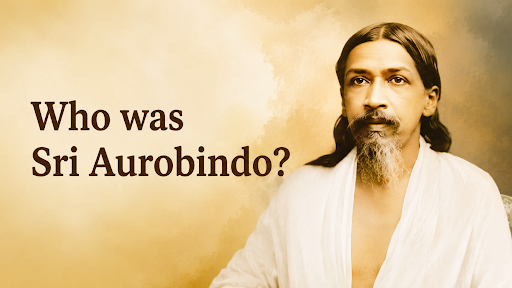
15 August marks the birth anniversary of Sri Aurobindo (1872–1950), an early advocate of complete independence and founder of Integral Yoga.
Who was Sri Aurobindo?
Birth: Sri Aurobindo Ghose was born in Calcutta on 15 August 1872 and died in Pondicherry on 5 December 1950.
Education: He went to England at age 7, studied at St. Paul’s School and King's College, Cambridge, and passed the Indian Civil Service (ICS) open competition in 1890, but deliberately skipped the final horse-riding test to get disqualified.
Baroda Phase: From 1893–1906, he worked in the Baroda State and taught at Baroda College while developing his nationalist ideas.
Revolutionary Activity: During the Baroda period, he became involved in secret revolutionary preparations against British rule.
Political Shift: After the Partition of Bengal in 1905, he moved to Calcutta in 1906 and emerged as a major nationalist leader.
What was His Role in the Freedom Movement?
Complete Independence: Aurobindo was among the earliest political leaders to openly demand complete independence, moving beyond the moderate demand for gradual constitutional reform.
Swadeshi: He supported Swadeshi, boycott and national education as instruments of economic and political resistance.
Passive Resistance: He developed a theory of passive resistance through writings in Bande Mataram, linking political freedom with organised non-cooperation.
Mass Mobilisation: His political strategy sought to transform nationalism from an elite constitutional activity into organised popular resistance.
Revolutionary Nationalism: He influenced Bengal's revolutionary movement and was associated with networks connected with Anushilan Samiti.
Surat Congress: During the 1907 Surat split, Aurobindo emerged as an important leader of the nationalist or extremist group alongside leaders such as Bal Gangadhar Tilak.
He faced prosecution for sedition twice and conspiracy once, but was released for lack of evidence.
"New Lamps for Old" (1893–1894), published by Aurobindo Ghose in Indu Prakash, was a nine-part political series offering a systematic early critique of the Indian National Congress's moderate leadership.
What were His Major Political Ideas?
Swaraj: For Aurobindo, Swaraj meant real political independence, not merely administrative concessions within the colonial system.
Swadeshi: Economic self-reliance was a political weapon because dependence on foreign goods strengthened colonial economic power.
Boycott: Boycotting British goods, institutions and courts could create self-help institutions outside colonial control.
National Education: He advocated national schools and colleges that could build character, self-confidence and national consciousness.
Passive Resistance: Political resistance required non-cooperation, self-reliance and organised national action, not merely petitions.
Mass Politics: He wanted the nationalist movement to mobilise ordinary people, making political freedom a national rather than elite objective.
What was His Contribution to Nationalist Journalism?
Bande Mataram: Aurobindo became the leading intellectual force behind Bande Mataram, which carried 353 surviving political articles and speeches from 1906–1908.
Political Education: The newspaper converted complex political issues into a strong argument for Swaraj, Swadeshi and resistance.
Colonial Critique: His writings attacked the legitimacy of colonial rule and challenged the belief in British political superiority.
Public Opinion: Bande Mataram helped create a more assertive nationalist public sphere during the Swadeshi period.
Karmayogin: His later political writings appeared in Karmayogin during 1909–1910, before his withdrawal from active politics.
He was arrested in the Alipore Bomb Case (1908) and was defended by Chittaranjan Das.
What Happened After His Active Politics?
-
Pondicherry: In 1910, Aurobindo withdrew from active politics and moved to Pondicherry to focus on spiritual development.
-
Integral Yoga: During nearly 40 years in Pondicherry, he developed Integral Yoga as a method for transforming human consciousness and nature.
-
Ashram: In 1926, Sri Aurobindo and the Mother established the Sri Aurobindo Ashram.
-
Intellectual Output: His later writings expanded from political freedom to human evolution, spirituality and global unity.
What is Integral Yoga?
-
Meaning: Integral Yoga seeks not only spiritual liberation but also the transformation of human consciousness and nature.
-
Holistic Development: It integrates mind, life and spirit rather than treating spirituality as separate from everyday existence.
-
Human Evolution: Aurobindo saw human development as an ongoing evolutionary process towards higher consciousness.
-
Supramental Idea: He associated this evolution with the emergence of a higher or supramental consciousness.
-
Social Dimension: Individual transformation ultimately connects with the broader transformation of human society and civilisation.
Important Works
-
The Life Divine: Explores evolution, consciousness, spirituality and the relationship between matter and spirit.
-
Savitri: A major philosophical-poetic work presenting themes of human destiny, consciousness and spiritual transformation.
-
Essays on the Gita: Interprets the Bhagavad Gita through the ideas of action, knowledge, devotion and spiritual development.
-
The Human Cycle: Examines the psychological and social evolution of human societies.
-
The Ideal of Human Unity: Explores the possibilities and limits of global political and human unity.
-
Bande Mataram: Contains his major political writings of 1906–1908.
-
Karmayogin: Contains his political writings and speeches from 1909–1910.
He was nominated for the Nobel Prize in Literature (1943) and Nobel Peace Prize (1950).
Source: PIB
PRACTICE QUESTIONQ. Consider the following statements regarding Sri Aurobindo:
Which of the statements given above are correct? A. 1 and 2 only B. 1, 2 and 3 only C. 2, 3 and 4 only D. 1, 2, 3 and 4 Answer: D Explanation: Statement 1 is correct: Sri Aurobindo was among the earliest radical nationalist leaders who openly and consistently demanded Swaraj in the sense of complete independence from British rule, rejecting the moderate approach of incremental reforms. Statement 2 is correct: He was deeply associated with the English-language nationalist newspaper Bande Mataram, serving as its editor and using it to widely popularize the concept of absolute independence. Statement 3 is correct: Following his acquittal in the Alipore Bomb Case and a profound spiritual transformation, he left British India and moved to the French territory of Pondicherry (Puducherry) in April 1910, completely withdrawing from active political life. Statement 4 is correct: During his four decades in Pondicherry, he shifted his entire focus toward spiritual transformation and formulated a new path of spiritual practice known as Integral Yoga. |