Why In News?
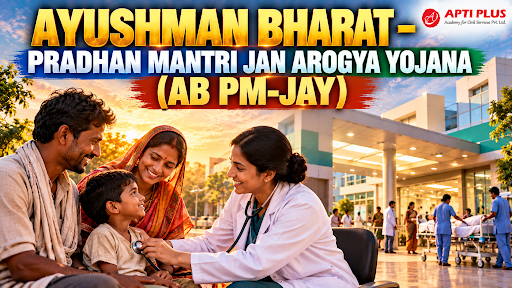
Marking its eighth anniversary, Ayushman Bharat – Pradhan Mantri Jan Arogya Yojana (AB PM-JAY) has funded 13.25 crore authorized hospital admissions valued at over ₹2.03 lakh crore, covering nearly 33% of India's population.
What Is Ayushman Bharat PM-JAY?
World's Largest Publicly Funded Health Assurance Scheme: Launched on September 23, 2018, from Ranchi, Jharkhand, AB PM-JAY provides secondary and tertiary care hospitalization cover to India’s bottom 40% economically vulnerable population.
Cashless and Paperless Care: Operates through a digital ecosystem guaranteeing cashless hospitalization across thousands of empanelled healthcare providers (EHCPs) nationwide.
Implementing Machinery:
-
National Health Authority (NHA): An attached office of the Ministry of Health and Family Welfare, serving as the apex statutory body responsible for policy formulation, digital platform administration, and fraud oversight.
-
State Health Agencies (SHAs): State-level nodal bodies executing the scheme either through a trust mode, an insurance company mode, or a hybrid operational model.
Portability: Allows an eligible beneficiary from any state to seek free inpatient medical care at any empanelled public or private hospital across India, establishing seamless inter-state portability.
What Are The Core Features Of The Scheme?
Financial Protection Limit: Provides an annual defined benefit cover of ₹5,00,000 per family per year on a family floater basis.
Zero Restrictions on Demographics: Imposes no cap on family size, gender, or age, ensuring that women, children, and elderly relatives are fully covered.
Pre-Existing Disease Coverage: Covers all pre-existing medical conditions from day one of enrollment without waiting periods or exclusions.
Comprehensive Inpatient Continuum: Covers up to 3 days of pre-hospitalization expenses (diagnostics and consultations) and 15 days of post-hospitalization follow-up treatment, medicines, and consumables.
Standardized Health Benefit Packages (HBP): Categorizes treatment under standardized surgical, medical, and day-care packages covering oncology, cardiology, neurology, and orthopedics.
Who Are The Entitled Beneficiaries?
Socio-Economic Base: Originally targeted approximately 10.74 crore poor and vulnerable families identified through the Socio-Economic and Caste Census (SECC) 2011 deprivation criteria, subsequently expanded to 12.34 crore families (over 55 crore individuals) by integrating state food ration databases.
Universal 70-Plus Senior Citizen Cover: Provides universal coverage to every citizen aged 70 years and above, irrespective of their socio-economic status or family income:
-
Eligible seniors in existing PM-JAY families receive an exclusive top-up cover of ₹5 lakh annually.
-
Seniors belonging to non-PM-JAY families receive a distinct family cover of ₹5 lakh per year.
Frontline Healthcare Cadres: Unconditionally extends the ₹5 lakh annual health shield to all active Accredited Social Health Activists (ASHA), Anganwadi Workers, and Anganwadi Helpers.
Four Pillars Of Ayushman Bharat Ecosystem
Pillar 1: AB PM-JAY (Tertiary & Secondary Health Protection): Manages inpatient hospitalization risks through publicly financed financial risk pooling.
Pillar 2: Ayushman Arogya Mandirs (AAMs - Comprehensive Primary Care): Transformed over 1.7 lakh primary health sub-centres and primary health centres into frontline clinics providing preventive, promotive, and curative care, free essential drugs, diagnostic tests, and tele-consultations (e-Sanjeevani).
Pillar 3: Ayushman Bharat Digital Mission (ABDM): Builds the national digital backbone by issuing unique Ayushman Bharat Health Account (ABHA) numbers, creating verified digital health records, and connecting healthcare professionals and registries.
Pillar 4: PM-Ayushman Bharat Health Infrastructure Mission (PM-ABHIM): A Centrally Sponsored Scheme aimed at fortifying primary, secondary, and tertiary health infrastructure, establishing critical care hospital blocks, integrated public health laboratories, and pandemic surveillance units.
What Are The Structural Bottlenecks Facing PM-JAY?
Severe Supply-Side Disparities and Regional Skew: Inpatient empanelment is heavily concentrated in southern and western states, leaving underdeveloped districts in northern and eastern states with inadequate private hospital density.
-
Example: Inter-State Utilization Skew, where tertiary procedures are disproportionately claimed in states like Tamil Nadu, Kerala, and Gujarat, while rural beneficiaries in Bihar and Uttar Pradesh must travel hundreds of kilometers for specialized surgeries.
Package Rate Stagnation and Private Sector Reluctance: Leading tertiary care private hospitals frequently opt out or under-allocate beds due to perceived unviable reimbursement tariffs for high-end surgeries.
-
Example: Health Benefit Package Disputes, where private healthcare federations cite inflation and rising biomedical costs as deterrents to empanelling advanced critical care units.
Fraudulent Claims and Phantom Billing: Organized cartels and dishonest empanelled facilities engage in phantom admissions, unnecessary procedures (such as unjustified hysterectomies and cataract surgeries), and upcoding.
-
Example: National Anti-Fraud Unit (NAFU) Actions, leading to the de-empanelment of hundreds of hospitals and recovery of penalty dues worth crores via algorithmic risk-profiling.
Deficit in Primary-to-Tertiary Gatekeeping: Weak referral gatekeeping at Ayushman Arogya Mandirs allows patients to bypass primary health centres and directly crowd tertiary hospital OPDs for minor ailments.
-
Example: Comptroller and Auditor General (CAG) Performance Audit, highlighting instances where hospital beds were occupied for minor conditions that could have been resolved at primary health clinics.
Way Forward
Strengthen Primary Gatekeeping through Ayushman Arogya Mandirs: Institutionalize a mandatory referral link where tertiary hospital admissions require certification from primary care clinics, reserving tertiary beds for complex clinical interventions.
-
Example: United Kingdom NHS Gatekeeping Model, where General Practitioners (GPs) manage primary health screening and authorize elective specialist referrals.
Dynamic, Evidence-Based Package Rate Rationalization: Regularly update Health Benefit Package (HBP) tariffs using scientific cost-accounting models that reflect regional hospital overheads and clinical consumables.
-
Example: Niti Aayog Health System Costing Framework, establishing variable regional reimbursement rates to incentivize quality private hospital participation in rural belts.
Deploy Advanced AI-Driven Anti-Fraud Surveillance: Integrate artificial intelligence and machine learning analytics into the Transaction Management System (TMS) to detect aberrant billing, phantom patient profiles, and duplicate surgeries in real time.
-
Example: NHA National Fraud Analytics Engine, conducting automated predictive audits on hospital discharge patterns before funds are disbursed.
Scale Public Health Spending towards 2.5% of GDP: Progressively elevate government health expenditure from 1.9% to 2.5% of Gross Domestic Product (GDP) as mandated by the National Health Policy, 2017, prioritizing physical infrastructure under PM-ABHIM.
-
Example: High-Level Expert Group (HLEG) on Universal Health Coverage, emphasizing that demand-side insurance financing must be complemented by robust supply-side public hospital funding.
Conclusion
Ayushman Bharat PM-JAY has transformed India's healthcare landscape from distress financing to institutionalized entitlement, demonstrating that universal health coverage is achievable when secondary and tertiary financial protection is anchored in a robust primary care foundation.
Source: PIB
|
PRACTICE QUESTION Q. With reference to the Ayushman Bharat – Pradhan Mantri Jan Arogya Yojana (AB PM-JAY), consider the following statements: 1. It provides an annual health cover of ₹5,00,000 per family for outpatient consultations as well as inpatient hospitalization. 2. There is no restriction on family size, age, or gender of the beneficiaries under the scheme. 3. The scheme has been extended to provide universal health coverage to all Indian citizens aged 70 years and above, irrespective of their income. Which of the statements given above are correct? (a) 1 and 2 only (b) 2 and 3 only (c) 1 and 3 only (d) 1, 2 and 3 Answer: (b) Explanation: Statement 1 is incorrect: The Ayushman Bharat PM-JAY scheme provides a health cover of ₹5,00,000 per family per year exclusively for secondary and tertiary care inpatient hospitalization (including pre- and post-hospitalization expenses). It does not cover routine outpatient department (OPD) consultations. Comprehensive primary healthcare and outpatient needs are addressed separately through the network of Ayushman Arogya Mandirs (formerly Health and Wellness Centres). Statement 2 is correct: Unlike earlier health insurance schemes such as the Rashtriya Swasthya Bima Yojana (RSBY), which had a cap of five members, PM-JAY places no restriction on family size, age, or gender to ensure that female members and elderly relatives are not left out. Statement 3 is correct: The Union Cabinet approved the expansion of the AB PM-JAY to provide universal health coverage of ₹5 lakh to all Indian citizens aged 70 years and above, irrespective of their socio-economic or income status (issued through the Ayushman Vay Vandana Card). |