Why In News?
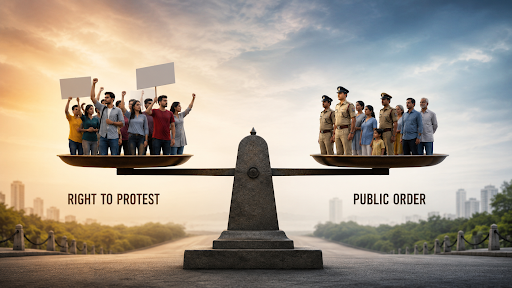
Police use of lathis and tear gas against the "Chalo Sansad" protest under Section 163 of the BNSS has ignited a national debate on the balance between police authority and the constitutional right to democratic dissent.
What is the Right to Protest?
The right to protest is a fundamental democratic principle that allows individuals and groups to publicly express, promote, and defend their shared ideas, grievances, or demands
Constitutional Basis
Article 19(1)(a): Guarantees freedom of speech and expression, forming the constitutional basis for voicing dissent and criticism of government policies.
Article 19(1)(b): Guarantees the right to assemble peaceably and without arms, the core constitutional protection for peaceful protests.
Article 19(1)(c): Protects the right to form associations and unions, enabling collective movements, trade unions and protest groups.
Article 21: Supreme Court has interpreted the Right to Life and Personal Liberty to include the dignity and liberty necessary for peaceful forms of protest, including hunger strikes in appropriate circumstances.
Note: The Constitution does not use the exact word "protest," but the Supreme Court built this right by combining these Articles.
What are the Limits on Police Power?
Regulation, Not Prohibition
Reasonable Restrictions: Right to protest is subject to Articles 19(2) and 19(3), allowing restrictions only in the interests of sovereignty, integrity of India, security of the State and public order, not arbitrary prohibition.
Regulation, Not Blanket Ban: In Mazdoor Kisan Shakti Sangathan vs Union of India (2018) and Amit Sahni (Shaheen Bagh) vs Commissioner of Police (2020), the Supreme Court held that authorities may regulate the time, place and manner of protests, but cannot impose blanket or indefinite prohibitions on peaceful demonstrations.
Minimum Necessary Force: The Ministry of Home Affairs' Code of Conduct for the Police (1985) directs police to use only the "irreducible minimum" force necessary for dispersing unlawful assemblies, emphasizing restraint and proportionality.
Prohibitory Orders
Section 163, BNSS: Since 1 July 2024, Section 163 of the Bharatiya Nagarik Suraksha Sanhita (BNSS) has replaced Section 144 CrPC, empowering Executive Magistrates to issue temporary prohibitory orders in cases of immediate danger or threats to public order.
Nature of Power: Orders under Section 163 BNSS are preventive, must be based on written reasons, and remain in force for a maximum of two months unless extended according to law.
No Unlimited Force: A dispersal order under Section 163 BNSS is not a licence to use unlimited force. Police action must satisfy the constitutional tests of necessity, proportionality and reasonableness, and force can be used only to the extent required to restore public order.
What are the Major Challenges?
Balancing Liberty and Order: Managing large crowds without disrupting daily life or local commerce remains a logistical hurdle.
Excessive Force: The Status of Policing in India Report 2025 reveals that 40% of police personnel believe physical force is acceptable for gathering information.
Access to Space: Authorities frequently relegate protesters to isolated areas, effectively silencing their message.
Communication Blackouts: The use of internet shutdowns during the July 2026 protests hindered free speech and organizational coordination.
Colonial Legacy: Reliance on the Police Act of 1861 creates inconsistent standards for protest rights across different states.

Way Forward
Ensure Police Action Meets the Test of Necessity and Proportionality: Police should follow the Doctrine of Proportionality—force should be a last resort, strictly limited to what is absolutely necessary to control violence
Increase Transparency in Granting or Denying Protest Permissions: Avoiding delaying or cancelling protest permissions as a trick to silence political opposition
Promote Dialogue Between Authorities and Protest Organisers: Creating Citizen Police Review Boards helps build trust between the police and the community
Strict Accountability: With 147 deaths in police custody recorded in 2022 (NHRC Report 2022-23), the state must ensure guilty officers face swift judicial trials rather than mere transfers.
Develop Standard Operating Procedures for Peaceful Assemblies
Police must give clear, loud warnings and ensure safe exit routes for crowds before they ever use tear gas or lathis.
Mandatory Identification: All crowd-control officers must wear visible name tags to ensure individual accountability.
Conclusion
To keep democracy strong, India must protect citizens' right to peaceful dissent while ensuring that the police act within strict, transparent, and proportionate legal limits to maintain public order.
Source: THEHINDU
|
PRACTICE QUESTION Q. "The right to peaceful protest is indispensable to democracy, but it is not absolute." Examine. 150 words |