Why In News?
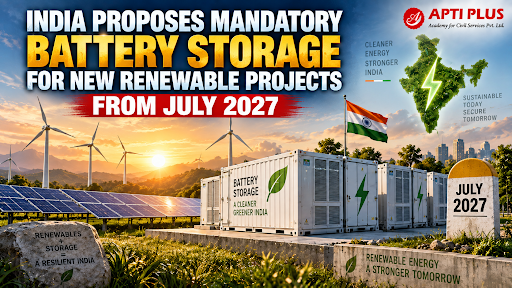
The Central Electricity Authority proposed mandating a minimum two-hour co-located battery energy storage requirement for all new solar and wind projects commissioned from July 2027.
Highlights of Proposed Battery Storage Requirement
Mandatory Two-Hour Storage Capacity: Requires all commercial solar and wind farms to install co-located battery storage capable of delivering power for at least two hours.
Effective Compliance Timeline (July 2027): Applies strictly to all utility-scale renewable power plants commissioned after July 1, 2027, across interstate transmission networks.
Mandatory Grid-Forming Inverters (15% Quota): Enforces that at least 15% of project inverters must possess grid-forming capabilities to provide synthetic mechanical inertia.
Aligning with National Electricity Plan Targets: Support the CEA's National Electricity Plan roadmap requiring 74 GW / 411 GWh of storage capacity by 2031-32.
Curbing Midday Renewable Curtailment: Empowers the Grid Controller of India to store midday surplus solar electricity instead of curtailing renewable generation.
What is Battery Energy Storage?
Electrochemical Storage Systems (BESS): Advanced devices using chemical cells to capture electricity during low demand and discharge it during peak grid requirements.
Dominant Lithium Iron Phosphate (LFP) Packs: Employs fire-safe LFP battery chemistry, deployed commercially at Tata Power’s 10 MW/10 MWh grid-scale BESS at Rohini, Delhi.
Sub-Second Fast-Response Frequency Control: Discharges electricity within milliseconds to stabilize sudden grid voltage and frequency fluctuations caused by cloud cover.
Four Core Subsystem Assemblies: Integrates electrochemical battery racks, bidirectional Power Conversion Systems (PCS), thermal cooling loops, and computerized Energy Management Systems (EMS).
Why is Storage Needed for Renewable Energy?
Overcoming Solar-Wind Intermittency: Smooths severe power drops caused by monsoon cloud cover over Rajasthan's Bhadla Solar Park and nightfall generation halts.
Flattening the Duck Curve Phenomenon: Absorbs excessive midday solar flooding and discharges during the critical 7 PM to 10 PM evening lighting peak.
Meeting Record Summer Peak Demand: Supplies flexible power when national electricity peak demand surges, preventing costly emergency gas plant operations.
Eliminating Transmission Network Congestion: Prevents overloading of high-voltage Green Energy Corridors by storing local power during peak sunshine hours.
Replacing Heavy Thermal Spinning Reserves: Provides synthetic inertia without keeping polluting coal-fired units idling on standby under the National Grid Code
What are the Major Challenges?
High Levelized Cost of Storage (LCOS): Standalone BESS tariffs remain high at ₹6 to ₹7 per kilowatt-hour, straining the purchase capacity of debt-ridden state DISCOMs.
Heavy Critical Mineral Import Vulnerability: Relies entirely on imported raw lithium, nickel, and cobalt processed predominantly inside mainland China.
Battery Degradation Over Operating Lifespans: High ambient summer temperatures exceeding 45°C degrade cell life, requiring costly pack replacements every 8 to 10 years.
Financial Stress of State DISCOMs: Cash-strapped electricity distribution companies hesitate to sign power purchase agreements with higher storage tariff markups.
Thermal Runaway Fire Safety Risks: Demands stringent fire-suppression systems to prevent thermal runaway incidents in dense containerized battery parks.
Underdeveloped Recycling and Recovery Chains: Lack of domestic hydrometallurgical recycling facilities prevents circular recovery of valuable battery materials
Way Forward
Expand Viability Gap Funding (VGF) Outlays: Utilize the ₹3,760-crore VGF scheme to subsidize up to 40% of capital costs for 10,000 MWh of BESS projects.
Enforce Strict Energy Storage Obligations (ESO): Mandate state DISCOMs to procure a minimum of 4% of their total energy consumption from storage assets by 2030.
Commercialize Alternative Non-Lithium Chemistries: Fund commercial pilot scale-ups of indigenous sodium-ion batteries developed by CSIR-CECRI and IIT Madras.
Create Ancillary Services and Capacity Markets: Introduce specialized market mechanisms on the Indian Energy Exchange (IEX) to remunerate battery plants for fast frequency support.
Pair BESS with Closed-Loop Pumped Hydro Storage (PSP): Synergize batteries with mega pumped storage projects like Greenko’s 1,200 MW Pinnapuram Integrated Renewable Energy Project.
Mandate Extended Producer Responsibility (EPR): Implement strict recycling quotas under Battery Waste Management Rules 2022 to recover 90% of critical battery metals by 2030.
Conclusion
Mandating two-hour battery energy storage transforms intermittent green energy into predictable, grid-firm baseload power, securing India's sustainable path to 500 GW of clean energy.
Source: REUTERS
|
PRACTICE QUESTION Q. Examine the financial and technological bottlenecks confronting large-scale deployment of Battery Energy Storage Systems (BESS) by Indian power distribution utilities. (10 Marks, 150 Words) |