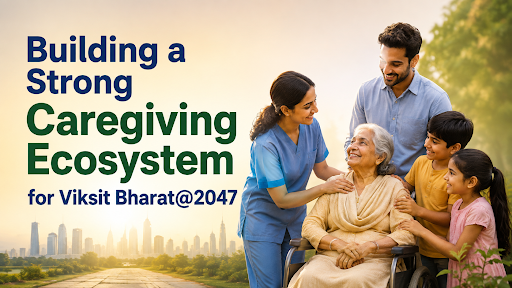
Why In News?
NITI Aayog released the report "Reimagining Care: Strategies for Empowering Caregivers in Viksit Bharat@2047" recommending a National Caregiver Council to professionalise India's caregiving workforce.
What is the "Reimagining Care" Report?
The report frames a professionalised, dignified caregiving system as integral to India's developed-nation aspirations by its centenary of independence.
It provides a roadmap to build a well-organised, professional, accessible, and future-ready caregiving ecosystem.
The report emphasises quality of care, professional recognition, workforce welfare, and institutional support, while also enabling families and communities to access reliable and affordable care.
NITI Aayog stated that rising global demand for caregivers presents a unique opportunity for India to become a global leader in supplying trained care professionals.
What is the Care Economy?
As per the World Health Organisation definition, caregiving involves physical, emotional, and social support for those unable to perform daily activities independently; a formal caregiver ("personal care aid") is a trained professional, distinct from informal, unpaid family caregivers.
The care economy includes all paid and unpaid, direct and indirect activities that meet people's physical, psychological, social and developmental needs across the life cycle, including childcare, healthcare, eldercare, disability support, education and domestic care.
Two Components
-
Paid care work: Healthcare workers, teachers, childcare workers, social workers, domestic workers and other professional caregivers.
-
Unpaid care work: Cooking, cleaning, collecting water/fuel, childcare, eldercare and supporting persons with disabilities within households and communities.
The global care economy accounts for around 381 million jobs, or 11.5% of total employment, while unpaid care work is estimated to contribute about US$11 trillion annually to the global economy. (Source: ILO)
India's Time Use Survey 2024 shows the persistent gendered distribution of unpaid domestic and care work, making the care economy closely linked with female labour-force participation, time poverty and gender equality.
Why is Caregiving Important for India?
Ageing population: India's elderly population (60+) currently stands at about 104 million (a little over 10% of the population) and is projected to reach 19.5% by 2050, raising demand for long-term and elderly care services.
Rising demand for long-term care: More than 75% of India's elderly suffer from chronic diseases, driving sustained demand for trained, professional caregivers rather than one-time medical intervention
Women's labour force participation: Since unpaid caregiving falls disproportionately on women, professionalising and formalising care work can free women for paid employment, directly supporting female labour force participation goals.
Employment generation: A regulated caregiving sector can become a major formal employment generator, particularly for semi-skilled and skilled workers in both urban and rural India.
Social protection: Formalisation extends social security nets to a workforce that today operates largely outside labour law protections.
Global care workforce opportunities: Given global demand for trained caregivers (especially in aging developed economies), India can position itself as a global supplier of skilled care professionals, similar to its success in nursing and IT services exports.
Key Recommendations of The NIT Aayog Report
National Caregiving Policy: Develop National Policy on Caregiving with Centre-State coordination, integrating currently fragmented schemes across health, disability, social justice and skilling. .
National Caregiver Council: Establish a proposed National Caregiver Council (NCC) as the apex body for regulation, standards, workforce planning, accreditation and grievance redressal.
National Caregiver Registry: Create a National Caregiver Registry and Digital Portal listing certified caregivers, with background verification and safeguards against abuse, exploitation and unsafe placements.
Standardised Certification: Develop national standards for curriculum, competency, certification and continuing professional development, while accrediting caregiver training institutions.
Specialised Care Workforce: Create specialised cadres for palliative and long-term care, integrate caregiving modules into school/college curricula and expand digital training.
Social Security for Caregivers: Extend labour protection, social security, occupational disease and accident insurance to caregivers, including through expansion of protections for unorganised workers.
Technology-enabled Care: Develop multilingual digital training, assistive technologies and a certified-caregiver portal; include blacklisting, mandatory reporting and grievance mechanisms for abuse or neglect.
India as a Global Care Workforce Hub: Use bilateral agreements for caregiver training, ethical recruitment, qualification recognition, safe migration and reintegration, positioning India as a trusted global supplier of skilled caregivers.
Source: NEWSONAI
|
PRACTICE QUESTION Q1. Consider the following statements regarding the "Reimagining Care" report:
Which of the statements given above is/are correct? (a) 1 and 2 only (b) 2 and 3 only (c) 1, 2 and 3 (d) 1 only Answer: (a) Explanation: Statement 1 is Correct: The report was released by NITI Aayog on August 5, 2026. It outlines a roadmap for building a professional and inclusive caregiving ecosystem in India. Statement 2 is Correct: The report explicitly recommends the establishment of a National Caregiver Council (NCC) (also referred to as the National Caregiving Council). This body is intended to provide institutional leadership, regulate, standardize, and professionalize caregiving services, including accrediting training programs. Statement 3 is Incorrect: The report distinguishes between informal and formal caregivers. It identifies informal caregivers as family members or community members who typically provide unpaid and often untrained support. In contrast, it defines formal caregivers as trained professionals who provide paid services. The report aims to bridge this gap by professionalizing the sector and supporting both groups. |