Why In News?
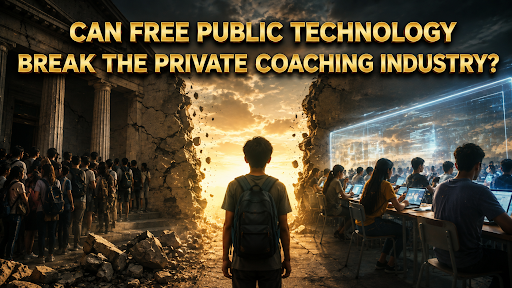
The Government of India has unveiled a nationwide plan to provide free online coaching for national competitive examinations by leveraging Digital Public Infrastructure (DPI).
About the New Initiatives
The initiative expands the SATHEE (Self-Assessment Test and Help for Entrance Exams) portal, built jointly by the Ministry of Education and IIT Kanpur, alongside DIKSHA, SWAYAM, and PM e-VIDYA.
Universal Public Tech Stack: It creates an open, scalable education stack that delivers video lectures, doubt-solving sessions, and mock test engines without charging any subscription fees.
Curated by Top Academicians: Faculty members and top rankers from the Indian Institutes of Technology (IITs), the Indian Institute of Science (IISc), and the All India Institute of Medical Sciences (AIIMS) prepare and review all study content.
Key Features
-
AI-Powered Adaptive Analytics: The portal uses machine learning algorithms to diagnose a student’s weak subject areas and automatically recommends customized practice sets and video explanations.
-
Multilingual Instruction (13+ Languages): In alignment with the National Education Policy (NEP) 2020, study notes and video lectures are available in English, Hindi, and 12 regional Indian languages.
-
Live Interactive Doubt Resolution: Students receive live assistance and peer discussions supported by student mentors from premier central universities and IITs.
-
School-Integrated Hybrid Delivery: Government schools, including PM SHRI Schools, conduct 2-hour daily interactive SATHEE classes inside school timetables.
-
All-India Benchmarking Mock Tests: Students take simulated computer-based tests (CBT) that offer instant national-level percentile rankings and speed-accuracy breakdowns.
Why Introduced: Core Problem of the Private Coaching Industry
Massive Financial Drain on Families: The private coaching market exceeded ₹58,088 crore, forcing middle-class and rural families to spend up to 20% to 25% of their total household income on coaching fees. (Source: NSO)
Severe Mental Health and Suicide Epidemic: Intensive high-pressure coaching hubs witness severe student burnout, anxiety, and rising student suicides.
The "Shadow Education" System: Private coaching centers reduce regular school classrooms to mere attendance centers through "dummy schooling," destroying foundational holistic schooling.
Deep Geographical and Economic Inequality: Students from rural areas and low-income families cannot afford high hostel fees, expensive study notes, and premium test series in metro cities.
Significance of Public Ed-Tech
Democratizing Competitive Education: It levels the playing field so that family wealth and urban geography no longer decide a child’s chance of clearing national entrance exams.
Advancing Sustainable Development Goal 4 (SDG 4): Guarantees inclusive, equitable, and quality education for all socio-economic groups.
Huge Household Capital Savings: Saves thousands of crores of rupees for low-income households, which can now be spent on better nutrition, health, and higher education.
Strengthening Public Digital Public Infrastructure (DPI): Expands India's digital public goods model beyond identity (Aadhaar) and payments (UPI) into digital education.
Challenges In Implementation
The "Passive Video Library" Trap: Private coaching sells rigid daily schedules and enforced discipline; free online video libraries suffer from high drop-out rates and low student completion rates.
Missing 1-on-1 Emotional and Academic Mentorship: Online computer portals struggle to match the personal attention, motivation, and psychological support provided by classroom teachers.
Shortage of Exam-Specific "Speed-Solving" Tricks: Private centers train students in rapid multiple-choice elimination techniques, whereas public portals focus primarily on textbook theories.
Rural Digital Divide and Electricity Gaps: Millions of rural students lack high-speed 4G/5G mobile internet and smartphones at home.
School Board vs Entrance Exam Disconnect: State school board curricula focus on descriptive writing, whereas entrance tests demand rapid objective application, forcing students to seek specialized coaching.
Examination Paper Leaks and Systemic Distrust: Security breaches and paper leak incidents in competitive exams undermine confidence in standard testing unless strictly guarded.
Way Forward
Transform Content from Static Videos to Structured Sprints: Structure online platforms into mandatory weekly tests, ranked challenges, and dynamic daily practice problems (DPPs).
Operationalize NEP 2020 School Skill Hubs: Turn local government schools into physical study centers in the evenings where students can watch public lectures and receive guidance from physical teachers.
Deploy Offline-First Satellite Ground Stations: Install local caching servers and smart boards in remote tribal schools so students can access study modules without live internet connectivity.
Align School Curricula with Competitive Exams: Implement the PARAKH (Performance Assessment, Review, and Analysis of Knowledge for Holistic Development) framework to shift school exams from rote learning to critical problem-solving.
Enforce the Public Examinations (Prevention of Unfair Means) Act, 2024: Implement stringent biometric security, encrypted question paper downloads, and zero-leak exam pipelines to restore absolute merit transparency.
Strictly Regulate Private Coaching Centers: Enforce the central Guidelines for Regulation of Coaching Centers to ban misleading advertisements, penalize dummy schooling, and fix fair fee caps.
Provide AI Doubt-Resolvers in Regional Languages: Integrate automated regional-language voice and text AI bots to answer student doubts instantly 24/7.
Conclusion
Free public technology can democratize examination resources, but breaking the private coaching monopoly requires combining digital tools with physical school mentorship and structural examination reform.
Source: THEHINDU
|
PRACTICE QUESTION Q. "The proliferation of the shadow coaching industry in India is not merely an educational phenomenon, but a symptom of structural deficiencies in school education and hyper-competitive seat scarcity." (15 Marks, 250 Words) |