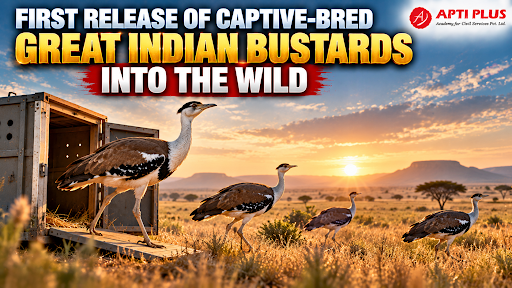
Why In News?
India’s Great Indian Bustard (GIB) Conservation Programme is preparing to release the first cohort of captive-bred birds into the semi-arid grasslands of Rajasthan.
What is the Great Indian Bustard?
-
Scientific Name: Ardeotis nigriceps, an iconic heavy-flying avian species belonging to the family Otididae.
-
Grassland Bird: An apex ecological indicator species whose survival reflects the structural health and ecological integrity of India's dry, open grassland biomes.
-
Critically Endangered Species: Categorized as Critically Endangered (CR) on the IUCN Red List of Threatened Species, with fewer than 150 individuals remaining in the wild.
-
India’s Flagship Grassland Bird: Historically proposed as India’s national bird, representing one of the heaviest flying avian species capable of ground-dwelling and short-range flight.
Where is the Great Indian Bustard Found?
-
Rajasthan: Harbors the single largest viable wild breeding population (over 90% of the surviving population), primarily concentrated within the Desert National Park (DNP) landscape in Jaisalmer.
-
Gujarat: Fragmented relic populations survive within the coastal semi-arid grasslands and salt marshes of the Kutch Bustard Sanctuary (Lala-Parjan).
-
Maharashtra: Recorded in isolated open scrub pockets, including the Great Indian Bustard Sanctuary at Nannaj (Solapur).
-
Karnataka: Sporadic historical occurrences across the dry plains of the Ranebennur Blackbuck Sanctuary and Ballari district.
-
Andhra Pradesh: Small isolated population residing in the Rollapadu Wildlife Sanctuary in Kurnool district.
-
Grassland and Semi-Arid Habitats: Requires open, arid, and semi-arid landscapes dominated by dry grasslands, thorny scrub, and rain-fed agrarian mosaics.
What is Captive Breeding?
Conservation Breeding: Controlled propagation of an endangered species within human-managed facilities to build an insurance population against extinction.
Artificial Incubation: Harvesting vulnerable wild-laid eggs from the Thar landscape and incubating them inside climate-controlled electronic incubators to ensure high hatchability.
Controlled Husbandry: Maintaining disease-free breeding facilities at specialized conservation centers in Sam (Jaisalmer) and Ramdevra (Rajasthan) managed by the Wildlife Institute of India (WII) and the Rajasthan Forest Department.
Chick Rearing & Puppetry Techniques: Utilizing custom-made hand-puppets shaped like adult bustards during hand-feeding to prevent human imprinting, preserving natural wild instincts.
Genetic Management: Sequencing genomes and curating breeding studbooks to maximize genetic diversity and prevent inbreeding depression across captive generations.
Preparation for Wild Release: Conditioning adolescent birds in large predator-proof open-air flight aviaries to develop foraging skills, predator-avoidance behavior, and wing muscle endurance.
What is the Great Indian Bustard Conservation Programme?
National Species Recovery Programme: Funded under the Integrated Development of Wildlife Habitats (IDWH) by the Ministry of Environment, Forest and Climate Change (MoEFCC).
Captive Breeding Center Network: Joint collaboration between the Rajasthan Forest Department, Wildlife Institute of India (WII), and the International Fund for Houbara Conservation (IFHC) of Abu Dhabi.
In-Situ Habitat Protection: Declaring inviolate predator-proof enclosures across the Desert National Park to protect active wild breeding patches.
Power-Line Mitigation: Judicial interventions and central initiatives to mandate the undergrounding of power cables and installation of bird diverters.
Population Monitoring: Deploying satellite telemetry tags and radio-collars to map seasonal dispersal corridors and habitat usage.
Scientific Research: Conducting extensive studies on dietary intake, nesting preferences, and microclimate variables governing chick survival.
Source: INDIANEXPRESS
|
PRACTICE QUESTION Q. With reference to the Great Indian Bustard (Ardeotis nigriceps), consider the following statements: 1. It is classified as 'Critically Endangered' under the IUCN Red List of Threatened Species. 2. It is predominantly a fruit-eating arboreal bird that nests in the high canopies of tropical evergreen forests. 3. In India, the species is accorded the highest level of statutory legal protection under Schedule I of the Wildlife (Protection) Act, 1972. Which of the statements given above is/are correct? (a) 1 and 2 only (b) 2 and 3 only (c) 1 and 3 only (d) 1, 2 and 3 Answer: (c) Explanation: Statement 1 is correct: The Great Indian Bustard (Ardeotis nigriceps) is facing an extremely high risk of extinction in the wild and is listed as 'Critically Endangered' on the IUCN Red List of Threatened Species. Statement 2 is incorrect: It is a large, terrestrial (ground-dwelling) bird, not an arboreal bird. It inhabits dry grasslands and scrublands, not tropical evergreen forests. Furthermore, it is opportunistic and omnivorous (feeding on grass seeds, insects like grasshoppers and beetles, and sometimes small rodents or reptiles), and it nests on the ground. Statement 3 is correct: The species is listed under Schedule I of India's Wildlife (Protection) Act, 1972, granting it the highest level of legal protection against hunting and exploitation. |