Why In News?
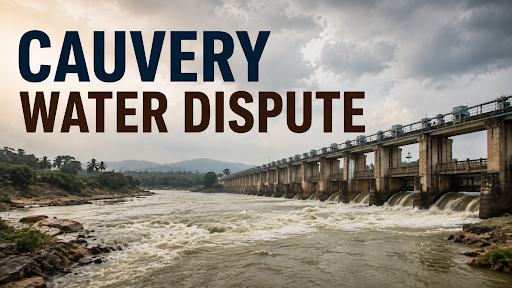
The Supreme Court is set to hear Tamil Nadu's plea for the immediate release of Cauvery water from Karnataka.
Cauvery River System
Point of Origin: The Cauvery River originates at Talakaveri in the Brahmagiri Range of the Kodagu district, Karnataka, located in the Western Ghats at an elevation of 1,341 metres.
Length and Basin Coverage: It is the third-largest river in Southern India, flowing roughly 800 kilometres across its course and draining a total basin area of 81,155 square kilometres.
Geographical Distribution: The river basin area is distributed across three states and one Union Territory, covering 43.8% in Tamil Nadu, 42.2% in Karnataka, 3.5% in Kerala, and 0.5% in Puducherry.
Unique Perennial Nature: Unlike other peninsular rivers, the Cauvery is almost perennial because its upper catchment area receives water from the Southwest Monsoon (June to September) while its lower catchment gets rain from the Northeast Monsoon (October to December).
Tributaries and Infrastructure
-
Left-Bank Tributaries: Harangi, Hemavathi, Shimsha, and Arkavati rivers
-
Right-Bank Tributaries: Lakshmantirtha, Kabini, Suvarnavati, Bhavani, Noyyal, and Amaravathi rivers
-
Major Dams and Reservoirs: Krishna Raja Sagara (KRS) Dam in Karnataka and the Mettur Dam in Tamil Nadu.
-
The river have the Shivanasamudra Falls, where Asia’s first major hydroelectric power station was established in 1902 to power the Kolar Gold Fields.
The fertile Cauvery Delta region in Tamil Nadu is known as the "Rice Bowl of Tamil Nadu," relying completely on the river for multi-season paddy cultivation.
What Is the Cauvery Water Dispute?
-
Riparian Interest Clashes: The conflict reflects upstream-versus-downstream clashes over water access between Karnataka and Tamil Nadu.
-
Storage and Flow Control: Karnataka manages the upper reservoir storage and release timelines, whereas Tamil Nadu relies entirely on a predictable downstream flow.
-
Heavy Agricultural Reliance: Both states depend heavily on the river basin to irrigate water-intensive crops like paddy and sugarcane.
-
Urban Drinking Water Demands: Rapid expansion adds immense municipal pressure, specifically for the urban centers of Bengaluru and Chennai.
-
Rainfall Deficit Instability: Seasonal monsoon variations and uneven reservoir storage levels routinely trigger fresh rounds of inter-state conflict.
Historical Background
-
The 1892 Baseline Pact: The initial formal water-sharing arrangement was signed between the Madras Presidency and the Princely State of Mysore.
-
The 1924 Fifty-Year Agreement: This pact refined state allocations but included a 50-year review clause that later became a major legal flashpoint.
-
Post-Independence Escalation: The dispute resurfaced after 1947 as both states unilaterally expanded their local canal and irrigation networks.
-
Tribunal Constitution (1990): The Central Government established the CWDT to legally adjudicate the growing inter-state conflict.
-
The 2007 Binding Award: The CWDT delivered its original final award allocating specific volumetric shares to all four basin states.
-
The 2018 Legal Settlement: The Supreme Court delivered its final judgment, modifying the tribunal's framework and establishing permanent state shares.
The 2018 Supreme Court Judgment
-
Volumetric Allocations Revised: The Court modified the 2007 Tribunal award based on updated state parameters.
-
Karnataka Share Increased: Karnataka's annual water allocation was raised by 14.75 TMC, bringing its total to 284.75 TMC.
-
Tamil Nadu Share Reduced: Tamil Nadu's share was reduced to 404.25 TMC, though it remained the largest overall consumer in the basin.
-
Groundwater Adjustments Factored: The reduction in Tamil Nadu's share accounted for its substantial sub-surface groundwater reserves.
-
Status Quo Maintained: Kerala’s share of 30 TMC and Puducherry’s share of 7 TMC were left completely unchanged.
-
Bengaluru Priority Acknowledged: The Court carved out 4.75 TMC specifically for Bengaluru’s domestic urban use, prioritizing drinking water over irrigation.

Institutional Framework
-
The Inter-State River Water Disputes Act, 1956 provides the legal basis for tribunal adjudication of inter-state river conflicts.
-
The Cauvery Water Disputes Tribunal (CWDT) delivered the original binding allocation award in 2007.
-
The Cauvery Water Management Authority (CWMA), set up per the 2018 Supreme Court judgment, is the apex implementing body for water-sharing decisions.
-
The Cauvery Water Regulation Committee (CWRC) functions under the CWMA, meeting roughly every 15 days to assess hydrological conditions and issue release directions.
-
The Supreme Court retains a supervisory and adjudicatory role, hearing compliance disputes such as the current 2026 case.
-
The Central Water Commission provides technical hydrological data supporting these institutional decisions.
Constitutional Provisions
|
Why Is the Dispute Difficult to Resolve?
-
Unequal rainfall distribution across the basin means water availability varies sharply year to year.
-
Heavy monsoon dependence leaves the entire allocation system vulnerable to a single poor rainfall year.
-
Reservoir storage variation between Karnataka's and Tamil Nadu's dams complicates fair, real-time comparison of "surplus" water.
-
Expanding irrigation demand in both states has outpaced the fixed allocation framework set decades ago.
-
Urban water demand, especially Bengaluru's rapid growth, adds a new and growing claim on the same river system.
-
Political mobilisation around water release orders turns technical hydrology into an emotionally charged political issue in both states.
-
Climate variability increasingly disrupts the predictability that any allocation formula depends on.
Way Forward
Empower the Regulatory Authority: Strengthen the Cauvery Water Management Authority (CWMA) by granting it statutory enforcement mechanisms and penalty provisions to penalize delayed state compliance, moving past a purely advisory mandate.
Integrate Telemetry Networks: Expand real-time data sharing on rainfall, reservoir levels, and evaporation losses by deploying an automated, satellite-linked telemetry network across the upper catchment area.
Codify a Distress-Sharing Formula: Establish a mathematically locked, proactive distress-sharing formula to automatically calculate proportionate water reductions during weak monsoons, removing the need for emergency court petitions.
Scale Up Micro-Irrigation Infrastructure: Channel state subsidies to expand drip and sprinkler irrigation networks among paddy and sugarcane farmers, lowering the agricultural water footprint in both states.
Incentivize Crop Diversification: Promote a phased structural shift away from water-intensive crops like sugarcane toward millets, oilseeds, and pulses through targeted minimum support price (MSP) mechanisms.
Deploy Advanced Hydrological Forecasting: Improve seasonal reservoir management by integrating artificial intelligence and satellite radar imaging into weather forecasting models to optimize water storage and release windows.
Enforce Minimum Environmental Flows: Mandate a non-negotiable minimum environmental flow within the final water-sharing formula to preserve riverine biodiversity and prevent groundwater salinity intrusion in coastal deltas.
Institutionalize Inter-State Platforms: Establish permanent, non-crisis-driven communication links and joint river basin committees between the irrigation departments of Karnataka and Tamil Nadu to build regular administrative trust.
Depoliticize Hydro-Technical Decisions: Insulate the technical decision-making processes of the CWRC and CWMA from electoral cycles by ensuring that all water-release schedules remain strictly tied to scientific data models.
Conclusion
The Cauvery dispute shows that legal allocation alone cannot ensure compliance without stronger institutional trust between states.
Source: NEWINDIANEXPRESS
|
PRACTICE QUESTION Q. "The Cauvery water dispute reflects the limits of cooperative federalism in India." Critically examine this statement with reference to the institutional and constitutional framework governing inter-state river water disputes. (250 words) |