Why In News?
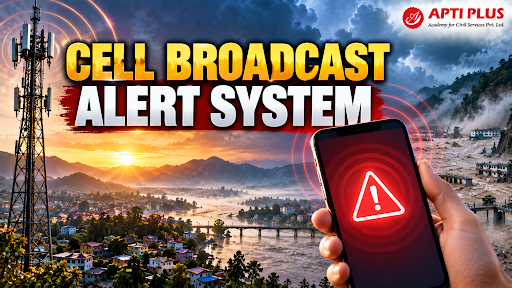
The Centre for Development of Telematics (C-DoT) expanded nationwide testing of the indigenous Cell Broadcast Alert System to deliver real-time, geo-targeted emergency warnings directly to mobile phones during disasters.
What is the Cell Broadcast System (CBS)?
It is a radio-network communication technology that broadcasts text messages and audio alarms simultaneously to all mobile devices within a specified geographical area served by designated cellular base towers.
Unlike point-to-point cellular communication, CBS transmits messages over dedicated radio signalling channels (e.g., channels 4370 and 4380), preventing network bottlenecks.
No Phone Numbers or Data Connection Required: It functions without accessing individual mobile phone numbers, subscriber registries, or requiring an active mobile internet (4G/5G data) connection.
Intrusive Audio-Visual Alarms: Warning alerts appear as prominent pop-up notifications on device screens accompanied by a distinct loud sound and vibration pattern that overrides silent, vibrate, and "Do Not Disturb" (DND) modes.
How Cell Broadcast System (CBS) Work?
The system is built upon the Common Alerting Protocol (CAP) standardized by the International Telecommunication Union (ITU):
-
Step 1 (Hazard Detection): Nodal Warning Generating Agencies detect impending natural hazards:
-
India Meteorological Department (IMD): Cyclones, extreme rainfall, thunderstorms, and heatwaves.
-
Central Water Commission (CWC): Riverine flood levels and dam discharge volumes.
-
Indian National Centre for Ocean Information Services (INCOIS): Tsunami bulletins and storm surges.
-
Geological Survey of India (GSI): Regional landslide susceptibility warnings.
-
Defence Geoinformatics Research Establishment (DGRE): Himalayan avalanche hazards.
-
Step 2 (Alert Integration): Authorized agencies input verified hazard parameters into the central C-DoT CAP Integrated Alert Gateway (SACHET).
-
Step 3 (Geofencing & Verification): The NDMA or State Disaster Management Authority (SDMA) defines the precise geographical polygon of the threat zone.
-
Step 4 (Network Dissemination): The CAP message is routed directly to Telecom Service Providers (Airtel, Jio, BSNL, Vodafone Idea), which instruct local Base Transceiver Stations (BTS) to beam the alert instantaneously to all active mobile devices within range.
How is Cell Broadcast Different from Traditional SMS?
|
Feature |
Cell Broadcast System (CBS) |
Traditional Short Message Service (SMS) |
|
Transmission Architecture |
One-to-Many: Single transmission broadcast across radio channels. |
One-to-One: Individual messages queued and routed point-to-point. |
|
Delivery Latency |
Instantaneous: Delivered within 2–5 seconds simultaneously. |
Delayed: Suffers queuing delays lasting hours during network congestion. |
|
Network Congestion Impact |
Zero Congestion: Operates on dedicated signalling channels. |
High Vulnerability: Network collapses when millions send/receive texts. |
|
User Privacy & Data |
Complete Privacy: Transmitted anonymously without phone numbers. |
Identifiable: Requires subscriber numbers, IMSI, and directory access. |
|
Alert Prominence |
High-priority pop-up screen alert with non-standard sound. |
Standard text message in SMS inbox with standard notification tone. |
Benefits of Indigenous Cell Broadcasting
Rapid Last-Mile Warning: Reduces transmission time from hours to seconds, bridging the critical gap between hazard detection and community response.
Maximum Population Reach: With over 1.1 billion cellular mobile subscribers in India, cell broadcasting covers a vast percentage of the vulnerable population.
Hyper-Local Geographic Targeting: Alerts can be restricted to a single telecom cell tower covering a small industrial zone or expanded across multiple administrative districts.
Multilingual Inclusivity: Delivers emergency messages in local regional scripts and languages based on the recipient's geographic state circle.
Alignment with Global Frameworks: Operationalizes India's commitments under Target G of the Sendai Framework for Disaster Risk Reduction 2015–2030 (increasing public access to multi-hazard early warning systems).

Source: THEHINDU
|
PRACTICE QUESTION Q. With reference to the 'Cell Broadcast System' (CBS) deployed for disaster alerts in India, consider the following statements: 1. Cell broadcast messages require the sender to possess the individual phone numbers of all recipients within the targeted area. 2. Unlike conventional SMS, cell broadcast alerts function over dedicated radio signalling channels and do not depend on mobile internet connectivity. 3. The indigenous Integrated Alert System (SACHET) was developed by the Centre for Development of Telematics (C-DoT) based on the Common Alerting Protocol (CAP). Which of the statements given above are correct? (a) 1 and 2 only (b) 2 and 3 only (c) 1 and 3 only (d) 1, 2, and 3 Answer: (b) Explanation: Statement 1 is incorrect: Cell Broadcast is a one-to-many technology that beams messages anonymously to all active devices connected to cell towers in a geographic area; it does not require, collect, or use individual mobile phone numbers. Statement 2 is correct: CBS operates on dedicated radio signalling channels, making it immune to network congestion, and delivers alerts to devices without requiring active mobile data or internet access. Statement 3 is correct: India’s Integrated Alert System (SACHET) was developed by C-DoT under the NDMA, utilizing the ITU-standardized Common Alerting Protocol (CAP). |