Why In News?
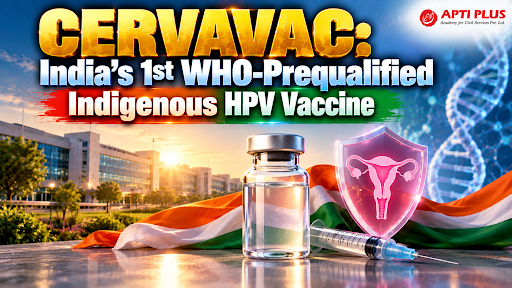
The World Health Organization (WHO) granted prequalification to CERVAVAC, India’s first indigenously developed recombinant quadrivalent Human Papillomavirus (qHPV) vaccine manufactured by the Serum Institute of India (SII),
What Is CERVAVAC?
CERVAVAC is India’s first indigenously developed, gender-neutral quadrivalent Human Papillomavirus (qHPV) vaccine.
It was manufactured by the Serum Institute of India (SII) in Pune through a collaborative partnership with the Department of Biotechnology (DBT), BIRAC, the Bill & Melinda Gates Foundation, and WHO’s International Agency for Research on Cancer (IARC).
It received market authorization from the Drugs Controller General of India (DCGI) / CDSCO and achieved official WHO Prequalification, making it eligible for international procurement by UN agencies like UNICEF and Gavi.
Mechanism: Produced using the yeast strain Hansenula polymorpha, it contains Non-Infectious L1 Virus-Like Particles (VLPs) mimicking native viral capsids. Because it lacks viral DNA, it cannot replicate or cause infection, but triggers a robust humoral immune response producing neutralizing IgG antibodies.
Target Group & Dosing Regimen: Licensed for administration to males and females aged 9 to 26 years:
-
Ages 9–14 years: 2-dose schedule (0.5 mL intramuscularly at 0 and 6 months).
-
Ages 15–26 years: 3-dose schedule (0.5 mL intramuscularly at 0, 2, and 6 months).
Impact: Lowers procurement costs to approximately ₹200–₹400 per dose, compared to imported alternatives (e.g., Gardasil) costing ₹2,000–₹4,000, ensuring fiscal sustainability for public health rollouts.
What Is Human Papillomavirus (qHPV)?
Human Papillomavirus (HPV) is a group of over 200 related double-stranded DNA viruses transmitted primarily through intimate skin-to-skin or sexual contact.
-
Quadrivalent Scope (qHPV): Quadrivalent HPV vaccines specifically target four major serotypes—HPV Types 6, 11, 16, and 18.
-
Disease Burden in India:
-
Cervical cancer is the second most common cancer and second leading cause of cancer mortality among Indian women.
-
India reports approximately 127,526 new cases and 79,906 deaths annually (GLOBOCAN 2022), contributing over 65% of the total cervical cancer burden in the WHO South-East Asia Region (SEARO).
Steps Taken By India To Expand Cancer Care
Universal Immunization Program (UIP) Integration:
-
Launched a nationwide HPV vaccination campaign in February 2026 under the UIP targeting 14-year-old girls. Over 8 million (80 lakh) doses were administered by September 2026.
NP-NCD & Primary Care Expansion:
-
Reorganized the National Program for Prevention and Control of Non-Communicable Diseases (NP-NCD) to deliver population-based screening for oral, breast, and cervical cancers among adults aged 30+ years.
-
Screening and primary management are decentralized to primary care platforms called Ayushman Arogya Mandirs (AAM), supported by Community Health Officers (CHOs) and frontline ASHAs.
Digital Health Infrastructure:
-
Operationalized the U-WIN digital platform for beneficiary registration, appointment slotting, and issuing digital vaccination certificates linked to the Ayushman Bharat Health Account (ABHA).
-
Cold-chain inventory and supply logistics are dynamically monitored via the Electronic Vaccine Intelligence Network (eVIN) portal.
Financial Protection & Tertiary Care:
-
Provided inpatient financial coverage for secondary and tertiary cancer care under Ayushman Bharat - Pradhan Mantri Jan Arogya Yojana (AB-PMJAY).
Source: THEHINDU
|
PRACTICE QUESTION Q. Under the World Health Organization’s Global Strategy for Cervical Cancer Elimination, what does the "90-70-90" target to be achieved by 2030 represent? (a) 90% reduction in cancer drug costs, 70% budget allocation to oncology, and 90% rural hospital coverage. (b) 90% HPV vaccination of girls by age 15, 70% screening of women by age 35 and 45, and 90% treatment of identified cervical disease. (c) 90% institutional deliveries, 70% post-partum check-ups, and 90% newborn immunization. (d) 90% decline in maternal mortality, 70% decline in infant mortality, and 90% reduction in communicable disease incidence. Answer: (b) Explanation: The WHO 90-70-90 strategy sets three key targets by 2030: 90% of girls fully vaccinated with the HPV vaccine by age 15; 70% of women screened with a high-performance test by age 35 and again by 45; and 90% of women identified with cervical disease receiving treatment. |