Why In News?
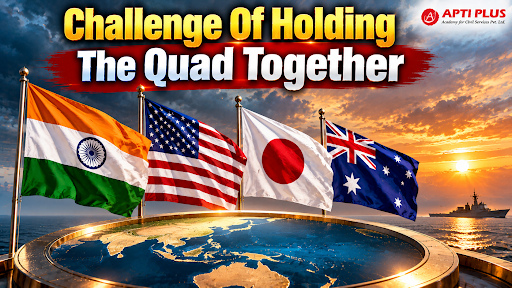
Leaders of India, the United States, Japan and Australia are set to meet in Manila on 17 November 2026, on the sidelines of the 49th ASEAN Summit, the first Quad leaders’ summit since September 2024.
What Is The Quad?
Evolution
|
Year |
Milestone |
|
2004 |
Tsunami Core Group of the four countries coordinated relief after the Indian Ocean tsunami |
|
2007 |
First informal Quad meeting; Japan’s PM Shinzo Abe spoke of the “Confluence of the Two Seas” in India’s Parliament |
|
2008 |
Australia withdrew, and the grouping went dormant |
|
November 2017 |
Revived at officials’ level in Manila on the margins of the East Asia Summit |
|
March 2021 |
First leaders’ summit, held virtually |
|
September 2021 |
First in-person summit in Washington |
|
September 2024 |
Leaders’ summit in Wilmington, Delaware |
|
2025 |
India’s planned summit collapsed amid US–India tariff friction |
Nature
-
Informal Grouping: The Quad has no charter or secretariat and is not a military alliance.
-
Stated Goal: A “free, open, inclusive and resilient Indo-Pacific”.
What Is On The Manila Agenda?
-
Maritime Security And Critical Minerals: Expected to dominate discussions, along with economic security and strategic infrastructure.
-
AI Infrastructure: Leaders may announce about $85 million in technical and financial support for stable AI infrastructure in the Indo-Pacific.
What Has The Quad Achieved?
|
Area |
Initiative |
|
Maritime |
Indo-Pacific Partnership for Maritime Domain Awareness (IPMDA), launched in Tokyo (2022), tracks illegal fishing and “dark shipping” |
|
Health |
Quad Vaccine Partnership during COVID-19; Quad Cancer Moonshot (2024) on cervical cancer |
|
Critical Minerals |
Quad Critical Minerals Initiative, announced in 2025 |
|
Infrastructure |
Quad Ports of the Future Partnership (2024) |
|
Disaster Relief |
Humanitarian Assistance and Disaster Relief coordination; observers to Indian exercises |
|
People |
Quad Fellowship for STEM students |
-
Military Coordination: Australia rejoined the Malabar naval exercise in 2020, bringing all four navies together, though Malabar is formally separate from the Quad.
Why Quad Matter For India?
-
Balancing China: Provides a platform to strengthen deterrence and capacity in the Indian Ocean without a formal alliance.
-
Technology And Supply Chains: Access to partnerships in critical minerals, semiconductors and AI, reducing dependence on China.
-
Maritime Awareness: IPMDA supports India’s Information Fusion Centre–Indian Ocean Region (IFC-IOR) in Gurugram.
-
Global Standing: Reinforces India’s role as a net security provider and a key Indo-Pacific power.
Initiatives Taken By India For Strengthening Indo-Pacific Partnerships
Act East Policy
-
Upgrade: Upgraded from Look East in 2014, focusing on ASEAN, Japan and the wider Indo-Pacific through trade, connectivity and defence.
MAHASAGAR Vision
-
From SAGAR To MAHASAGAR: India expanded its 2015 SAGAR (Security and Growth for All in the Region) vision to MAHASAGAR in 2025, covering the wider Global South.
Indo-Pacific Oceans Initiative (IPOI)
-
Launch: Announced in 2019 at the East Asia Summit, with seven pillars such as maritime security, ecology and capacity building; partners like Australia and Japan lead individual pillars.
Information Fusion Centre–Indian Ocean Region
-
Launch: Set up in 2018 in Gurugram, sharing maritime information with partner countries and liaison officers.
Defence Agreements With Quad Partners
-
Foundational Pacts With US: LEMOA (2016), COMCASA (2018) and BECA (2020) enable logistics, secure communications and geospatial data sharing.
-
Australia And Japan: Mutual logistics support agreements with Australia (2020) and Japan (2020).
Malabar Exercise
-
Four-Navy Drill: India hosts and participates in Malabar, which since 2020 includes all four Quad navies.
Critical Technology Partnerships
-
India–US TRUST: The Transforming the Relationship Utilizing Strategic Technology initiative, launched in 2025, succeeded iCET to cooperate on AI, semiconductors and critical minerals.
What Are The Key Challenges In Holding The Quad Together?
Uncertain US Commitment
-
Policy Swings: Trump’s tariff disputes with India, Japan and Australia and his efforts to improve ties with Beijing have raised doubts about US commitment.
-
Summit Gaps: Over two years without a leaders’ summit weakened momentum on flagship projects.
Trade And Tariff Disputes
-
Economic Friction: US tariffs on India, Japan and Australia undermine the economic security agenda the Quad promotes.
Differing Approaches To China
-
Hedging: Each member balances deep trade ties with China against security concerns, avoiding naming China in joint statements.
-
India’s Caution: India avoids making the Quad an anti-China military bloc, given its long land border and continental vulnerabilities.
India’s Strategic Autonomy
-
Multi-Alignment: India’s ties with Russia, including oil and defence purchases, create friction with Washington.
-
No Alliance: India rejects formal military alliance commitments.
Lack Of Institutional Structure
-
No Secretariat: Without a permanent secretariat or budget, the Quad depends on political will, making it vulnerable to leadership changes.
Delivery Deficit
-
Slow Projects: Many initiatives, such as vaccine supply and infrastructure, have delivered less than promised.
Competing Groupings
-
Overlap With AUKUS And Others: Defence cooperation through AUKUS (Australia, UK, US) and trilaterals like JAI may draw attention away from the Quad.
-
JAI Grouping: Japan–Australia–India defence ministers met in Cebu, signalling trilateral cooperation independent of Washington.
-
Japan’s OCEAN: Japan launched the One Cooperative Effort Among Nations (OCEAN) framework for regional security cooperation.
What Is The Way Forward For Keeping The Quad Relevant?
Regularise Summits
-
Fixed Calendar: Hold annual leaders’ summits on a predictable schedule, including the summit India was due to host.
Focus On Public Goods
-
Practical Deliverables: Prioritise projects the region values, such as maritime domain awareness, disaster relief, health and AI infrastructure, like the proposed $85 million support.
Economic Security Agenda
-
Critical Minerals Chains: Build joint processing and recycling capacity to reduce dependence on a single supplier.
-
Trusted Technology: Coordinate on semiconductor and AI supply chains.
Strengthen ASEAN Centrality
-
Support ASEAN: Align Quad work with the ASEAN Outlook on the Indo-Pacific (2019), so Southeast Asian countries see the Quad as a partner, not a bloc.
Insulate Quad From Bilateral Disputes
-
Separate Tracks: Keep trade disputes from derailing Quad cooperation through regular working groups and senior officials’ meetings.
Build Light Institutional Support
-
Coordination Mechanism: Create a small coordination cell or rotating secretariat to sustain projects between summits.
Leverage Minilaterals
-
Complementary Groupings: Use trilaterals like JAI and Japan’s OCEAN to strengthen cooperation even when US engagement fluctuates.
Conclusion
The Manila summit offers a chance to revive a Quad weakened by US policy swings, tariff disputes and divergent threat perceptions. Regular summits, practical public goods and economic security cooperation can keep the Quad relevant while preserving India’s strategic autonomy.
Source: THEHINDU
|
PRACTICE QUESTION Q. The Quad has evolved from a loosely structured maritime dialogue into a comprehensive platform for Indo-Pacific governance. Critically analyze. 150 words |